
Art Deco Interior Design: The Geometry, and How to Use It Without a Costume
Art deco is a geometry before it is a palette, which is why rooms that buy the gold and the velvet still miss it. Here is the underlying grammar, room by room, and the line between an art deco room and a Gatsby set.
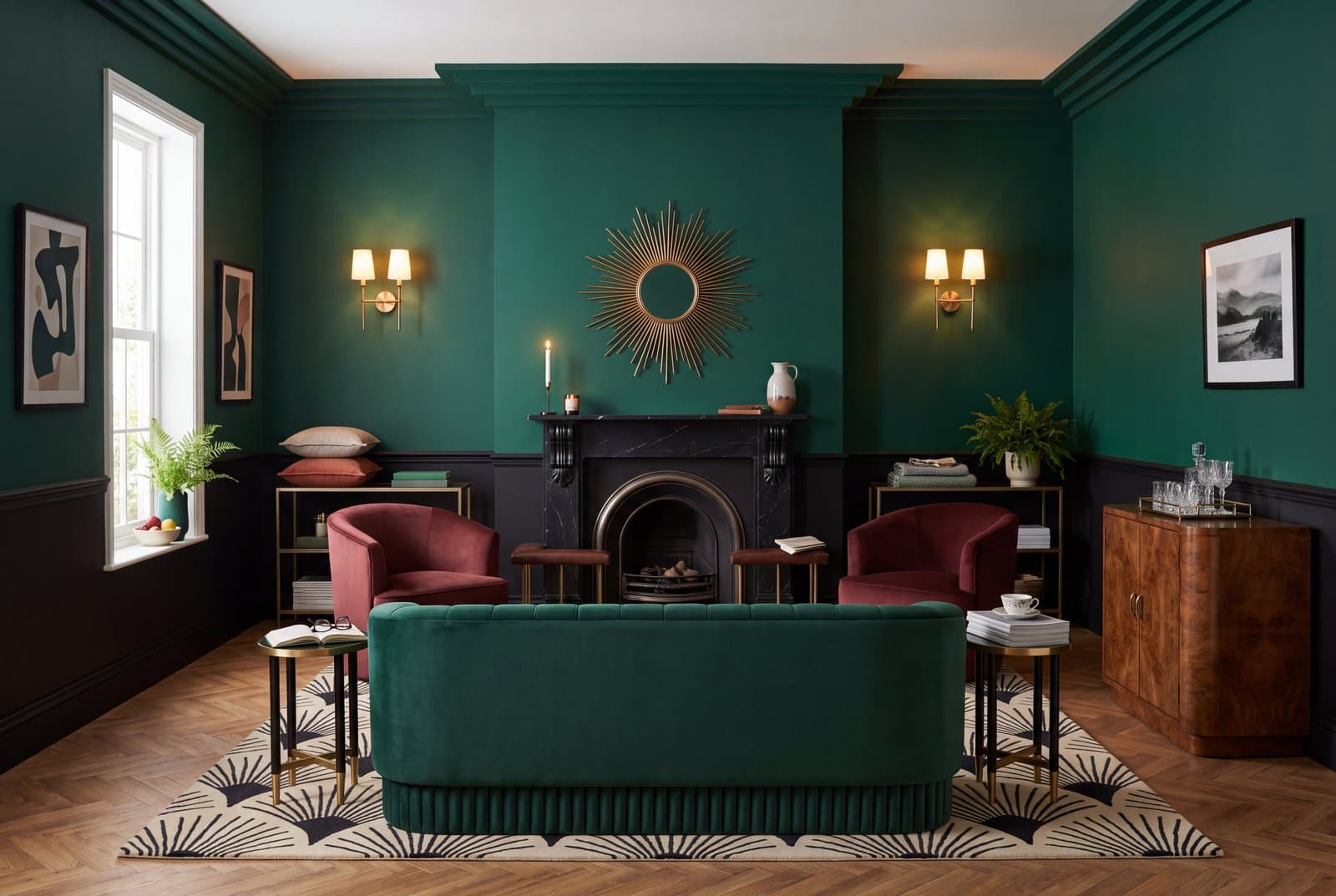
Art deco is a geometry before it is a palette. That is the sentence that separates the rooms that work from the ones that bought gold, velvet and a peacock and stopped.
The style has a genuine visual grammar underneath the glamour: repeated geometric forms, stepped and tiered profiles, radiating fans, and strong symmetry. A room that gets that grammar right reads as art deco in oak and cream, with no gold in it at all. A room that skips it does not become art deco by adding brass, it becomes a themed room with brass in it.
What Art Deco Actually Is
Art deco is a decorative style of the 1920s and 1930s built on geometry, symmetry, luxurious materials and machine-age optimism. In an interior it appears as bold repeated pattern, curved and stepped forms, high-contrast color, lacquered and polished surfaces, and metal used as line rather than as ornament.
Its four structural principles:
- Geometry, repeated. Chevrons, zigzags, sunbursts, fans, trapezoids and concentric arcs. The motif recurs at different scales through a room.
- Symmetry. Art deco arranges in pairs and around a center far more strictly than the styles around it. Asymmetry reads as a different period immediately.
- Stepped and tiered profiles. The ziggurat outline shows up in cornices, mirrors, headboards, cabinets and lighting. It is the most reliable single tell.
- Contrast of material. A hard polished surface against a soft deep one. Lacquer against velvet, marble against mohair, chrome against burl walnut.
The style was applied to everything from ocean liners to cinemas, which is why it scales up dramatically and needs restraint at domestic size.
Where It Came From
Art deco takes its name from the 1925 Exposition Internationale des Arts Décoratifs et Industriels Modernes in Paris, though the style was already forming before it and the label was applied retrospectively in the 1960s.
It drew on an unusually wide set of sources at once: cubism and abstraction, the geometry of Egyptian art following the 1922 opening of Tutankhamun's tomb, Aztec and Mesoamerican stepped architecture, and the streamlined forms of new machines, cars, aircraft and liners.
Two phases are worth telling apart. The 1920s version is angular, ornamented and exotic, heavy on inlay and rare materials. The 1930s version, often called streamline moderne, is rounder, plainer and more industrial: curved corners, horizontal banding, chrome and glass block. If a reference image looks art deco but simpler than you expected, it is usually the second phase, and it is considerably easier to live with.
Art Deco, Art Nouveau and Hollywood Regency
Three styles that get confused, with one distinguishing question each.
Art nouveau came first, roughly 1890 to 1910, and its line is organic: whiplash curves, vines, flowers, asymmetry. If the motif comes from a plant, it is nouveau. If it comes from a machine or a crystal, it is deco.
Hollywood regency is a later, more theatrical descendant, heavier on lacquer, mirror, animal print and high-gloss color, and much looser about geometry. If the room is glamorous but has no repeated geometric motif, it is regency rather than deco.
Art deco is the geometric, symmetrical, machine-age one. That is the whole test.
The Art Deco Palette
The palette is high contrast, and the contrast matters more than the specific colors.
The classic scheme is a deep saturated color against black and a metal: emerald with black and gold, navy with black and chrome, oxblood with cream and brass. Two strong tones and one metal, not five.
The 1930s streamline version runs paler: cream, oyster, dove gray, soft peach and eau de nil, that particular pale green the period used constantly, with chrome and black accents. This version is much easier in a small or dark room.
Metals are used as line rather than as mass. Brass and gold for the warm scheme, chrome and polished nickel for the cool one. Pick one and stay with it, because mixing them dilutes the graphic effect the style depends on.
What breaks it: mid-tone muddy colors, and low contrast generally. Art deco has no beige.
The Geometry, in Practice
This is the section to actually use, because the motifs are what you are looking for when shopping.
The sunburst or fan. Radiating lines from a point. Appears in mirrors, headboards, inlay, rugs and grilles, and is the most recognizable deco motif of all.
The chevron and the zigzag. In flooring, notably herringbone and parquet, in upholstery, in tile and in wallpaper.
The stepped ziggurat. Tiered profiles in cornices, mirror tops, cabinet outlines and lamp bases.
Concentric arcs and circles. Overlapping rings, half-moons, and the fluting or reeding that runs vertically down cabinet fronts and sofa bases. Fluted furniture is the most available deco element in contemporary retail.
The trapezoid and the octagon. In mirrors, tables and tile layouts.
The rule that makes it cohere: choose one or two of these and repeat them at three different scales in a room. A fan mirror, a fan-patterned rug and a fluted cabinet front is a scheme. One of each of all five is noise.
Materials and Finishes
Art deco is a materially rich style and it is where most of the budget goes.
The period materials: burl walnut, ebony and macassar, lacquer in black or a strong color, marble, particularly with dramatic veining, chrome and brass, mirror including antiqued and tinted mirror, velvet and mohair, shagreen and inlay.
The affordable modern equivalents that read correctly: fluted wood or MDF panels, a good black lacquer paint, brass-effect hardware and lighting, a bold veined porcelain rather than real marble, velvet upholstery, and geometric wallpaper.
The finish quality matters more than in most styles, because the whole look depends on surfaces being either genuinely polished or genuinely soft. A satin finish where the room wants gloss reads as a mistake rather than as a choice.
Art Deco Living Room
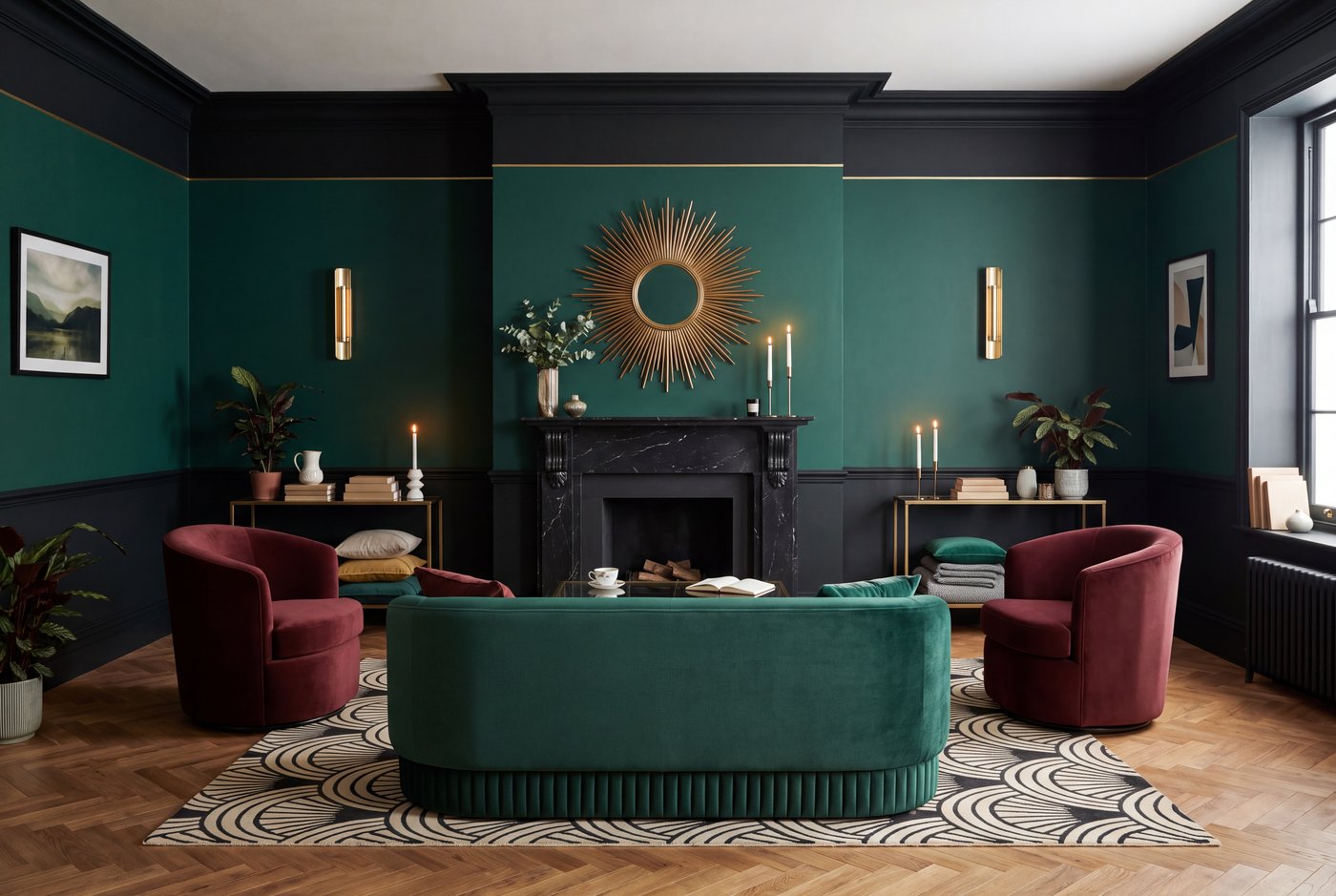
The living room is where the symmetry rule does the most work.
Establish a center, ideally a fireplace or a large mirror, and arrange the seating symmetrically to it. A pair of chairs facing a sofa, matching lamps, matching side tables. This is one of the few styles where a matched pair is correct rather than lazy.
The sofa should be low with a curved or fluted base, or with strongly rolled arms, upholstered in velvet in a saturated color. Add a pair of club or barrel chairs.
Then the geometry: a rug with a fan, chevron or concentric pattern, a sunburst mirror or a stepped-top mirror over the fireplace, and a cocktail cabinet or bar cart, which is the one piece of furniture the period genuinely invented for the home.
Lighting at multiple levels with at least one strongly geometric fitting. Keep the walls otherwise disciplined; art deco does not want a gallery wall.
Art Deco Bedroom
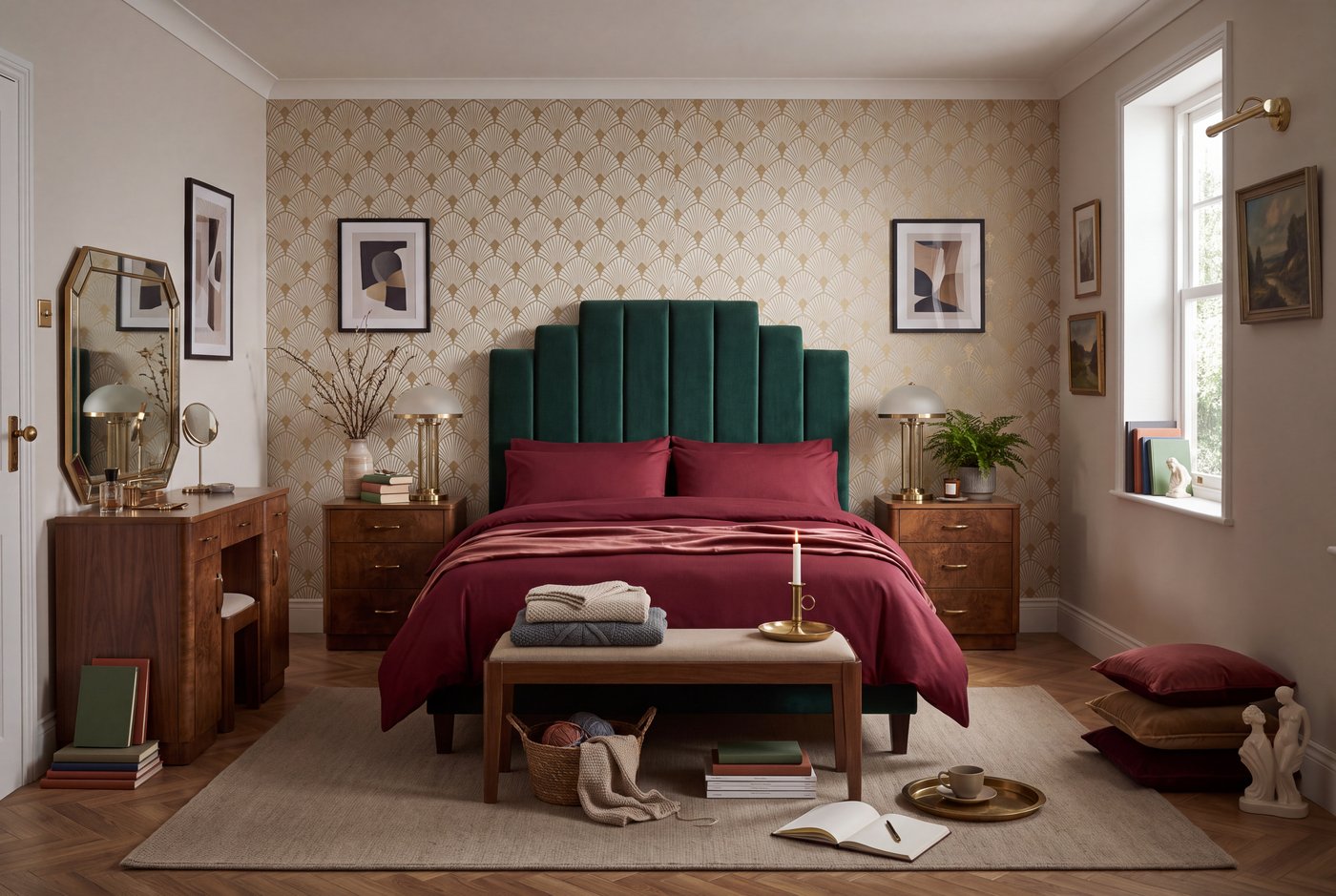
The bedroom concentrates the style behind the bed and calms down elsewhere.
A headboard is the defining object: fluted, fan-shaped, or upholstered in velvet with a stepped outline. Flank it with matching nightstands and matching lamps, because symmetry does more here than anywhere.
Bedding in solid saturated color or a simple geometric, with a satin or velvet throw. A dressing table with a round or octagonal mirror, which is a period-correct piece that most bedrooms have room for.
Keep the pattern to one surface, usually the headboard wall or the floor. A bedroom with deco pattern on the walls, the bed and the rug at once is difficult to sleep in.
Art Deco Bathroom
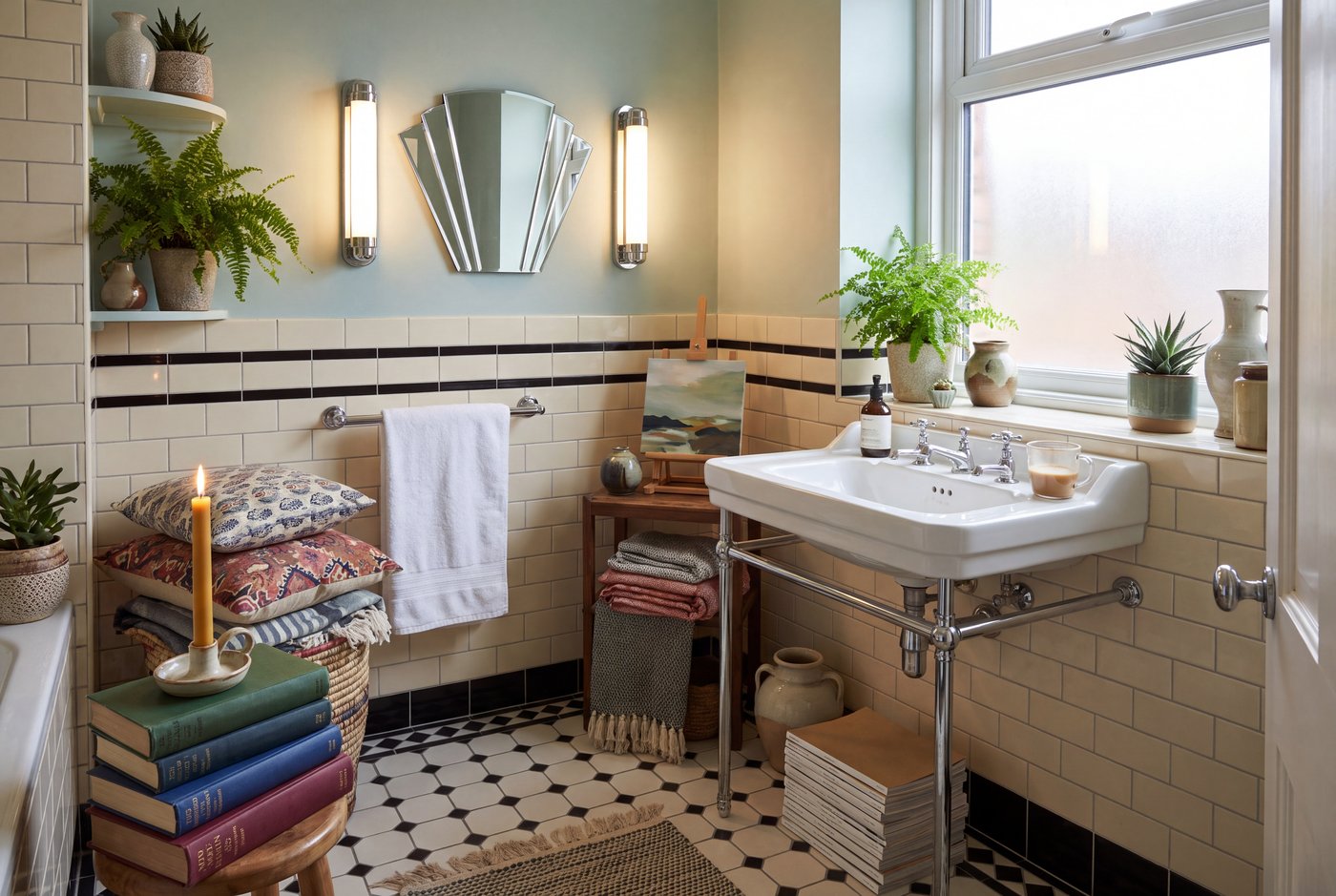
The bathroom is the best room in the house for this style and the one I would start with.
It is small, so bold material choices are affordable. It is naturally hard-surfaced, which the style wants. And period deco bathrooms are among the most copied interiors of the twentieth century, so the references are excellent.
The elements: black and white geometric floor tile, hexagonal or a strong chevron; a half-height tiled wall with a black border running horizontally; a pedestal or console basin with chrome legs; an octagonal or fan-topped mirror; and vertical sconces flanking it rather than a single light above.
Add brass or polished chrome fittings, a fluted vanity front if the room takes one, and one strong color, oxblood, emerald or the pale eau de nil, on the upper wall.
Art Deco Kitchen
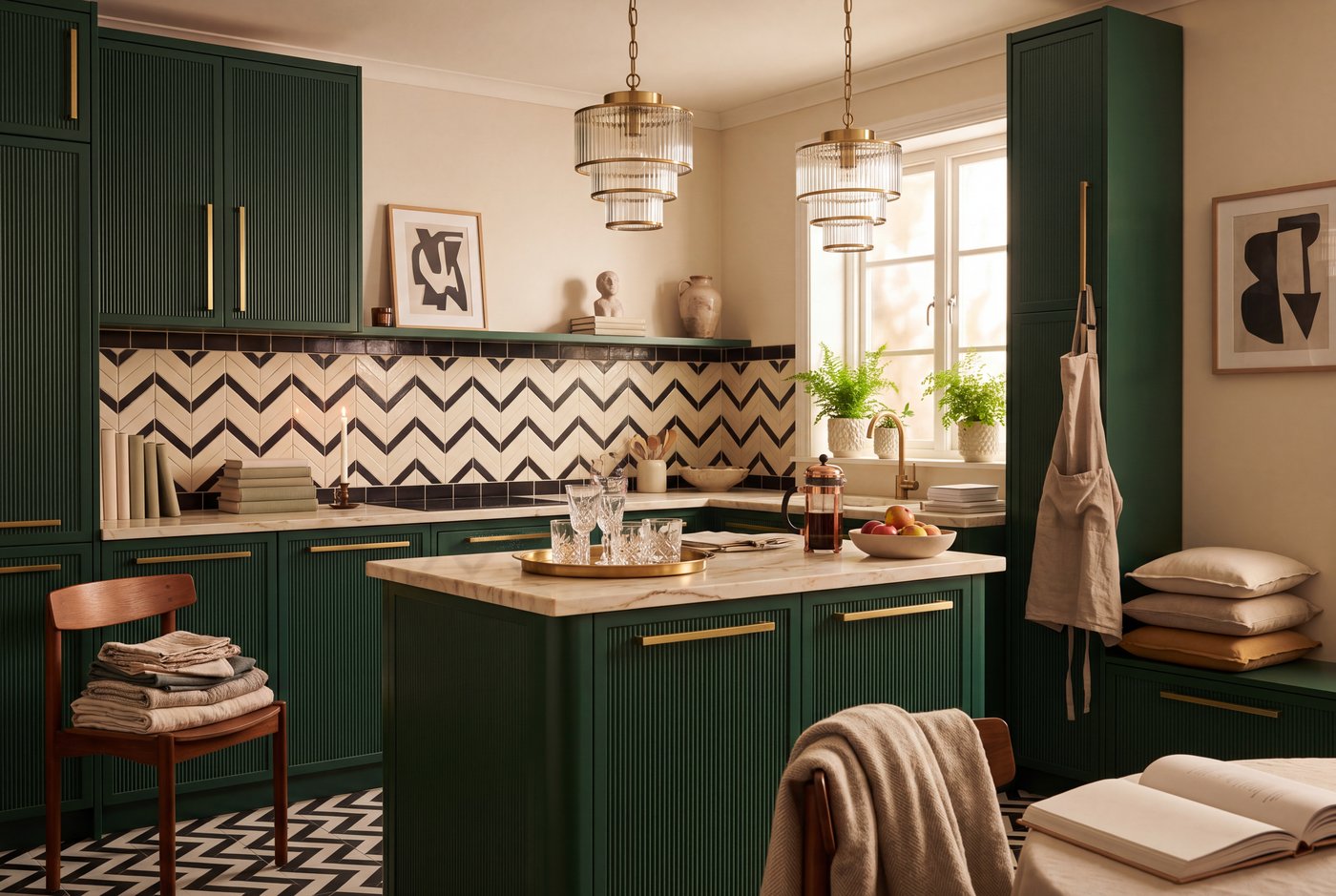
The kitchen carries deco through cabinetry, hardware and tile rather than furniture.
Flat or fluted cabinet fronts, lacquered in a deep color or a period cream. Long slim brass or chrome pulls, mounted vertically. A geometric tile backsplash, chevron or a stacked pattern with a contrasting border. A veined stone or stone-effect counter.
Then one or two glass and brass pendants with stepped or globe shades. A black and white floor if the room can take it.
Art Deco Lighting
Lighting deserves its own section because the period treated it as jewelry and because it is the cheapest way into the style.
The reliable forms: the fluted or stepped glass shade, frosted or opal; the sunburst or starburst fixture; slim vertical wall sconces, ideally in pairs; the globe on a geometric brass frame; and table lamps with stepped bases and drum or fan shades.
If you buy nothing else, a pair of deco sconces flanking a mirror will do more for a room than any amount of gold accessorizing.
Wallpaper and Pattern
Art deco wallpaper is widely available and it is the fastest route to the geometry.
The categories that work: large-scale fans and scallops; stylized geometric florals; chevron and zigzag repeats; and metallic-line patterns on a dark ground.
Use it on one wall, in a small room, or above a dado. A whole living room in large-scale deco pattern is the point at which the style stops being a room and becomes a set, which is the next section.
Doing It Without the Gatsby Costume
The failure mode has a name, and it is worth being blunt about.
A room tips into costume when every element is performing the 1920s at once: gold everything, a peacock, feathered lampshades, a flapper print, mirrored furniture on every wall, and typography. The period reference stops being a design language and becomes a theme.
The version that works is structural. Get the geometry, symmetry and material contrast right, then use very few of the obvious signifiers on top. One sunburst, not four. Metal as line, not as surface. Mirror on one piece, not five.
The test: strip out every explicitly glamorous object and ask whether the room still reads as art deco. If the pattern, the symmetry and the stepped profiles carry it, the bones are right. If what remains is a plain room, you decorated a theme.
Restraint is also more period-accurate than the excess suggests. Actual 1930s interiors were considerably calmer than their film depictions.
In a Small Space or a Rental
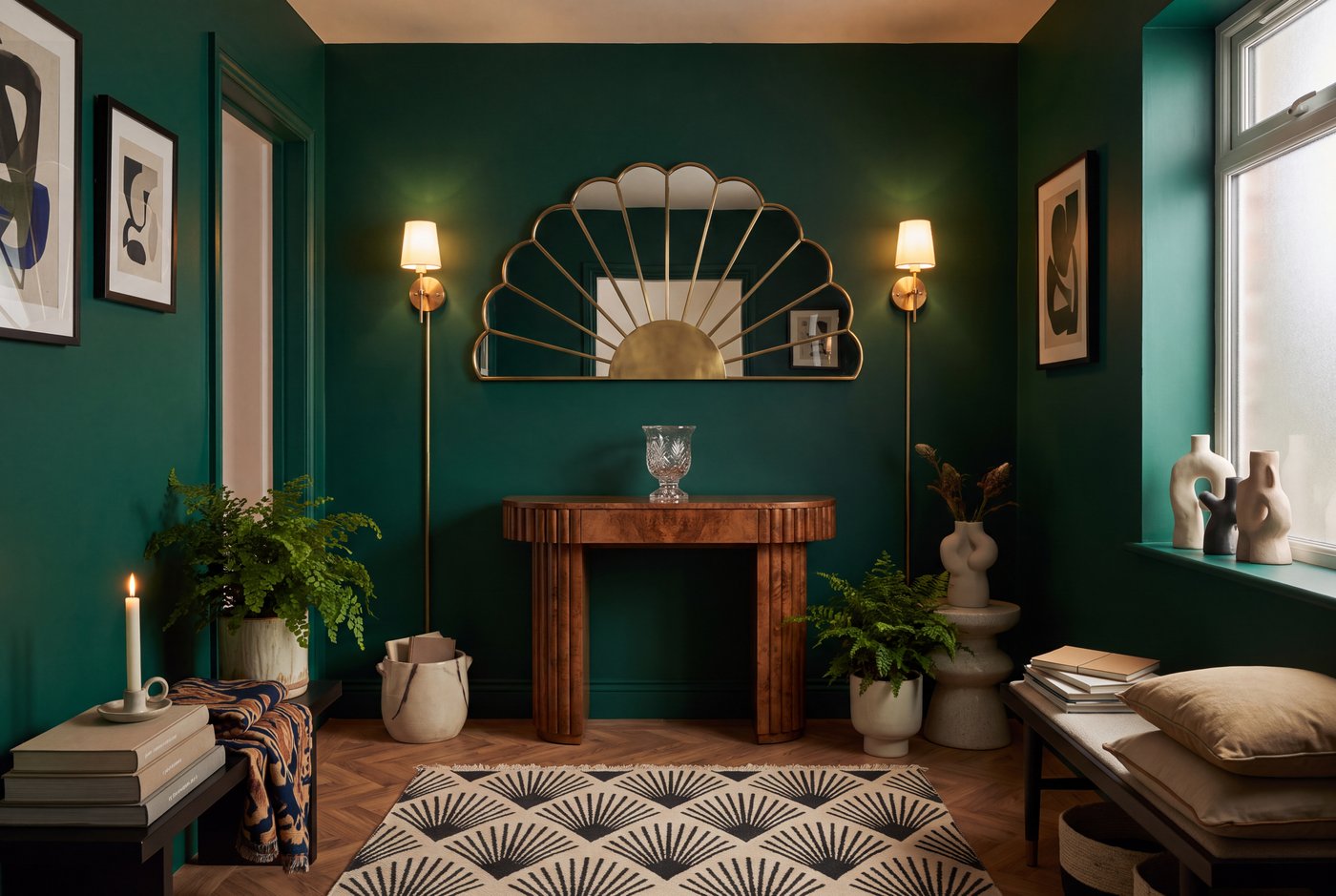
Art deco suits small rooms better than large ones, which surprises people given how grand the reference imagery is.
The reason is that the style's drama comes from pattern, contrast and symmetry rather than from scale, and all three are cheaper to deliver in a small room. A small bathroom or entrance hall in full deco is achievable in a weekend; a whole living room is not.
For a rental, the portable elements carry most of it: a fan or sunburst mirror, a pair of sconces converted to plug-in, velvet upholstery, a geometric rug, fluted furniture, and lamps. Peel-and-stick geometric tile handles a floor you cannot change.
Concentrate rather than spread. One fully committed small room beats deco touches distributed through a flat.
Where to Start
Start with a mirror and a pair of lights. A fan or stepped mirror with two sconces flanking it establishes the geometry and the symmetry simultaneously, costs little, and is portable.
Then add one fluted or curved piece of furniture, and one geometric textile. Only after those should you introduce the metal and the velvet, which are the parts everyone starts with and the parts that do the least on their own.
Art deco sits closest to the Traditional and Modern profiles in our style quiz, which takes about three minutes and returns a palette, a material direction and reference rooms you can hold a real piece of furniture up against. If the geometry appeals but the glamour does not, look at mid century modern, which inherits the same interest in pattern and machine-age form in a far plainer register.
Not sure where to start?
Take the style quiz and get a design profile you can actually furnish against. About three minutes.
Take the Find Your Room