
Mid Century Modern Interior Design: What It Is and How to Get It Right
Mid century modern is the most reproduced style of the last seventy years, which is why so many rooms that use its furniture do not look like it. The style is a set of proportions, not a shopping list.
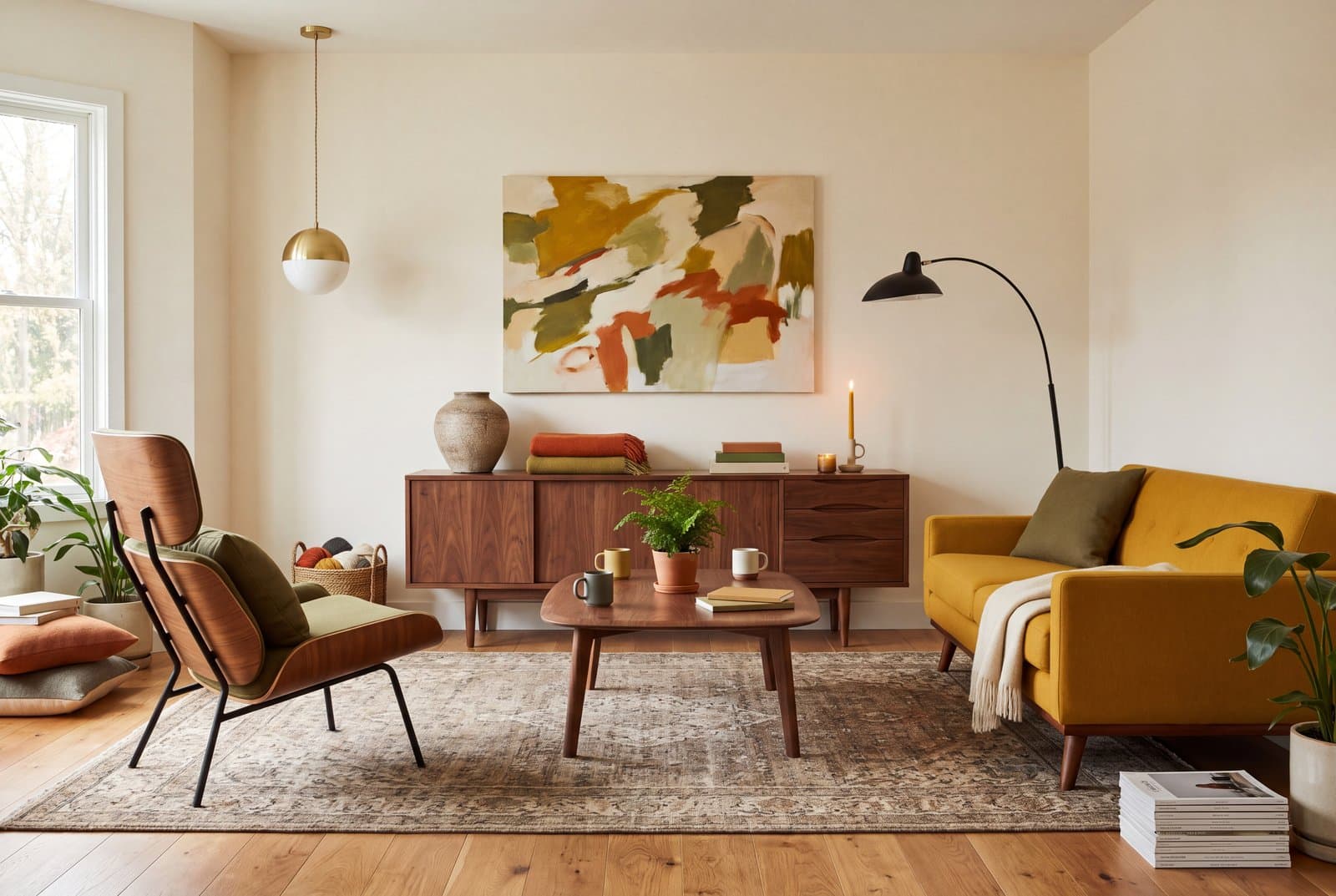
Mid century modern is the most reproduced style of the last seventy years, and that is the whole reason it goes wrong. Almost everyone has access to the furniture. Very few rooms that contain it actually read as mid century modern.
The gap is proportion. The style is a set of relationships between height, mass and empty space, and the furniture is only the visible part of that. A room can be filled entirely with tapered legs and walnut veneer and still look like a showroom, because it got the objects right and the geometry wrong. What follows is the geometry first, then the rooms.
What Mid Century Modern Actually Is
Mid century modern is a design movement running roughly from 1945 to 1969, defined by clean lines, organic curves, honest materials and furniture raised on visible legs.
Its four governing principles, which matter more than any individual piece:
- Everything sits on legs. Sofas, credenzas, chairs, beds. The floor stays visible underneath the furniture, and that continuous plane of floor is what makes these rooms feel larger than they are.
- Low horizontal lines. The furniture is lower than its equivalents in other styles, which leaves more wall visible above it and produces the characteristic sense of openness.
- Function is not hidden. A joint, a leg, a frame or a grain is allowed to be seen. Nothing is disguised as something else.
- Organic curve against straight line. A rectilinear credenza next to a curved shell chair. Neither alone is the style; the contrast is.
Get those four right with modest furniture and the room reads correctly. Get them wrong with expensive reproductions and it does not.
Where It Came From
The movement grew out of postwar American and Scandinavian design, and the two strands are worth separating because they still shop differently.
The American side runs through Charles and Ray Eames, Eero Saarinen, George Nelson and Florence Knoll, working with new industrial processes: molded plywood, fiberglass, cast aluminum. It is more experimental, more sculptural and more optimistic about technology.
The Scandinavian side, through Hans Wegner, Arne Jacobsen and Finn Juhl, is warmer and more craft-based: solid teak and oak, hand-shaped joinery, woven paper cord and leather. It is the strand that connects directly to Scandinavian interior design as a living style rather than a period one.
Most rooms people call mid century modern are a blend. Knowing which strand a piece belongs to helps you tell why a room feels cold, which is usually too much American plastic and not enough Danish wood.
Mid Century Modern, Modern, Contemporary and Retro
These four get used interchangeably in listings and it costs people money.
Mid century modern is a specific historical period, 1945 to 1969. It is finished. Pieces are either from it, reproductions of it, or inspired by it.
Modern as a design term means the broader modernist tradition of the early twentieth century onward, which is why a Bauhaus chair is modern but not mid century modern.
Contemporary means whatever is being designed now. It has no fixed look, and it changes.
Retro describes anything that references an earlier period, often the 1950s to 1970s, usually with more color and less discipline. A retro room can contain mid century furniture without being mid century modern, because retro tolerates kitsch and this style does not.
The practical consequence: a listing described as "modern retro style" is telling you almost nothing about proportion, which is the thing that matters.
The Mid Century Modern Palette
The palette is warmer and more saturated than most people expect, because the version that circulates online has been washed out toward gray.
The base is warm wood, and the wood choice is the single most important decision. Walnut and teak are the signature timbers, both mid-brown with visible grain. Oak appears on the Scandinavian side. Painted furniture is rare.
Walls are usually a warm neutral: cream, oatmeal, warm white, or a soft ochre. White is used, but a warm white rather than a bright one.
Then the accent colors, used with confidence and in small quantities: mustard, burnt orange, olive, teal, and a rusty red. These are the period's real colors and they are what most modern reproductions of the look leave out. A room in gray and walnut is not mid century modern; it is a contemporary room with mid century furniture in it.
Black is used sparingly and graphically, on legs, frames and lamp arms.
The Shapes That Define It
If you can recognize five shapes you can shop this style anywhere.
- Tapered legs, usually splayed slightly outward, in solid wood or with brass ferrules on the ends.
- The low horizontal credenza, a long storage piece well under waist height, which is the single most characteristic object in the style.
- The shell or scoop chair, a curved seat in molded plywood, fiberglass or upholstery, on a contrasting base.
- The floating shelf or wall unit, with storage lifted off the floor entirely.
- The globe or sputnik light, spherical or radiating, usually in brass, white glass or opal.
Anything with turned legs, carved detail, skirted upholstery or heavy ornament is from a different tradition and will fight the room.
Mid Century Modern Living Room
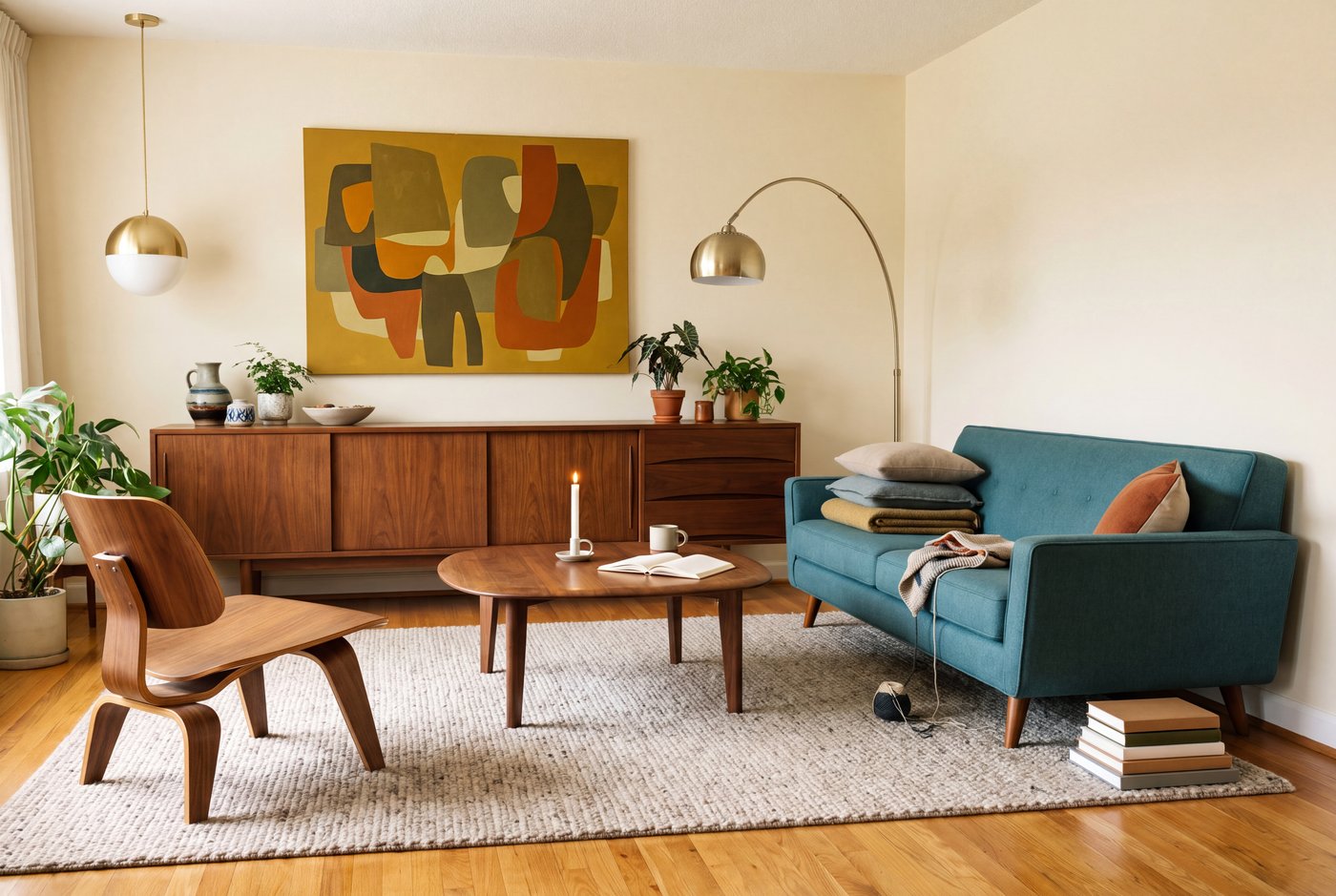
The living room is where the proportion rule does the most work.
Start with the sofa, and choose a low one on visible wooden legs with a clean back and defined arms. Upholster it in wool, in a solid warm color rather than a print. A mustard, teal or rust sofa is a genuinely period choice and it will set the palette of the entire room.
Then the credenza, on the longest wall. This is the piece that most reliably converts a room into a mid century modern one, because its length and lowness establish the horizontal line everything else sits against.
Add one sculptural chair that does not match the sofa, a low coffee table with an organic or rounded rectangular top, and a rug that leaves a wide border of floor showing on all sides. A rug running wall to wall breaks the sense of the furniture floating.
Lighting should include an arc or tripod floor lamp and a globe pendant. Keep the walls relatively clear with one large piece of abstract or geometric art rather than a gallery arrangement.
Mid Century Modern Bedroom
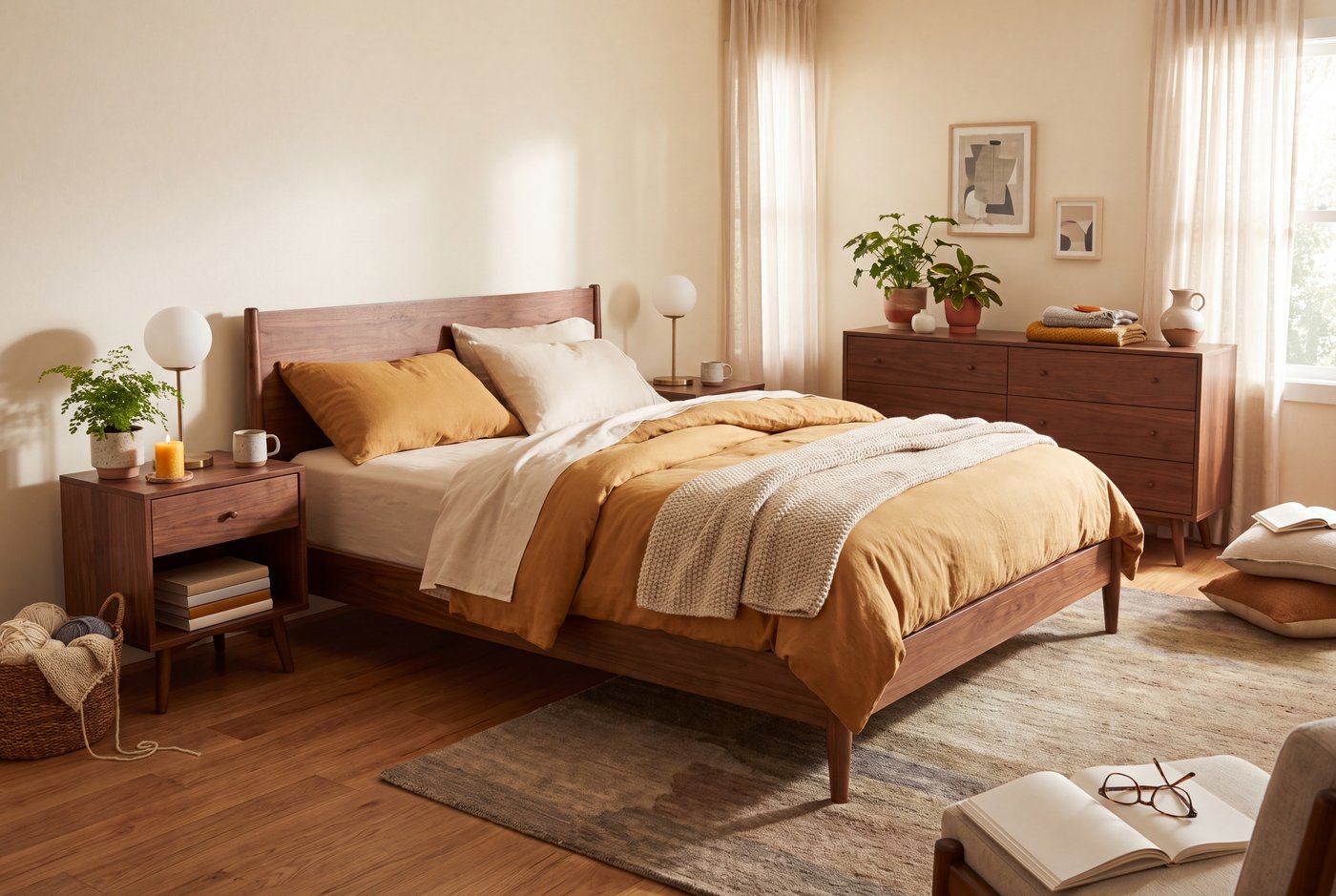
A mid century modern bedroom is simpler than the living room and easier to get right.
The bed should be low, on visible legs, with a plain wooden or upholstered headboard and no footboard. Height is the thing people get wrong: a tall upholstered headboard immediately reads as a different decade.
Flank it with two matching wooden nightstands, which is one of the few places this style actively wants a matched pair, and put a globe or cone lamp on each. A long low dresser rather than a tall chest.
Bedding in solid warm colors or a simple geometric, with a wool blanket. A rug on each side of the bed or one large one under the lower two thirds.
Keep the room sparse. This style tolerates empty surfaces better than almost any other, and filling them is the fastest way to lose it.
Mid Century Modern Kitchen
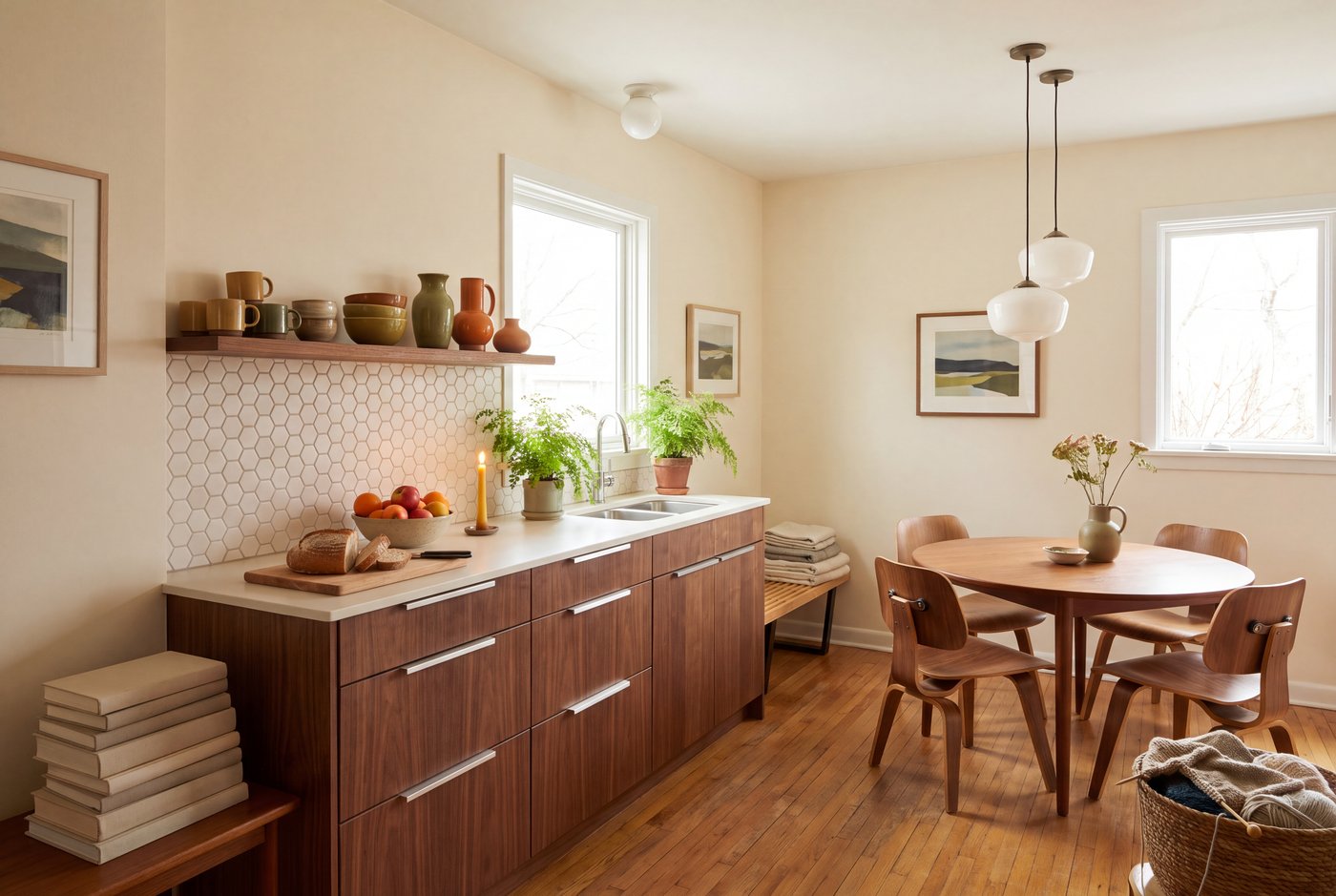
The kitchen has the least period furniture in it, so it is carried almost entirely by cabinetry and hardware.
Flat-slab cabinet fronts in wood, ideally walnut or a warm oak, with no raised panel and no molding. Long horizontal pulls or recessed finger pulls rather than knobs. If painting, use a period color: sage, mustard, a soft teal or a warm white.
Counters in a plain solid surface or butcher block. A geometric or hexagonal tile backsplash. Open shelving in small amounts holding ceramics in period colors.
Then the one element that reliably does it: a pendant or a pair of pendants in opal glass or brass over the island or table.
Mid Century Modern Dining Room
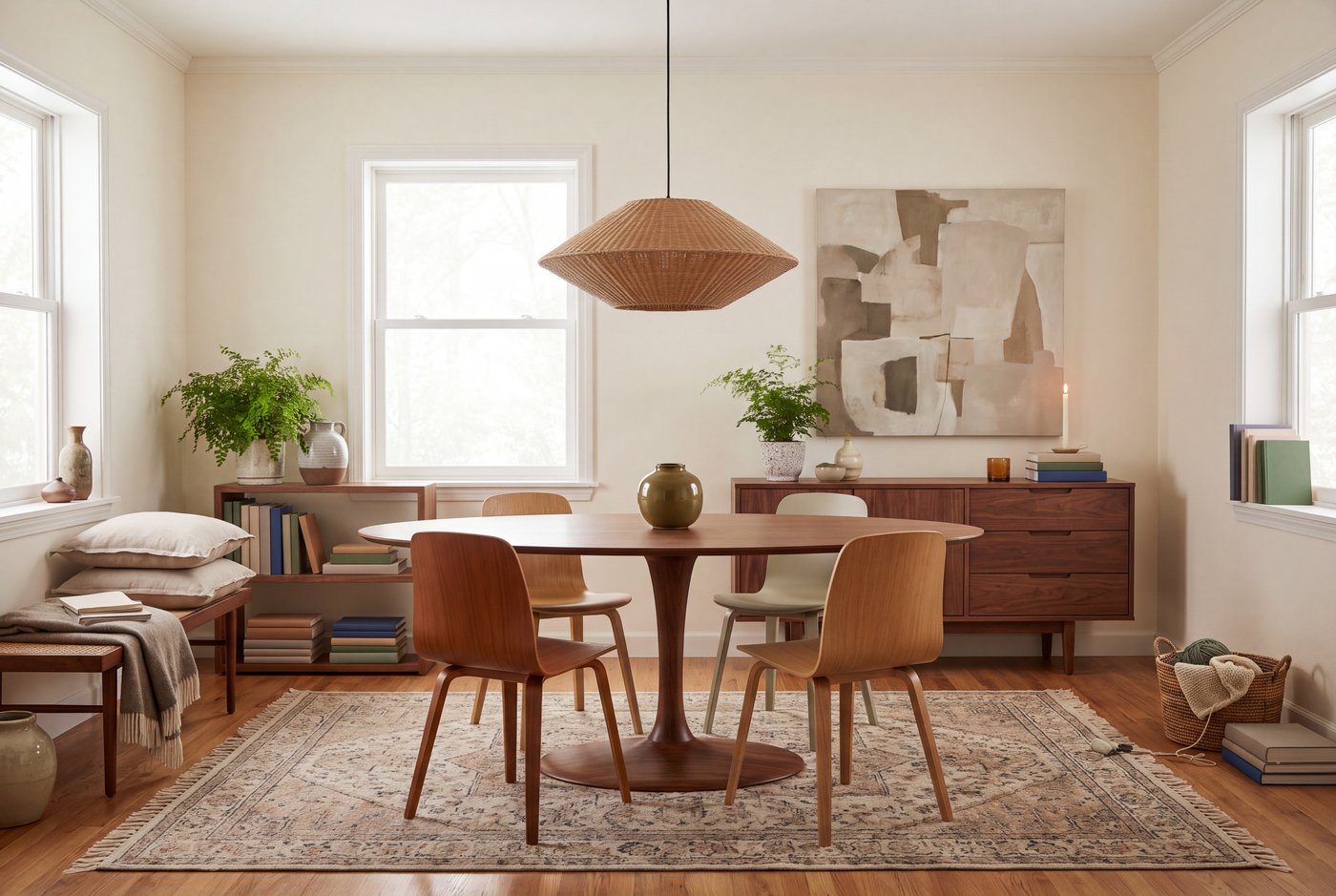
The dining room is the easiest room in the style, because the archetypal pieces are still widely made.
An oval or round pedestal table, or a rectangular one on tapered legs, in walnut or teak. Chairs with molded seats or spindle backs, and it is entirely period-correct for the chairs not to match the table.
A pendant hung low over the center of the table, and a sideboard or credenza against the wall. That is the whole room.
Mid Century Modern Home Office
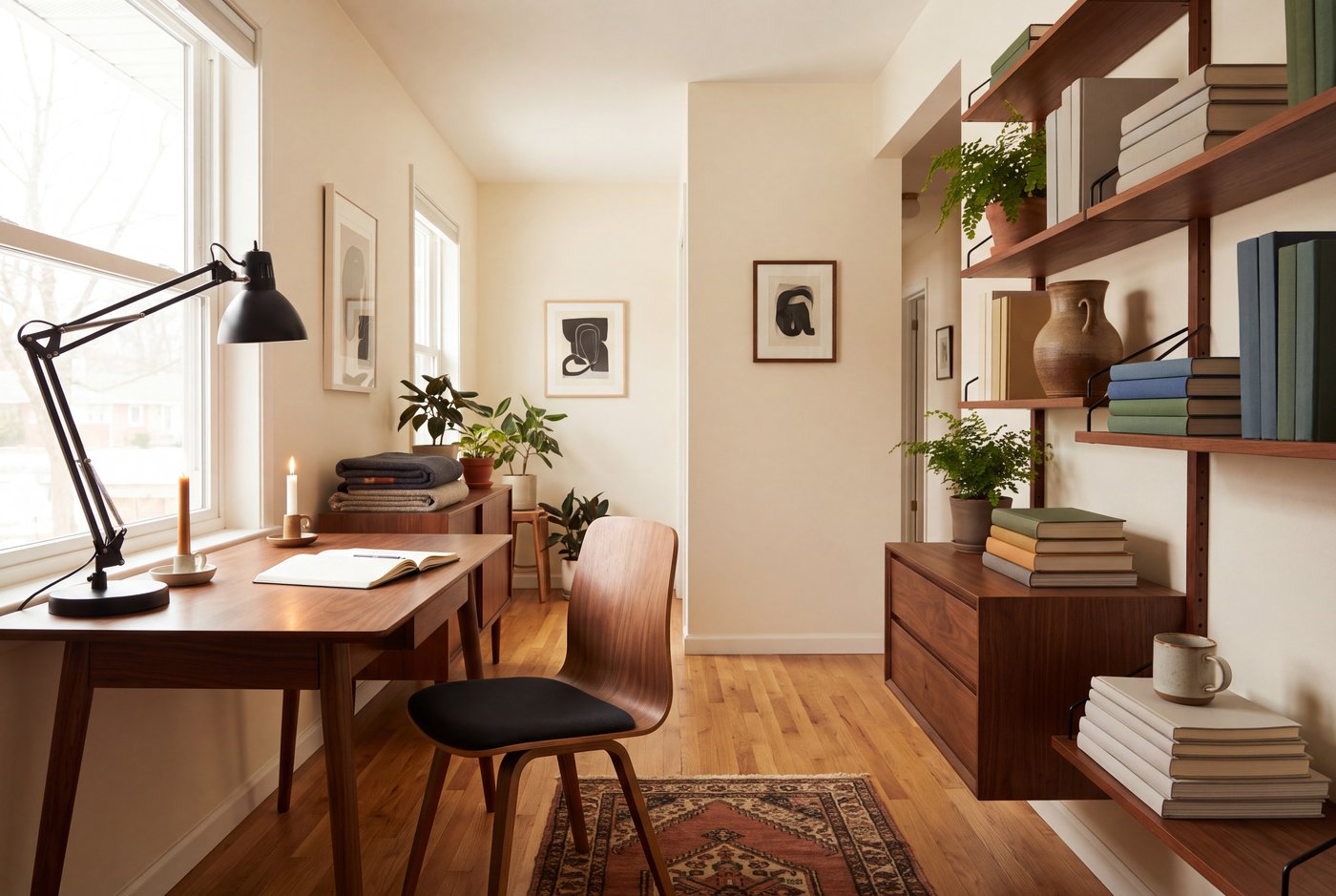
A mid century modern home office is built around one piece: a desk with a slim profile, tapered legs and often a floating drawer unit rather than a full pedestal.
Add a low bookshelf or wall-mounted unit rather than a tall bookcase, a task lamp with an articulated arm in black or brass, and a chair with a molded seat. Position the desk perpendicular to the window so daylight lands on the work surface without glare.
The style suits a home office unusually well because its low horizontal storage keeps sightlines open in a room that is often small.
Original, Reproduction or Inspired
This is where most of the money gets spent and most of the regret happens, so it is worth being direct.
Original vintage means a genuine piece from the period. It has real age, real materials and the correct proportions, and it holds value. It is also the route that requires patience, and condition matters enormously: veneer damage and failed foam are expensive to fix.
Licensed reproduction means a current manufacturer producing a design under license, to the original specification. Correct in every dimension, expensive, and it will not appreciate the way an original does.
Inspired means a piece that borrows the visual language without being a specific design. This is the bulk of what is sold as mid century modern, and it is where quality varies most. Judge it on the four principles above: is it low, is it on visible legs, is the material honest, is the leg genuinely tapered rather than a straight dowel.
Practical order for a normal budget: buy the case goods vintage, because that is where age and material quality show most and where reproductions are least convincing. Buy the upholstery new, since sixty-year-old foam is rarely comfortable and reupholstering costs more than it looks. Buy the lighting wherever the shape is right.
What the Furniture Searches Do Not Tell You
Most searching in this style is for individual objects: a credenza, a coffee table, a bed frame, a TV stand. That is a reasonable way to shop and a poor way to furnish, because it optimizes each piece in isolation.
Two rules that fix it. First, decide the wood tone once and hold it across every wooden piece in the room. Mixed walnut and teak is acceptable; mixed walnut and orange-toned pine is not, and it is the single most common way a room of individually good purchases fails.
Second, buy the largest piece first. The sofa or the credenza sets the height everything else answers to, and buying a coffee table before the sofa is how people end up with a table that is two inches too tall, which is visible and cannot be fixed. The numbers for that relationship are in our guide to coffee table height and size.
In a Rental or a Small Space
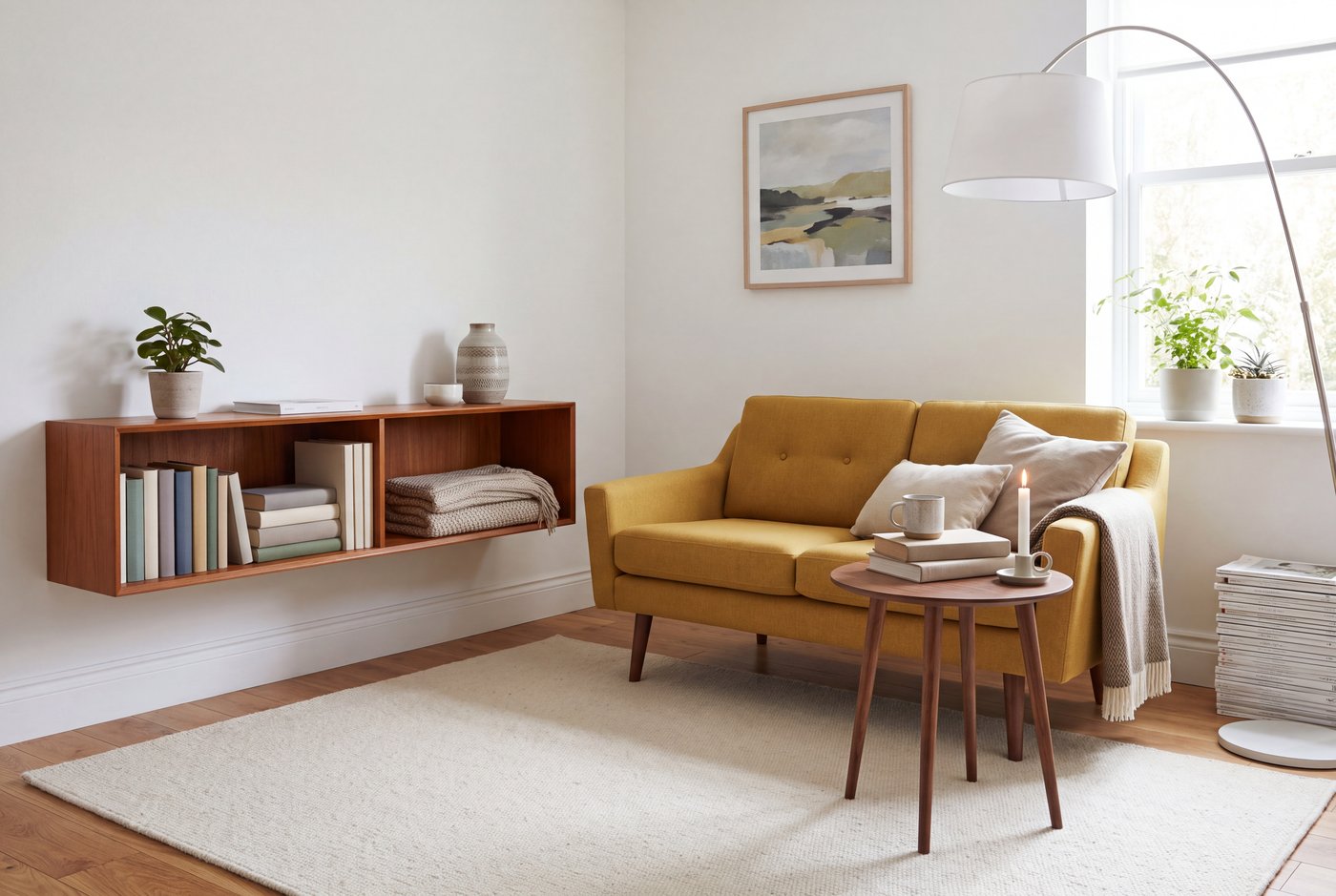
Mid century modern is genuinely well suited to small rooms, and it was largely designed for them: postwar homes were not big.
The raised legs are the reason. Visible floor under every piece makes a small room read as larger, and it is the one styling decision that does more in a small space than in a large one. Choose pieces with the highest legs and the slimmest frames you can find.
Wall-mounted or floating storage extends the same logic. A hung shelf unit keeps the floor plane unbroken in a way a bookcase cannot.
For a rental, the style is almost entirely furniture and lighting, so nothing needs permission. If the walls must stay white, warm them with a wool rug, a saturated sofa and wood tone rather than paint.
The Mistakes That Make It Look Like a Showroom
Four failures account for most of them.
Everything from the same era and nothing else. A room with no object newer than 1965 reads as a set. Real period rooms had older inherited things in them, and one non-period piece keeps it from tipping.
Gray instead of color. Covered above, and it is the most common. The period was not gray.
Too much furniture. The low profiles tempt people to add more because the room still looks empty. That emptiness is the style.
Reproductions of famous chairs, in quantity. One recognizable design in a room is a focal point. Three is a catalog.
Where to Start
Start with the credenza, or with whatever long low storage piece the room can take. It establishes the horizontal line that defines the style, it is useful regardless, and it is the piece that most reliably makes the rest of a room legible as mid century modern.
Then commit to one wood tone, and add one saturated period color in a large soft object.
Mid century modern sits closest to the Modern and Scandinavian profiles in our style quiz, which takes about three minutes and returns a palette, a material direction and reference rooms you can hold a real piece of furniture up against. If you want the same restraint with more warmth and less hard-edged geometry, look at japandi or organic modern, both of which inherit from this tradition directly.
Not sure where to start?
Take the style quiz and get a design profile you can actually furnish against. About three minutes.
Take the Find Your Room