
Cottagecore Decor: How to Get the Look Without It Becoming a Costume
Cottagecore started as an internet aesthetic, not an interior style, which is why so many cottagecore rooms look staged. Here is how to translate it into rooms you can live in, including the dark cottagecore variant.
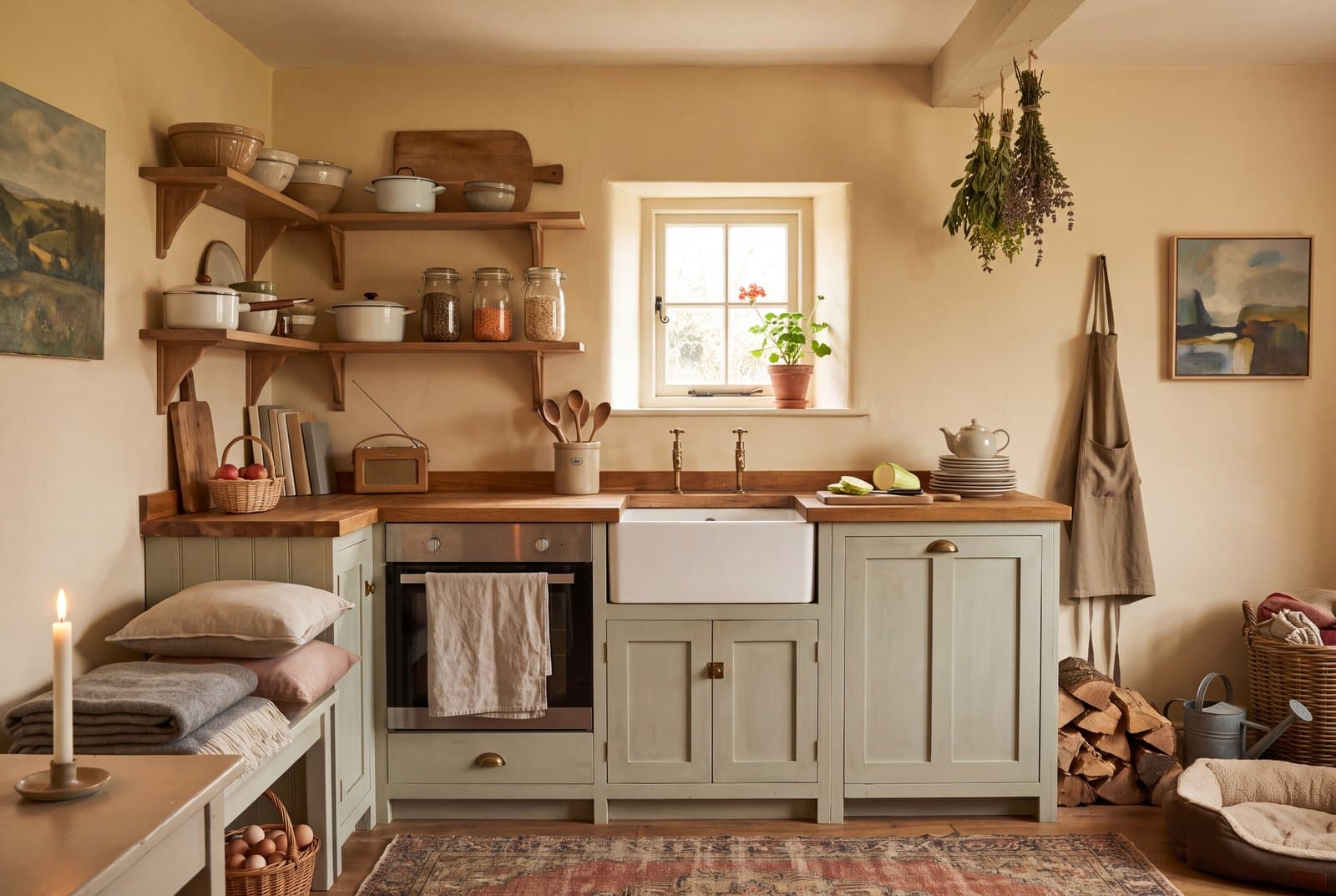
Cottagecore did not come out of a design movement. It came out of the internet, which is why it behaves differently from every other style on this list. Japandi and organic modern were named by designers describing rooms. Cottagecore was named by people describing a feeling, and the rooms were reverse-engineered afterwards.
That origin causes the one problem cottagecore rooms actually have. The reference imagery is a fantasy of a life, not a plan for a house, so copying it directly gives you a room that photographs beautifully and is exhausting to live in. What follows is the translation: which parts of cottagecore are a genuine interior grammar, which parts are set dressing, and how it lands room by room.
What Cottagecore Actually Is
Cottagecore is a romanticized rural aesthetic built around self-sufficiency, handmade things, and an unhurried relationship with time. In a house it shows up as floral prints, aged wood, soft worn textiles, open shelving with visible provisions, dried flowers, mismatched china, and a general preference for things that look like they have been used.
As an interior style it has three real principles underneath the imagery:
- Nothing is new. Or nothing looks new. Cottagecore is the only style on this list where wear is a feature rather than a defect, which makes it unusually friendly to secondhand furniture.
- Nothing matches exactly. Matched sets read as a showroom, and a showroom is the opposite of the feeling. Chairs differ. Plates differ. The wood tones differ.
- Everything is soft. Rounded edges, worn paint, layered fabric, no hard reflective surfaces. Cottagecore has almost no chrome, no glass tables and no gloss.
The cottagecore aesthetic that circulates online includes a lot beyond interiors, clothing, baking, gardening, and a fair amount of pure fantasy. The interior part is the portion of it you can furnish, and it stands up better than its reputation suggests.
The Line Between Cottagecore Decor and a Costume
This is worth naming directly because it is the difference between a room that works and one that does not.
A cottagecore room becomes a costume when every single object in it is performing the theme. Nine floral prints, a butter churn, dried lavender on every surface and a hand-lettered sign about bread. Each element is fine. All of them at once is a stage set, and a stage set is tiring in a way that is hard to place until you have lived with it.
The version that works is structural rather than decorative. Get the bones right, warm wall colors, aged wood, layered soft textiles, some genuine age in the furniture, and then use only a handful of the obvious cottagecore signifiers on top. One good floral, not six. A working herb pot rather than a decorative one.
The test: could you remove every explicitly cottagecore object from the room and still have a warm, coherent, pleasant space? If yes, the bones are right. If the room collapses into a beige box, you have decorated a set.
Cottagecore Bedroom
A cottagecore bedroom is the room where the style is at its most convincing, because the things it asks for, softness, layering, and worn textiles, are things a bedroom wants anyway.
The bed does most of the work. A painted iron frame, a simple wooden frame with a low headboard, or an upholstered headboard in a small-scale print. Then layer: a white or ecru base sheet, a quilt in a faded floral or a simple patchwork, a wool blanket folded at the foot, and two different pillowcases rather than a matched set. Cottagecore bedding is layered rather than styled, and the layers should look like they got there over years.
Walls in a warm chalky color: butter, dusty rose, sage, or a warm white. This is one of the few styles where a small-scale floral wallpaper genuinely works, though it is far easier to live with on one wall or in an alcove than across all four.
Furniture should be mismatched and wooden. A painted nightstand on one side, a small wooden chair holding a stack of books on the other. A vintage chest of drawers with visible wear. Nothing here needs to be expensive, and secondhand is not a compromise but the correct sourcing route.
Finish with dried flowers rather than fresh, a small lamp with a fabric shade, and curtains in a light unlined cotton so morning light comes through them rather than being blocked.
Cottagecore Kitchen
The cottagecore kitchen is the most functional room in the style and the one where the aesthetic and real cooking actually agree.
Open shelving instead of upper cabinets, holding cottagecore kitchenware that gets used: stoneware bowls, a mismatched set of plates, glass jars of dry goods, enamel pots, a wooden board leaning against the wall. Painted lower cabinets in sage, cream, dusty blue or a soft clay, ideally with a visible brush finish rather than a factory spray.
A butler's or farmhouse sink if the plumbing allows. Wood or butcher-block countertop rather than stone. Brass or aged nickel faucets, and a plate rack if there is anywhere to put one.
The details that carry it are small and cheap: a linen tea towel hung on the oven door, a ceramic crock of wooden spoons, a hanging bunch of drying herbs, a small pot of something growing on the windowsill. Cottagecore kitchen ideas almost always come down to visible provisions and visible tools, which is the same principle a professional kitchen runs on for entirely different reasons.
Cottagecore Living Room
The cottagecore living room is the hardest of the rooms, because living rooms are dominated by one large modern object: the television.
Deal with that first. Either accept it and place it low in a wooden cabinet so it is not the visual center, or put it in a different room. Cottagecore living rooms in reference imagery never have one, which is a large part of why they are hard to reproduce.
For the rest: a soft, deep sofa with a rolled or loose-cushioned shape, slip-covered in a washed cotton or linen. Add a wingback or a small floral armchair that does not match it. A wooden coffee table with visible wear, or a large ottoman with a tray on it.
Layer a patterned rug over floorboards. Add a throw over the arm of the sofa, cushions in three different fabrics, and a bookcase that is genuinely full. Cottagecore is one of the few styles where a full bookcase is better than a curated one.
Lighting: table lamps with fabric shades, never a bare overhead. Candles that get lit.
Cottagecore Bathroom
A cottagecore bathroom is mostly a matter of removing the modern and adding the soft.
The elements: a freestanding tub with exposed brass or nickel feet if the space and budget allow, a wooden or painted vanity rather than a molded unit, a simple round mirror, and a small-scale wallpaper or a warm painted wall.
Then soften it. A cotton rug rather than a bath mat. Towels in ecru or a faded color, folded on an open shelf or a wooden ladder. A ceramic dish for soap, a glass jar for cotton wool, a plant that tolerates humidity. A brass hook rail instead of a chrome towel bar.
Small bathrooms suit this better than large ones, because the style's warmth does more for a cramped room than it does for a spacious one.
Dark Cottagecore
Dark cottagecore is the same aesthetic with the light turned down, and it is a substantially better fit for real houses than the bright version.
Where standard cottagecore is butter, cream and dusty rose, dark cottagecore decor runs on deep forest green, oxblood, charcoal brown, aubergine and black. The objects stay the same: aged wood, worn textiles, dried flowers, mismatched ceramics. Only the tonal range changes, and it shifts the mood from pastoral daytime to something closer to autumn evening.
It works particularly well in rooms that were never going to be bright. North-facing rooms, basements, small rooms with one small window. Fighting a dark room with pale cottagecore produces something washed-out and slightly sad. Leaning into it produces a dark cottagecore living room that feels intentional.
In a dark cottagecore bedroom, paint the walls a deep green or brown, keep the bedding warm rather than cool, ecru and rust rather than white and gray, and use enough lamplight at low level that the room reads as warm rather than gloomy. That last part is the whole trick. Dark rooms fail when they are underlit, not when they are dark.
For a dark cottagecore kitchen, deep green painted cabinets with brass hardware, a dark timber countertop, and open shelving holding pale stoneware so the contents read against the background.
Cottagecore Furniture and Where to Find It
Cottagecore furniture is the one category on this site that is genuinely easier to buy secondhand than new, and it is worth saying so.
The pieces that define it are painted or aged wooden case goods, spindle and ladder-back chairs, iron beds, dressers with real wear, and soft slip-covered upholstery. New furniture that reads correctly exists, but the wear has to be simulated, and simulated wear is the most common way a cottagecore room tips into costume.
Practical sourcing order: buy the upholstery new, because comfort and structure matter and old sofas rarely deliver either. Buy the wooden pieces secondhand, because that is where age is doing the work. Buy the cottagecore home decor, the ceramics, the linens, the glassware, wherever you like, and let it accumulate rather than arriving all at once.
If you are buying new, look for painted finishes rather than stained, turned or spindled legs rather than straight, and small-scale prints rather than large ones. Farmhouse furniture is the closest widely-available category and works as a base, with the cottagecore character coming from what you layer on it.
Cottagecore in an Apartment or Rental
A cottagecore apartment is entirely possible and mostly a textile problem rather than a building one.
You will not get the beams, the flagstones or the deep windowsills. What you can control is everything soft: curtains hung high and wide in unlined cotton, a patterned rug over whatever flooring you have been given, layered bedding, slip-covered upholstery, and a full bookcase.
Then add the things that make a room feel grown rather than installed: plants that need attention, herbs on a windowsill, dried flowers, open shelving with real provisions on it. Cottagecore is fundamentally about visible evidence of daily life, and daily life is not a building material. It is the one style where a rental is not a disadvantage.
If the walls must stay white, put the color into the fabric instead and go heavier on it than you would otherwise.
Cottagecore Houses, Inside and Out
Most cottagecore house imagery is exterior: a stone cottage, a garden, climbing roses. That is worth separating from the interior question, because almost nobody gets to choose the outside of their house and almost everybody can choose the inside.
A cottagecore house interior does not require a cottage. The style is carried by wall color, wood, textile and the accumulation of used objects, none of which depend on the building's age or shape. A 1990s box room with warm chalky paint, a worn wooden dresser, layered fabric and a full bookcase reads more cottagecore than a genuine cottage furnished from a modern catalogue.
If you do have period features, exposed beams, a fireplace, deep sills, uneven plaster, the correct move is to leave them alone rather than restore them to sharpness. Cottagecore is the one style that gains from imperfection.
Where to Start
Start with wall color and one large soft object, the sofa or the bed. Those two decisions set the temperature of the room, and everything cottagecore does afterwards is layered on top of them. Buying the decorative pieces first is the standard mistake and produces a room full of props with nothing underneath.
Cottagecore sits closest to the Farmhouse and Traditional profiles in our style quiz, which takes about three minutes and returns a palette, a material direction and reference rooms you can hold a real piece of furniture up against. If you find yourself drawn to the darker version, look at hygge as well; the two share more than they appear to, particularly about light.
Not sure where to start?
Take the style quiz and get a design profile you can actually furnish against. About three minutes.
Take the Style Quiz