
Hygge: What It Means, How to Say It, and How to Build It Into a Room
Hygge is a Danish word for a quality of atmosphere, not a furniture style. Here is what it actually means, how to pronounce it, and the small number of decisions that produce it in a real room.
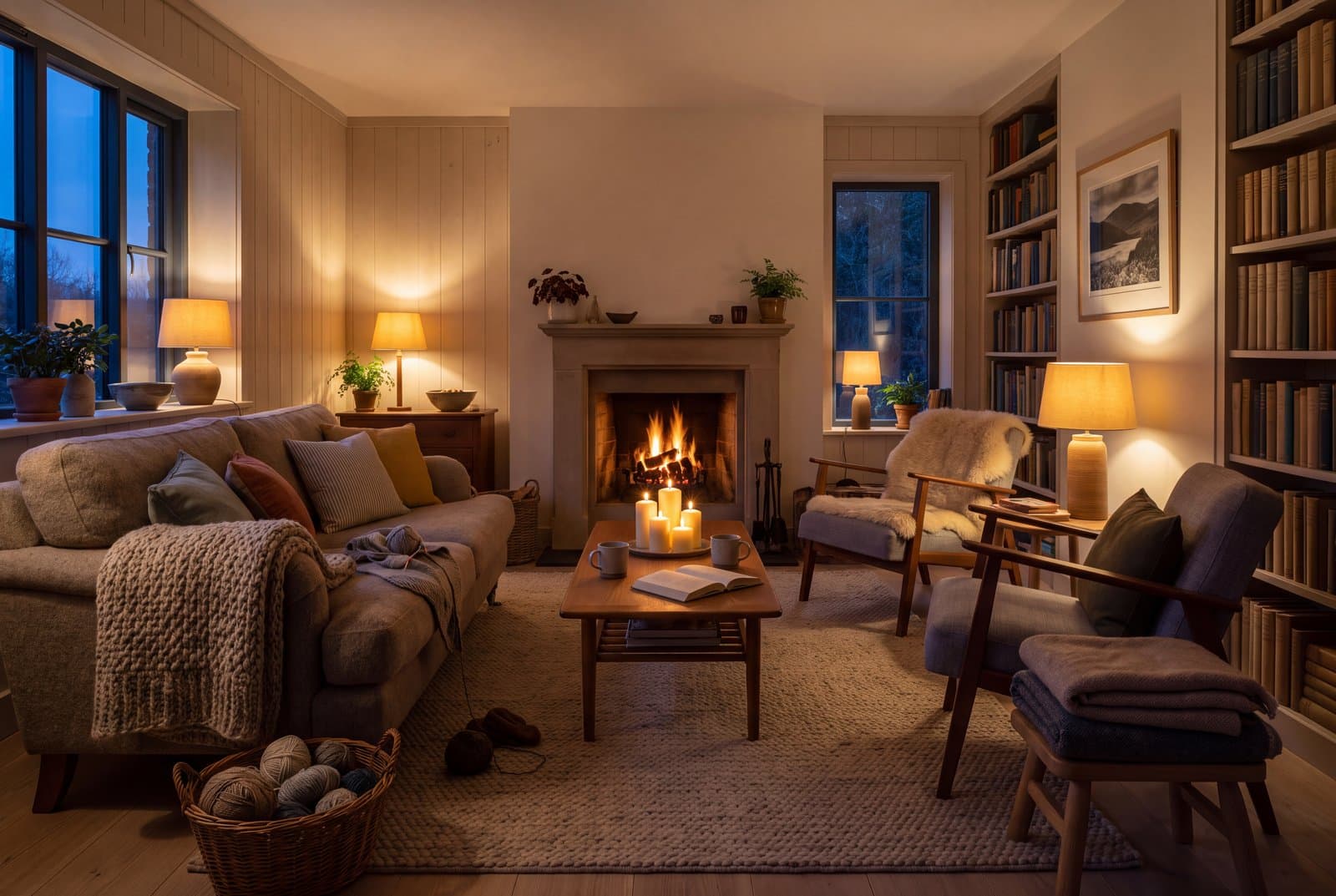
Hygge is a Danish word for a specific quality of atmosphere: warm, low-lit, unhurried, and shared with people you are comfortable around. It has no clean English translation, which is why it arrived in English intact rather than being translated, and why it is so frequently sold as a furniture category when it is not one.
That distinction matters more than it sounds. You cannot buy hygge. You can only build the conditions under which it tends to happen, and those conditions are surprisingly specific and mostly about light. What follows is the meaning, the pronunciation, and then the actual decisions that produce it.
What Hygge Means
Hygge describes a feeling of cozy contentment produced by an environment and a moment together. A room can be set up for hygge. Hygge itself is what occurs in the room.
The Danish sense of the word is closer to "the deliberate creation of comfort and companionship" than to "cozy." It carries an element of intention that the English word does not. A room that happens to be warm is not hygge. A room that has been arranged, lit and stocked so that people will stay in it longer is heading that way.
It also carries a strong association with winter, and specifically with a very long, very dark winter. Denmark is far enough north that a December afternoon is effectively evening. Hygge is the cultural response to that, which is worth knowing because it explains almost every design decision the concept implies. If a choice makes a dark afternoon better, it is hygge. If it does not, it probably is not.
The hygge lifestyle, as it gets described in English, extends past interiors into slow meals, board games, candles, hot drinks and small gatherings. The interiors part is the part you can furnish, and it is the part below.
How to Pronounce Hygge
Hygge is pronounced roughly HOO-guh, with the stress on the first syllable.
The honest answer is that the first vowel does not exist in English. Danish "y" is a rounded front vowel, made by shaping your lips as if for "oo" while your tongue sits where it would for "ee." English speakers land nearest by saying "HOO-guh" or "HYOO-guh." Both are close enough to be understood.
The second half is softer than it looks. The "gg" is not a hard English "g" as in "goggle." In Danish it is a soft, almost swallowed sound, so the word ends closer to "-uh" than "-gah."
What to avoid: "HIGGY," "HYGG-ee," and a hard "g" ending. If you want a single safe version to say out loud, use HOO-guh and stop worrying about it. Danes are used to it.
Hygge Is Not a Style, and Then It Is
Strictly, hygge is a mood and not a design style, and anyone who tells you a particular sofa is hygge is selling you something.
Practically, though, a consistent set of choices does produce it, and those choices are coherent enough to work with. Hygge style, as the term is now used in English, means Scandinavian interiors weighted heavily toward warmth and low light rather than toward brightness and minimalism. Same furniture vocabulary, different priorities.
The hygge aesthetic is the softer, darker, more layered end of Scandinavian design. Where a Scandinavian room aims for light and air, a hygge room aims for enclosure and warmth. They use the same wood and the same wool. They point them at different problems.
Hygge Interior Design: The Five Things That Do the Work
Almost all of the effect comes from five decisions.
1. Light low, warm, and in many small sources. This is the single most important one and the one most often skipped. No overhead light as the primary source. Instead, four to six small warm light sources at different heights: table lamps, a floor lamp, candles, a lamp on a low shelf. Bulbs at 2700K or warmer. A room lit from above at 4000K cannot be hygge no matter what furniture is in it.
2. Texture, layered and touchable. Wool, sheepskin, chunky knit, linen, unglazed ceramic, raw wood. The test is whether you would want to put your hand on it. Hygge is a tactile idea before it is a visual one.
3. Enclosure. Furniture pulled in toward a center rather than pushed against the walls. A rug that defines an area. A high-backed chair. A corner rather than a middle. People relax faster in a space with a clear edge to it.
4. A source of real warmth. A fire if you have one. A wood stove, a candle cluster, a heated throw. Something with heat coming off it, positioned where people sit.
5. Evidence of use. Books mid-read, a blanket that is not folded, mugs on the table. Hygge is incompatible with a room that looks like nobody is allowed to touch it. This is the hardest one for people who like tidy rooms and the one that most reliably separates a hygge room from a photograph of one.
Hygge Living Room
The hygge living room is built around one seating group, one light plan and one warm surface.
Start by pulling the furniture off the walls. A sofa and two chairs facing each other across a rug, close enough that a normal conversation does not need raising your voice. This alone changes a room more than any purchase.
The sofa should be deep and soft rather than firm and tailored, in wool, cotton or a heavy linen. Then layer: a sheepskin over one arm, a chunky knit throw over the back, cushions in at least three different textures. Nothing needs to match; matching sets read as a display.
Rug in wool, large, and warm-toned. Coffee table low enough to put your feet on, or an ottoman that lets you actually do it.
Then the light. Two table lamps and a floor lamp, all warm, all on, none of them overhead. Candles on the coffee table and the mantel. A hygge living room lit from a ceiling fixture is the most common failure and the cheapest one to fix.
Hygge Kitchen
The hygge kitchen is a kitchen you would sit in rather than pass through, which is mostly a question of whether it has somewhere to sit.
If there is any way to fit a small table and two chairs, or a bench against a wall, do that before anything else. A kitchen with a seat becomes the room people gather in, which is the entire objective.
Materials: wood countertops or a wooden island top, warm painted cabinets in muted greens, clays or off-whites rather than bright white, and open shelving holding things you use daily. Ceramic mugs on a hook rail. A kettle that lives out.
Light it in layers. Under-cabinet lighting at a warm temperature, a pendant over the table rather than over the sink, and a lamp on the counter, which sounds strange until you have done it and is one of the highest-impact things in this entire guide.
Add a rug. Kitchens almost never have one and it changes the acoustics and the temperature of the room immediately.
Hygge Bedroom
A hygge bedroom is simpler than the other rooms because bedrooms are already built for the objective.
Layered bedding is the whole method: a linen or brushed cotton base, a wool blanket, a heavy duvet, and a knit throw at the foot. Different weights and different textures, so the bed reads as depth rather than as a single flat surface.
Two bedside lamps with fabric or paper shades, warm bulbs, on dimmers if possible. No overhead light in use after dark.
A rug on each side of the bed so your feet land on wool rather than floor. Heavy curtains, floor length, that block the dark and hold the heat.
Then a chair. A hygge bedroom nearly always has a chair in the corner with a blanket on it, and the reason is that it turns the room into somewhere you might spend an evening rather than somewhere you only sleep.
Hygge Decor and Homeware
Hygge decor is a short list, and most of it is functional rather than decorative.
- Candles. Denmark uses a genuinely remarkable number of them. Plain unscented pillars and tapers, in clusters rather than singly.
- Blankets and throws. Wool, mohair, chunky cotton knit. More than you think you need, in the rooms where people sit.
- Sheepskins. Over chair backs, on benches, on the floor beside a bed.
- Ceramics. Hand-thrown mugs and bowls with weight to them. Hygge homeware is mostly things you hold, which is why the weight and the glaze matter.
- Baskets. For blankets, for logs, for the clutter that a lived-in room generates.
- Wooden boards and bowls. Used, not displayed.
What is not on the list: signs with the word hygge on them, and anything scented strongly enough to be the first thing you notice. Both work against the idea.
Hygge in an Apartment
A hygge apartment is arguably easier than a hygge house, because the concept rewards small enclosed spaces and most of the work is lighting and textiles rather than architecture.
The moves that matter, in order: replace every overhead light you rely on with two or three lamps; put a wool rug down; add layered throws to wherever you sit; hang curtains high and floor-length even if the window is small; and create one defined corner with a chair, a lamp and a blanket.
If you cannot have candles, warm LED candles are a poor substitute visually but the light level is the part that matters, and a very low warm light source is better than none.
Renting is not an obstacle here. Nothing on that list is attached to the building.
The Summer Problem
It is worth being straight about this. Hygge is a winter concept, and most of what produces it, candles, heavy textiles, enclosure, low light at four in the afternoon, does not translate to a bright July evening.
The Danish answer is that summer hygge exists but looks different: outdoors, long tables, lighter textiles, still with the same emphasis on shared unhurried time. If you furnish a room entirely for winter hygge, it will feel heavy for four months of the year. Building in some ability to lighten it, removable throws, curtains that pull fully clear of the glass, a rug you can roll up, is worth the small extra effort.
Hygge, Scandinavian and Lagom
Scandinavian design is the broader style: light woods, functional forms, neutral palettes, plenty of daylight. Hygge is a mood you can create inside it, weighted darker and softer.
Lagom is Swedish and means roughly "the right amount." It is a principle of moderation and balance, and it is about sufficiency rather than atmosphere. The two get marketed as competitors and are not really comparable.
Cottagecore shares hygge's love of soft layered textiles and low light, particularly in its darker form, but adds a rural fantasy and a lot more pattern.
Japandi shares the wood and the restraint but is much stricter about clutter, which puts it directly at odds with the "evidence of use" rule above.
Where to Start
Change the lighting first. It costs less than any other item on this page, takes an evening, and does more than a new sofa would. Two or three warm lamps in a room where you were previously using an overhead fixture will get you most of the way there before you buy any furniture at all.
Then add texture where people sit, and pull the furniture off the walls.
If you want a full profile to furnish against rather than a room-by-room fix, our style quiz resolves you against six defined profiles in about three minutes. Hygge sits closest to Scandinavian, weighted toward the warmer end of it.
Not sure where to start?
Take the style quiz and get a design profile you can actually furnish against. About three minutes.
Take the Style Quiz