

Affordable interior design starts with deciding how much help you need, then which rooms come first, what deserves real money, and how to pace the buying. This guide follows that order: service costs, room priority, spend-or-save rules, a phased timeline, and renter-friendly options for homes you do not own.
What Affordable Interior Design Costs by Type of Help
Four service levels cover most budgets: hourly consultations, flat-fee room packages, e-design (online design done remotely), and full-service design. E-design runs $150 to $600 per room, while full-service room fees typically range from $1,000 to $5,000+, according to Zweig Group. Picking the right level is the first place to save.
The Four Service Levels Side by Side
Ranges vary by source and region, so treat every figure below as a starting range to verify with quotes. One survey of the market, Showplace HQ, puts e-design at $80 to $2,000 per room and flat fees at $250 to $50,000 per project, which shows how wide the spread can be.
|
Service level |
How it is billed |
Typical range |
Best suited to |
|---|---|---|---|
|
Hourly consultation |
Per hour or a set consultation fee |
$60 to $125 per hour, consultation fees of $350 to $500 (per Thumbtack) |
One decision, such as a layout or a color direction, with you doing the rest |
|
Flat-fee room package |
One price per room or project |
Wide, from hundreds to $10,000 (per Thumbtack) |
A single room where you want a clear scope and a known cost |
|
E-design |
Per room, online |
$150 to $600 per room (per Zweig Group) |
Several rooms, a tight budget, and comfort ordering furniture yourself |
|
Full-service design |
Per room, hourly, or a percentage of project cost |
$1,000 to $5,000+ per room (per Zweig Group) |
Large budgets, complex projects, or people who want the work handled |
A Simple Way to Choose
Start with scope. One confusing room points to an hourly consultation or a flat-fee package. A whole empty house on a modest budget points to e-design, because the per-room cost stays low across many rooms.

Full-service makes sense when mistakes would be expensive or your time is the scarcer resource. A hybrid also works well: pay for one consultation, then carry out the plan yourself over several months.
What to Check Before You Pay
Ask any designer the same four questions. Each one protects the budget.
- What is included, and how many revisions are covered?
- Are furnishings sold at cost or with a markup? Thumbtack lists markups of 15%-35% of product cost.
- Who handles ordering, returns and delivery problems?
- What does an extra room or a change of direction cost?
Which Rooms Get Your Budget First
Start with the rooms you use every day, usually the bedroom, the living area and a place to sit and eat. Rarely used rooms wait. A priority order keeps early purchases from being the wrong ones, because money spent on a guest room in month one is money missing from the room you live in.
Budgets Pool in a Few Rooms
Put your money where you live most; the rooms you use every day earn the biggest share of the budget.
For scale, GoMortgage gives room-by-room estimates of $2,000 to $10,000 for a living room, $1,500 to $8,000 for a primary bedroom, $1,000 to $7,000 for a dining room, $500 to $3,000 for a guest bedroom and $500 to $2,500 for a home office. Whole-house furnishing runs $10,000 to $50,000 nationally, according to GoMortgage. Those are wide ranges, which is why your own order matters more than any average.
A Priority Order for an Empty House
- Bed and basic bedroom storage, because sleep affects everything else.
- The main seating area, usually the sofa and a rug.
- A place to eat, even if it starts as a small table and two chairs.
- Work space, if you work from home.
- Guest rooms, entries and secondary spaces, last.
Finish one anchor room before starting another. Living in a half-furnished house is uncomfortable, but a finished room gives you a place to rest while the rest catches up. It also shows you what you actually need, which is the real argument for going in order.
Where to Spend More and Where to Save
Spend more on pieces that take daily wear and are hard to replace, such as sofas, mattresses and dining chairs. Save on pieces that carry little load and are easy to swap, such as side tables, decor and lighting accents. Sorting by wear and replacement difficulty beats sorting by price tag.
Worth the Money

Designers tend to agree on sofas. One quoted in Good Housekeeping puts a quality sofa at the top of her investment list. Another designer quoted in Good Housekeeping points out that quality pieces can be recovered later and that performance fabrics suit households with kids and pets. Designer Jennifer Harkavy adds that investing up front can save thousands of dollars in the long run.
An honest tradeoff: a higher price does not guarantee quality. Check frame construction, cushion fill and fabric ratings, and buy the best version you can afford rather than the most expensive one available.
Good Places to Save
Side tables, lamps, mirrors, vases and wall art are low-risk. One designer quoted in Good Housekeeping says this kind of purchase is safe to make from your usual online retailers or local home stores.
Secondhand is a mainstream route here. In the US, Recommerce Report found that 51% of all shoppers and 67% of Gen Z choose secondhand over new always or most of the time when a suitable option exists. Rently reports 39% of renters shopping thrift stores.
Solid wood tables, dressers and frames are good secondhand finds because they can be cleaned, refinished or re-hardwared. Upholstered pieces and mattresses deserve more caution, since you cannot easily judge what is inside.
The Trend Question
Trend cycles push spending in the wrong direction. Earth911 notes that design trends now turn over every 10 months or so and that more than a third of furniture and decor purchases are prompted by social media. A timeless palette of warm woods and organic textures, which Livabl describes as the dominant 2026 direction for new homes, lets the big pieces last while small accents change cheaply.
Spreading a Full-Room Budget Over 6 to 12 Months
Buy anchor pieces first, live in the room, then add layers once real habits show what is missing. Furnishing over 6 to 12 months is typically 15% to 30% cheaper than buying everything in one wave, according to OpenDoor, thanks to seasonal sales, fewer impulse buys and spread-out costs.
A Workable Budget Split
One phased approach from AI Room Styler allocates 50% of the budget to anchor pieces (sofa, bed, dining table), 30% to the second room, and 20% to rugs, lighting and forgotten items. That source spreads it over 3 to 6 months. Stretching the same logic across 6 to 12 months suits larger homes, since OpenDoor says most homeowners take 3 to 9 months to furnish a 3-bedroom home and 6 to 12 months for a 4-bedroom.
Anchor pieces first, then let real daily habits tell you which layers the room still needs.
As an illustration only, a $6,000 budget would put $3,000 into anchors, $1,800 into a second room and $1,200 aside for rugs, lighting and surprises. Swap in your own total. The percentages are the useful part.
Phasing is also normal in professional practice. House Beautiful reports that 44% of interior designers often run projects in phases, with clients paying for design upfront and ordering furniture room by room over a year or two.
A Sample Sequence for One Room
- Month 1: the largest anchor, such as the sofa or bed.
- Months 2 to 3: a rug and the main lighting.
- Months 4 to 6: storage and side tables, after you see where things land.
- Months 7 to 12: textiles, art and the small accents, often secondhand.
Keeping Staggered Purchases Cohesive
The risk of buying slowly is a room that looks assembled from five different stores. A short plan prevents it. Choose a whole-home palette first, which AI Room Styler suggests as one main neutral, one secondary tone and one to two accent colors carried through the house.
A style profile and design moodboard, a saved collection of images, colors and materials, does the same job. Every later purchase gets checked against it, so a piece bought in month eight still belongs with the one bought in month one.
Working Within a Lease: Renter-Friendly Design That Still Looks Finished
Rugs, lighting, textiles and freestanding storage make a rental look finished without touching the walls. They are removable, they travel, and they keep their value. Rearranging what you own is the cheapest first step: 45% of renters plan to refresh their space that way, according to Rently.
Strategies That Respect the Lease
Lease limits are real. Rently found that 30% of renters cite no painting, no drilling and no permanent changes as a challenge. Work with the limits, not against them.
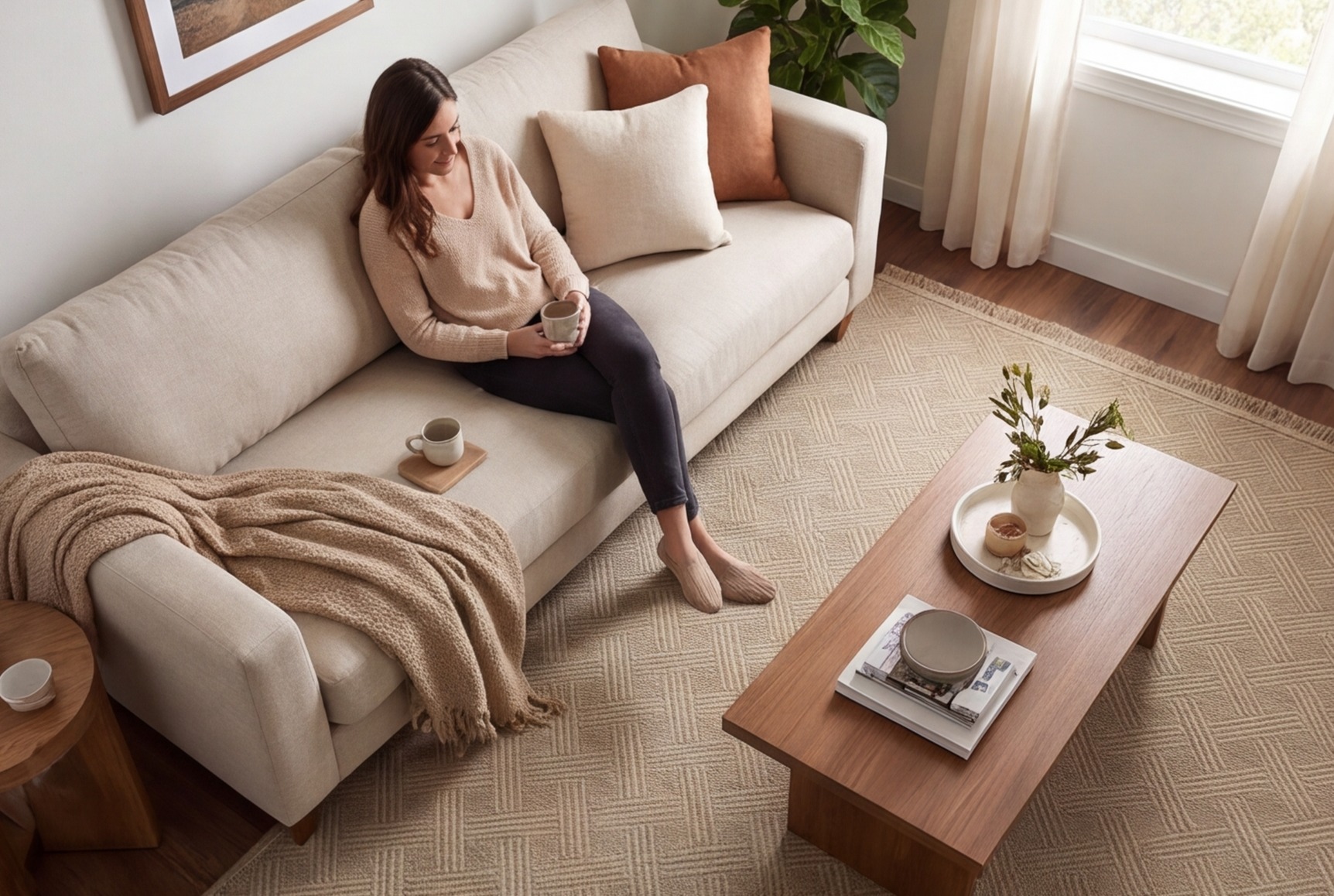
- A large rug defines a living area and covers worn flooring.
- Plug-in lamps and floor lamps replace harsh overhead light and need no installation.
- Curtains hung on tension rods and textiles in a consistent palette add softness.
- Low freestanding shelves and cabinets add storage without wall anchors. For taller units, use an anti-tip kit and ask your landlord whether anchoring is allowed.
- Plants add life, and 37% of renters plan to use them, per Rently.
Sizing for Small Spaces and the Next Home
In a small room, measure first. Choose a sofa with slim arms, a table that can shrink, and furniture on legs so the floor stays visible. Oversized pieces make a rental feel crowded and are the hardest to move.
Choosing pieces that travel is the best way to protect the money. Neutral upholstery, standard-size rugs, simple wood furniture and modular storage fit a new layout and hold resale value. Recommerce Report notes that furniture is a large share of the US recommerce market, so well-made pieces can be sold on if they do not fit the next place.
We build room plans around exactly this kind of sequencing at Cradle & Hearth. A free style quiz gives you a named style profile, and the room-by-room plan ties order, budget and timeline together so each purchase has a reason.