
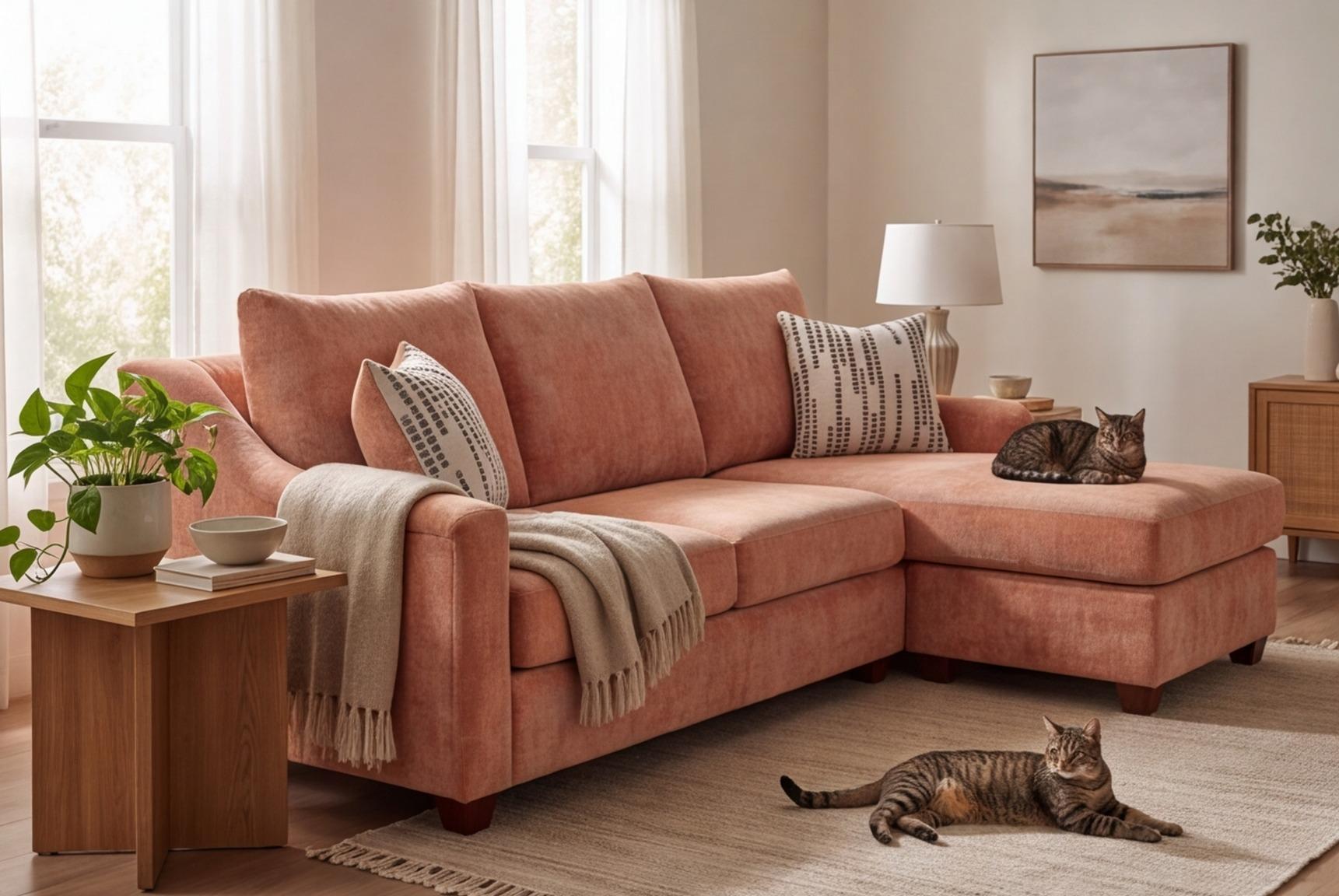
Advice on velvet, chenille and boucle for cat homes contradicts itself because each name covers both snag-prone and tightly built cloth. The fiber matters less than the structure: flat weave, pile height and loops. This guide moves from sofa fabric to cleaning codes, rugs, plants and scent.
Choosing the Best Couch Fabric for Cats: Why Leather Loses and Tight Synthetics Hold Up
Leather is a prime target for cat claws and shows every mark. Tightly woven microfiber, faux suede and synthetic performance fabric show claw marks less, so they are the strongest starting point for the best couch fabric for cats.
Why leather loses with cats
Leather is sleek, soft and durable, and it does not hold much pet hair or odor. Those are real strengths. The problem is that a claw leaves a visible line or puncture in the surface, and the mark does not relax back out the way it can in a woven fabric.
Cats are naturally drawn to couches. A 2018 pilot study of 140 cat-owning clients found that 83.9% of cats scratched inappropriate items, with furniture and fabric scratched most often, according to the Journal of Feline Medicine and Surgery. Expect some scratching in any home with a cat, and choose a surface that hides it.
What holds up better
Microfiber is a polyester cloth spun from very fine threads and woven tightly, so a claw meets a flat, dense surface with no loop to hook. Faux suede (often sold as microsuede) is a microfiber with a brushed face. Synthetic performance fabrics are built the same way, and StitchDesk reports that the category is moving toward stylish, tactile, pet-oriented furniture with washable covers and stain resistance.
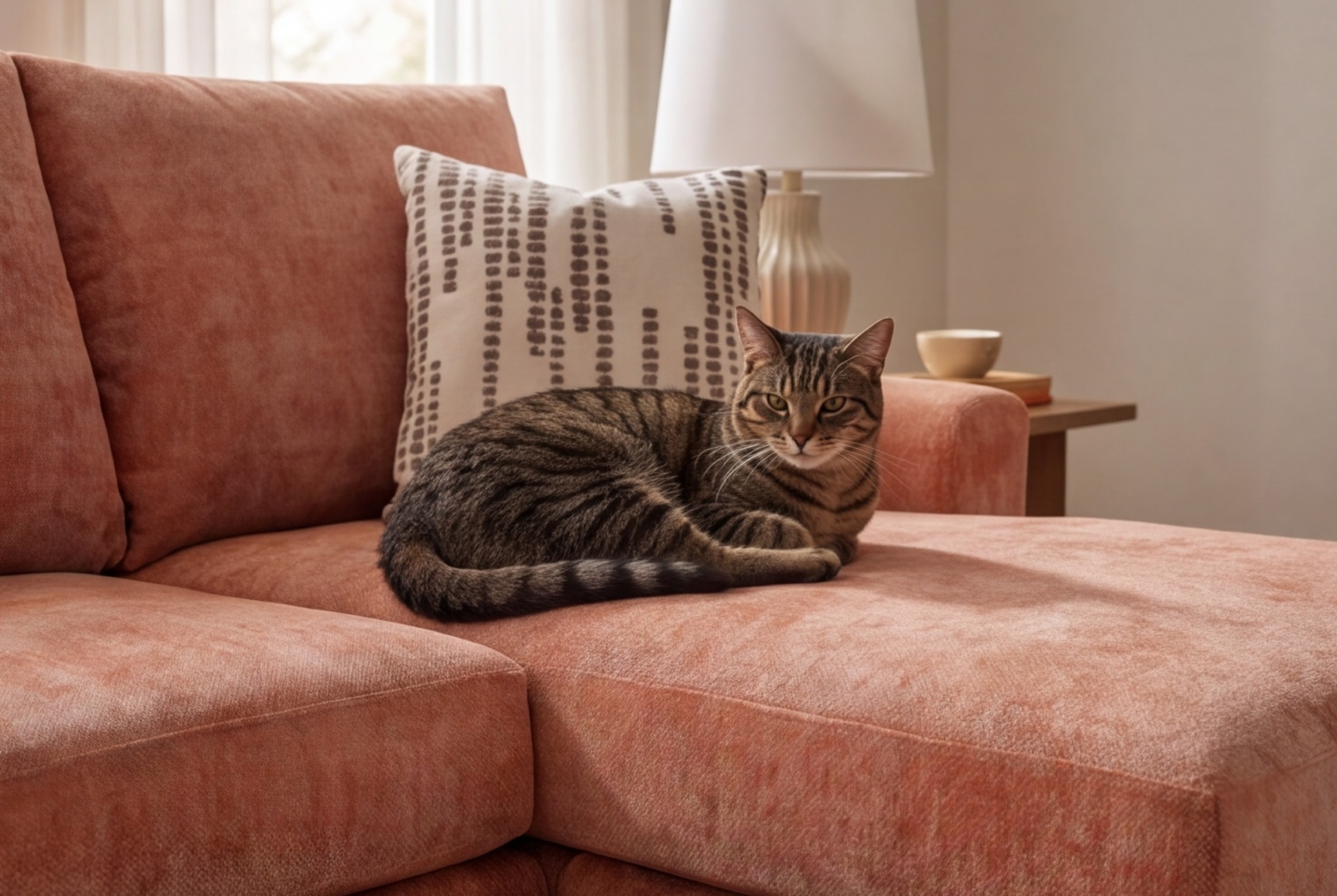
For anyone asking whether microfiber is good for pets, the answer is yes on construction. Cat hair sits on top of a flat weave and lifts off with a rubber glove or a vacuum. Pilling and fading over several years vary by line, so check a swatch before you commit.
A quick comparison
|
Surface |
How it is made |
What a claw does |
|---|---|---|
|
Leather |
Animal hide, smooth face |
Leaves visible lines and punctures |
|
Microfiber or faux suede |
Fine polyester threads, tight flat weave |
Slides across, marks are less visible |
|
Synthetic performance fabric |
Tight weave, often with a stain-resistant finish |
Little to hook, marks are less visible |
|
Loop or open weave |
Raised loops or loose yarns |
Hooks and pulls threads |
Even the best couch fabric for cats will not stop a determined scratcher. It gives you a surface that looks better for longer while a scratching post does the real redirecting.
Weaves That Catch Claws: Boucle, Chenille, Gauze and Loops
Boucle, gauze, nubby chenille and any looped weave invite scratching because a claw can hook a loop and pull. Choose a flat, tight weave, and judge the cloth by its structure, not by the name on the label.
Why loops pull
Boucle is a yarn twisted into small loops, then woven so the loops stand up from the surface. Each loop is a tiny handle for a claw. When a cat pulls back, the yarn stretches out of the weave and leaves a visible snag.
Judge a cloth by how it is built, not by its name. Loops and loose yarns snag; flat, tight weaves do not.
According to StitchDesk, standard open loop boucle can catch claws and embed hair, and the useful distinction is between decorative texture and tighter performance boucle. Gauze has a similar problem. It is a loose, open weave with wide gaps between threads, so claws slip through and tear.
Reconciling the velvet and chenille advice
One guide praises velvet and another warns against chenille. Both can be right, because velvet describes a cut pile, meaning short, dense yarn ends standing upright, and chenille describes a fuzzy yarn. Neither name tells you how the cloth is built.
A dense, short-pile polyester velvet has cut ends and no loops, so there is little for a claw to catch. A chenille woven loosely, with a nubby or looped surface, snags easily. Business of Home notes that velvet, chenille and boucle are all popular in 2025 alongside a growing performance category, which is why swatch testing matters more than the fiber name.
A swatch test you can do at home
- Run a fingernail across the swatch. If it lifts a thread or loop, a claw will too.
- Look for loops, slubs (thick, uneven yarn) or visible gaps between threads.
- Press a thumb in and release. A short, dense pile springs back evenly.
- Check the back. A tight, even weave there usually means a tight face.
A flat, tight weave is the better pick for a household that wants a clean look without pulled threads. Twill, a tight diagonal weave, is a good example.
Cleaning Codes for Cat Households: What W, W/S, S and X Mean
Upholstery cleaning codes tell you which cleaner a fabric tolerates. W or W/S fabrics clean with a water-based cleaner, which suits most pet messes. S is solvent only, and X is vacuum only.
Reading the code
The cleaning-code convention uses four codes, usually printed on a tag under a cushion or on the back of a swatch:
- W: clean with water-based cleaner or upholstery shampoo.
- W/S (sometimes written S/W): water-based cleaner or a dry-cleaning solvent both work.
- S: solvent only, with no water.
- X: vacuum or light brushing only.
Why W and W/S suit cat messes
Hairball stains, litter-box tracking and the occasional accident are water-soluble messes. A water-based cleaner can handle them, and you can spot clean the same day. An S-coded fabric needs a solvent product and good ventilation, and an X-coded fabric cannot be spot cleaned at all.
Cat hair is a separate task. On a flat weave it lifts with a vacuum, a rubber glove or a lint roller, and that works the same on any code.
Check before you order
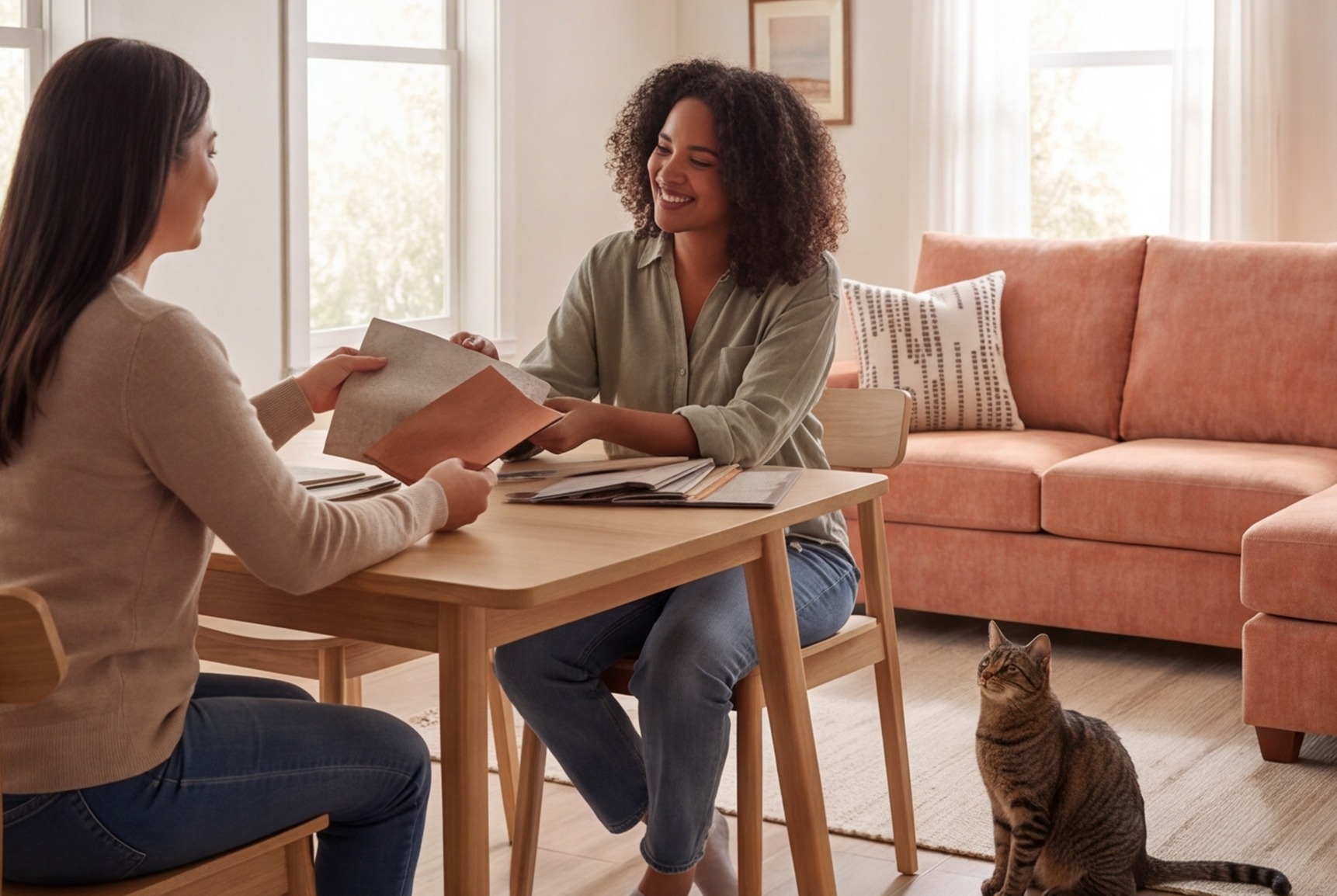
Ask for the code in writing before you buy a sofa online, and request a swatch. Test the swatch with a drop of water, and on the sofa itself, test a hidden corner. If the product page does not list a code, treat that as unknown and ask. A code does not guarantee that a particular stain will come out, but it tells you what the maker expects you to use.
Rugs Under the Sofa: Cut-Pile and Flatweave, and Why Sisal Belongs in a Post
Choose a cut-pile or flatweave rug and skip loop-pile Berber. Cats treat sisal as a scratching post, so keep sisal for a dedicated post near the sofa.
Pile construction decides the rug
Berber is a loop-pile rug, where the yarn is pulled through the backing in uncut loops. Just as with boucle, the loops catch claws. According to Livingetc, pet-friendly rug guidance treats construction as the deciding variable, with cut pile commonly recommended and loop pile warned against because claws can catch and unravel loops.
Cut pile has yarn ends sheared open, so there is nothing to hook. Flatweave, such as a dhurrie or kilim, is woven flat with no pile at all. Both vacuum easily, and the same source notes that color and a subtle pattern reduce how much fur and wear show.
Why sisal belongs in a post
Sisal is a stiff natural fiber made from agave leaves, and it is the material most cat posts are wrapped in. A sisal rug sends the same signal. Your cat will treat it as a scratching surface, and the edges will fray.
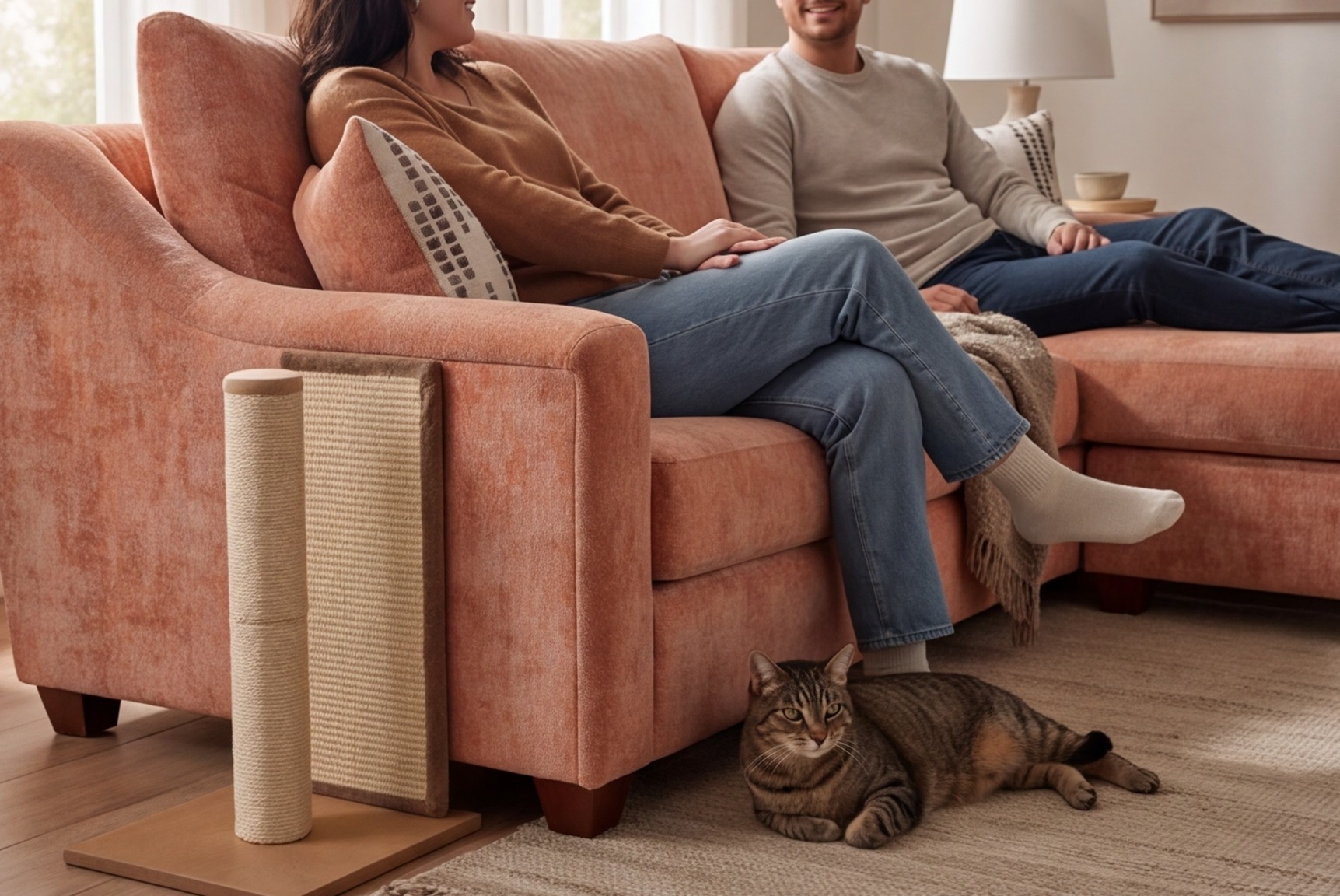
A 2020 study of 25 adult cats across 14 homes, published in Applied Animal Behaviour Science, found that rope and cardboard scratchers produced significantly more behavioral interaction than scratchers covered in sofa fabric. A sisal post gives a cat something it prefers to your upholstery.
Where to put the post
Placement matters. In a survey published in the Journal of Feline Medicine and Surgery, when owners put a post near the object being scratched, 49.3% of those posts were 1 to 5 feet away and 69.3% were in the same room. Set the post a foot or two from the sofa arm, not under the coffee table where it gets ignored.
A 2022 survey of 2,465 US and Canadian owners, published in Animals, found that 58% reported inappropriate scratching, and that it was significantly less frequent when owners provided flat scratching surfaces, sisal rope and additional posts. Pick a rug in a tone close to your sofa so the room still reads as one look.
Plants for a Cat Household: Faux Greenery and ASPCA Non-Toxic Species
Use faux plants or live species from the ASPCA non-toxic list. Lilies are toxic to cats, so keep them out of the living room.
The lily rule
The FDA states that ingesting a small amount of lily leaf or petal, licking a few pollen grains, or drinking vase water can cause fatal kidney failure in cats in less than 3 days. Kidney failure can occur within 24 to 72 hours. Even a bouquet on the coffee table puts a cat within reach of the vase water, so skip cut lilies as gifts or centerpieces.
How to choose live plants
ASPCA advises using the ASPCA's toxic and non-toxic plant resources, keeping lilies out of the home, and treating faux greenery or verified non-toxic species as the better decor route. Look up the exact plant by its botanical name before you buy, since common names overlap.
For scale, a parlor palm or a hanging spider plant fills a corner or a shelf. A large areca palm next to a sofa, a species on the ASPCA's non-toxic list, softens the room and picks up natural tones in a rug or wood frame.
Faux greenery
A faux plant is made of fabric, plastic or paper with a wire stem, and it needs no watering. Cats may still chew on it, so choose sturdy stems and secure the pot. Dust it every few weeks.
Mixing a few faux stems with one or two verified live plants keeps the styling coherent. Repeat the same leaf shape or green tone across the room so it feels planned.
Scent in a Cat Household: Unscented Decor Instead of Diffusers and Oil Warmers
Unscented decor is the better fit for a home with cats. The ASPCA warns that concentrated essential oils can harm pets, so skip reed diffusers and oil warmers.
What the ASPCA says about oils
The ASPCA says concentrated essential oils at 100% can be dangerous for pets, and it reports that concentrated tea tree oil may cause issues in cats with only seven or eight drops.
In a home with cats, skip the fragrance and let the materials do the work.
A reed diffuser sits at nose height on a sideboard, and an oil warmer heats the oil so it vaporizes into the air, so both put scent right where a cat sleeps and walks. ASPCA Poison Control notes that pets have a much better sense of smell than we do, so something that seems light to us may be overwhelming to them.
Scent through materials
A room can smell fresh without a diffuser. Wash throw covers weekly, vacuum the sofa and rug, and keep the litter box away from the seating area. Open a window when you can.
Texture can make a room feel finished without adding any scent. Linen, cotton and woven wood read as calm and natural. A 2023 study in iScience found that dried silver vine leaves are a suitable olfactory enrichment for cats, with no addictive behavior or liver or kidney injury markers after continuous exposure. Ask your vet before adding a new scent for your cat.
A room built from these materials
A tight-weave performance sofa, a flatweave rug, faux or verified non-toxic greenery and a sisal post by the arm add up to a living room that suits cats and still looks composed. Our organic modern living room shows that look built from natural-toned materials, and it is a practical place to see how the pieces fit together.