
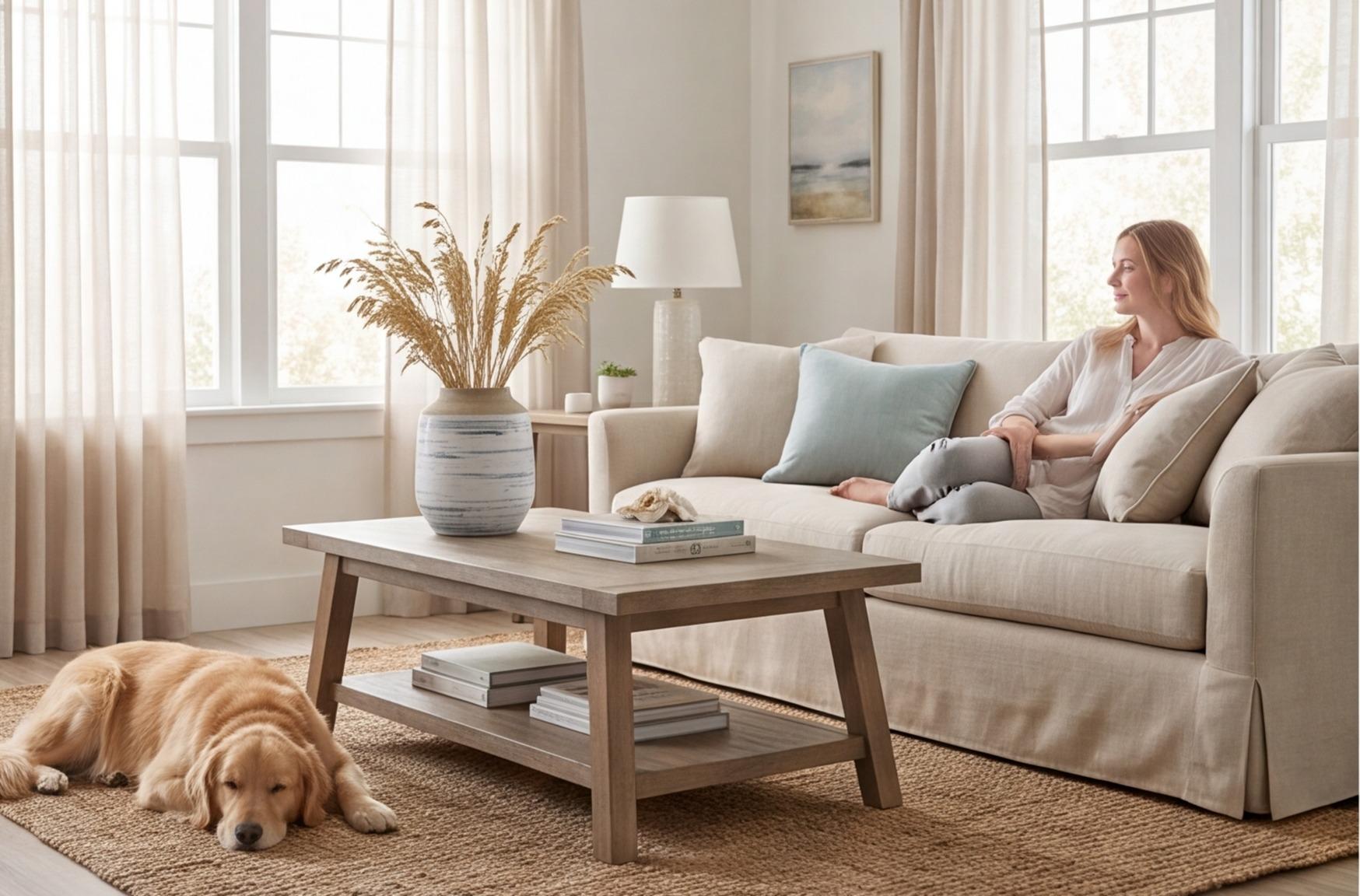
Coastal living room ideas work best when each one answers a real stress on the room: humid air, wet swimsuits, strong sun, or an older dog on slick floors. Below are five household situations, each with the fiber or build that solves it, starting with the one most coastal inspiration skips.
- Senior or large dogs: a larger area rug on a non-slip pad.
- Humidity: a synthetic natural-look rug and resin wicker on covered porches.
- Beach days: performance fabric or solution-dyed acrylic upholstery.
- Big windows: solution-dyed fabrics, UV-filtering shades and mid-tone colors.
- Sunny floors: solution-dyed polypropylene or indoor-outdoor rugs.
The dog idea comes first because it changes how you place the rug, and the rug anchors everything else. The full reasoning is in the last section. Coastal homes often have tile, hardwood or sealed concrete underfoot, and those surfaces are slick for older paws. A large rug on a stable pad creates a traction route and ties the sofa and chairs into one group.
Coastal Living Room Ideas for Humid Homes: Rugs and Porch Furniture That Hold Their Shape
In humid air, the safest coastal textures are synthetic ones made to look like natural fiber. A polypropylene or polyester rug with a woven, jute-like pattern keeps the sandy texture, and all-weather resin wicker holds its shape on a covered porch where natural rattan would soften.
Why Jute, Sisal and Seagrass Behave Differently in Damp Air
Jute, sisal and seagrass are plant fibers, and plant fibers are hydrophilic, meaning they absorb water. According to BioResources, natural fibers take up moisture under high humidity or liquid-water exposure, and that absorption can cause swelling, loss of mechanical properties, fiber degradation, cracking, and a risk of decay fungi.
The three are not identical. Jute is soft and absorbent and tends to hold dampness longest. Sisal is stiffer and more resilient but still takes up water. Seagrass has a waxy surface that sheds a little more, though it is woven tightly and dries slowly. All three can darken, ripple or smell musty in a room that stays damp. A rug that cannot dry between humid days is a poor match for a ground-floor living room near the water.
The Synthetic Rug With a Natural-Fiber Look
A flat-woven polypropylene rug is extruded from plastic into continuous strands and then woven with a chunky, looped pattern. It reads as jute from a few feet away and dries quickly, because the fiber does not absorb water. Solution-dyed versions also hold their color. The tradeoff is feel. Synthetic versions are smoother underfoot and lack the faint earthy scent of real jute, which some people miss.
All-Weather Resin Wicker for Covered Porches
Resin wicker is a synthetic strand, usually polyethylene, woven by hand or machine over a frame. Look for an aluminum frame, which does not rust the way steel can. The strand is typically UV-stabilized and is made as a solid or half-round profile, which resists cracking. Natural rattan is a vine cane, and it takes up moisture like the rugs above. Utah State University Extension notes that warm, humid climates favor insect pests and that excess moisture can promote decay and serious mold contamination, which is the reason to choose moisture-minimizing materials for a porch.
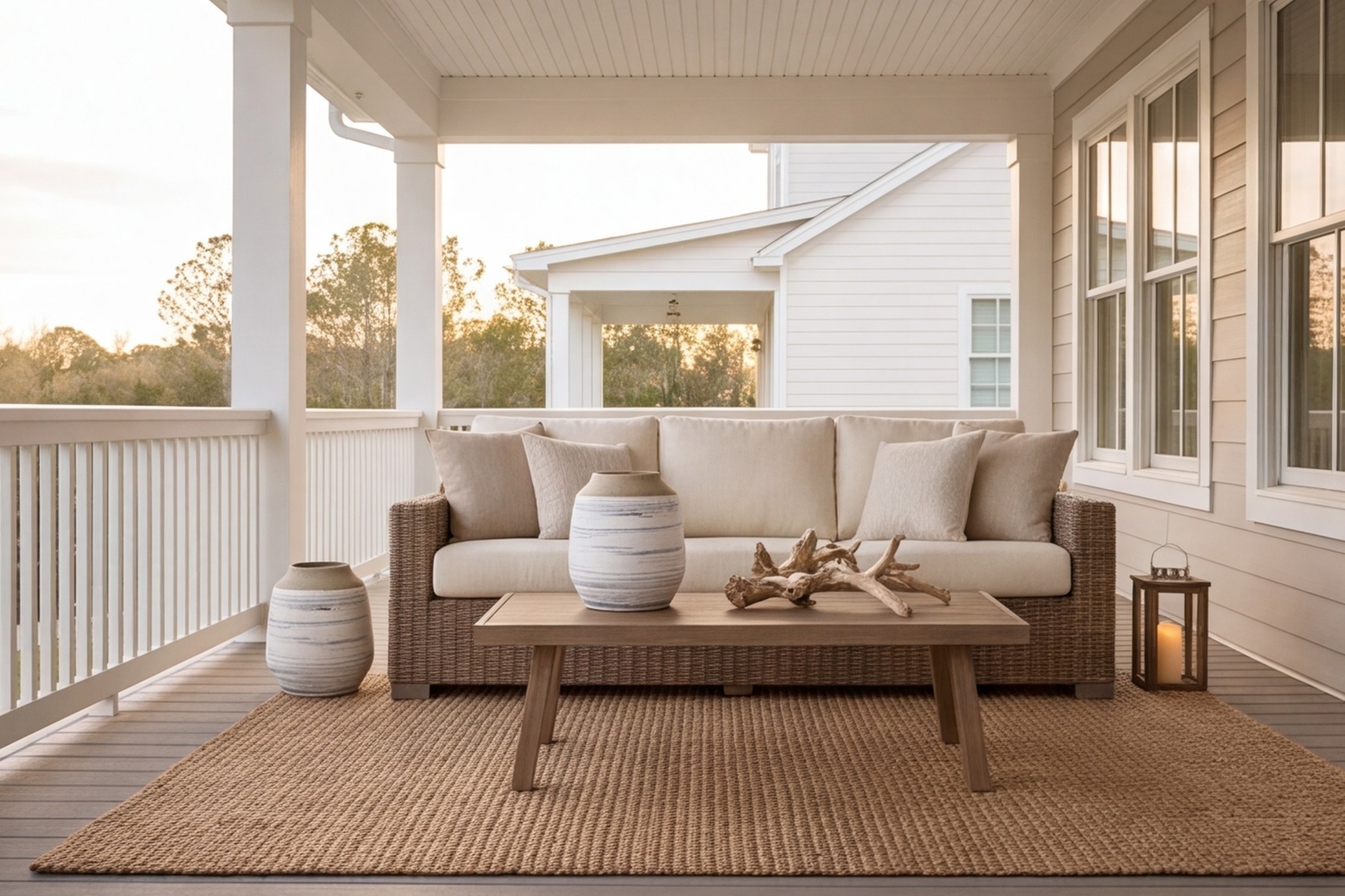
Resin wicker belongs on the covered porch. Indoors, a small amount of real rattan on a shelf or a lamp base is low risk.
Beach Days and Damp Towels: Upholstery Built for Wet Swimsuits
Households that come in from the water need upholstery that dries fast, hides sand and cleans without fuss. Performance fabric or solution-dyed acrylic is made for that routine, and standard cotton is not, because cotton holds water and shows it.
What Cotton, Performance Fabric and Solution-Dyed Acrylic Are Made Of
Standard cotton upholstery is a plant fiber, so it absorbs water, dries slowly and can stay damp deep inside the cushion. Performance fabric is a broad term. It usually means a tightly woven synthetic, often polyester, sometimes with a finish that makes water bead on the surface.
Solution-dyed acrylic is different in how the color is made. The pigment goes into the liquid before the fiber is formed, so it runs all the way through. That keeps the color from fading or washing out. Check the label before you machine wash a cover.
Reading the Cleaning Code
The cleaning code is a letter system printed on upholstery tags. W means clean with water-based cleaner, S means solvent-based cleaner only, WS means either, and X means vacuum only. For a household with wet towels and sandy feet, W or WS is the practical range. Code S means that any spill from a drink or a damp swimsuit needs a solvent cleaner, which is a hassle.
Wet swimsuits need fabric that dries fast and cleans with water, so check the tag for a W or WS code.
A Slipcovered, Light-Toned Sofa
A slipcovered sofa has a removable fabric cover over a fixed frame, so the cover can be laundered when the label allows. In a light tone, such as sand, oatmeal or soft white, it keeps the airy coastal look and makes sand less visible than a dark cover would. Slipcovers in performance fabric or solution-dyed acrylic are the easiest to live with.
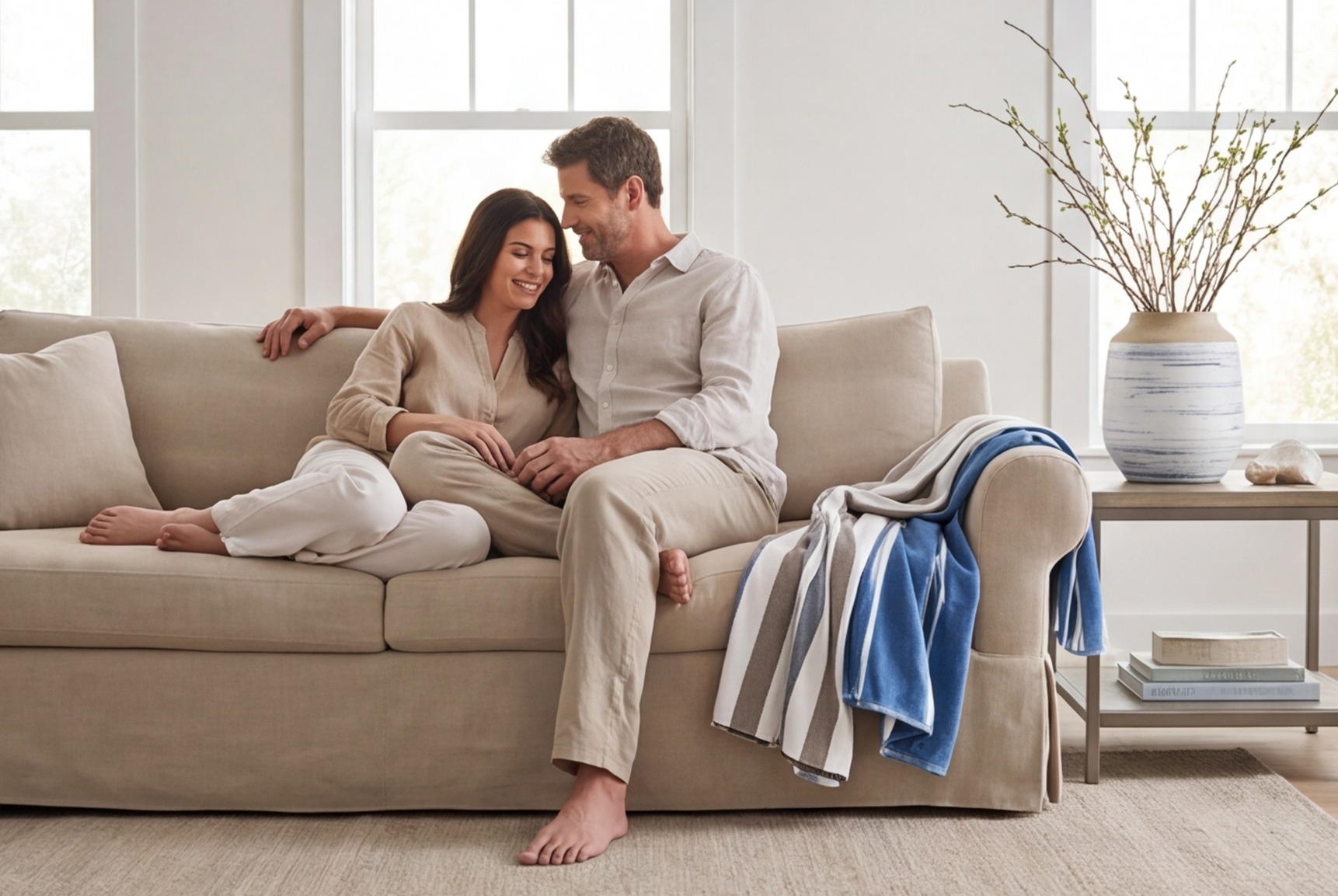
Linen is the question people ask most. It looks right and breathes well, but it absorbs water, wrinkles and can stain from a damp swimsuit. A linen-look performance fabric gives the same texture with less upkeep. Real linen is a fine choice for pillows or curtains that stay away from wet swimmers.
If the household includes cats, leave leather out of the plan. Claws mark it and a damp body sticks to it. A woven performance fabric with a tight weave gives claws less to catch.
Big Windows and Strong Sun: Fabrics and Shades That Resist Fading
Strong sun fades fabric unevenly, so a sofa near a big window ends up with one pale side. Solution-dyed fabric, UV-filtering shades or lined curtains, and mid-tone colors slow that down and keep the fade even.
Solution-Dyed Fabric and the ACT Benchmark
ACT is the Association for Contract Textiles, which sets performance guidelines for commercial fabric. According to Applied Lab, its colorfastness testing uses a xenon-arc light source intended to simulate sunlight through window glass, with a 40-hour option for upholstery and a 60-hour option for drapery. For upholstery near windows, look for Grade 4 after 40 hours or better.
The grading scale matters here. ASTM International states that lightfastness ratings use a numerical scale from 1 to 5, with 5 indicating negligible color change and 1 very severe change, and that curtain fabrics vary across fiber type, yarn twist, finishing treatments and other construction variables. For drapery, ACT's indoor guideline is Grade 4 minimum after 60 hours of accelerated light exposure. Solution-dyed construction is the most direct route to those grades, because the pigment is inside the fiber and not on the surface.
UV-Filtering Shades and Lined Curtains
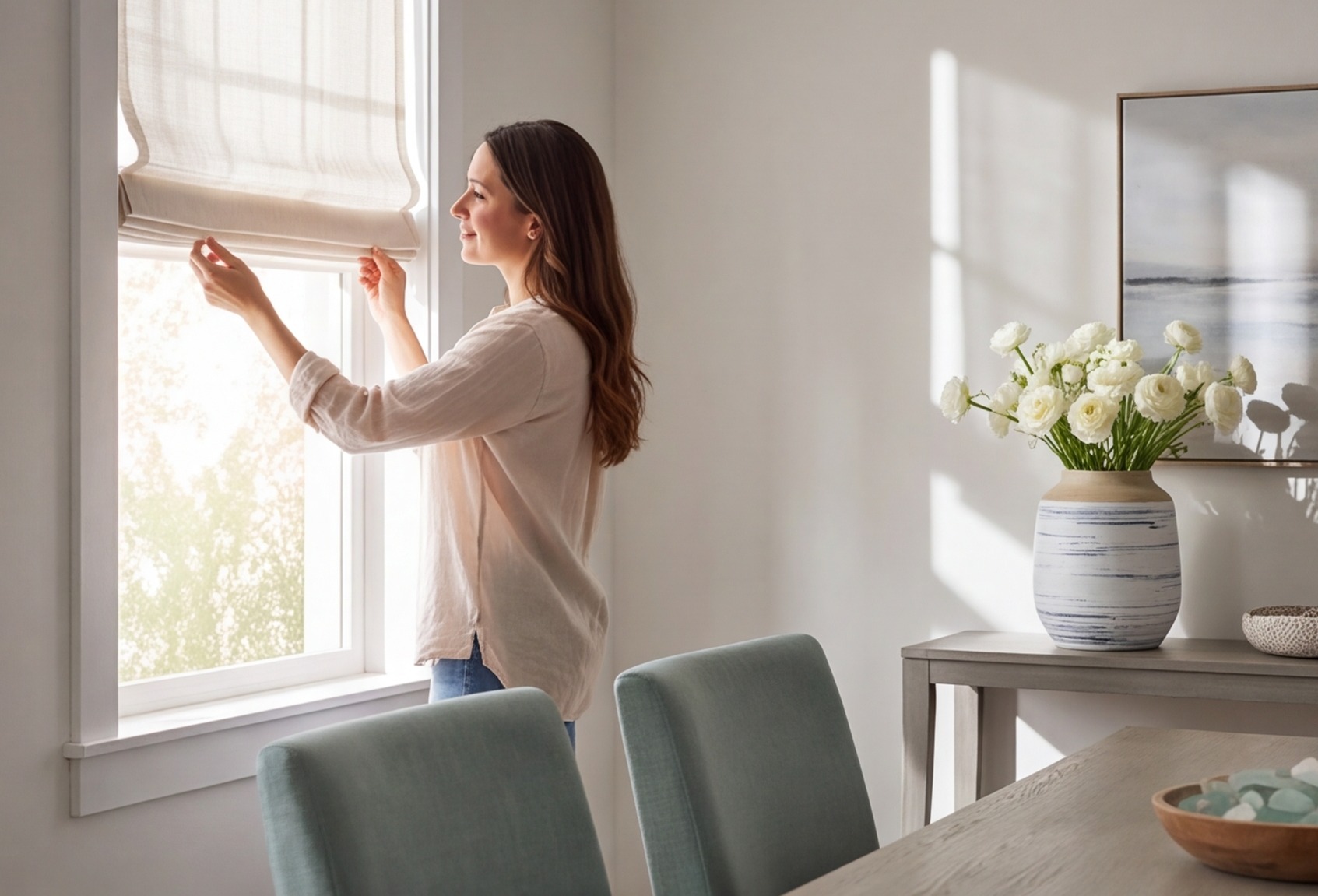
A UV-filtering shade is a woven or coated fabric that blocks a share of ultraviolet light while letting daylight in. Lined curtains add a second layer of fabric behind the face fabric, so the lining takes the sun and the front fabric ages more slowly. Both let you keep the shades or curtains closed through the brightest hours without losing all your daylight.
Glass itself can help. The U.S. Department of Energy says low-emissivity window coatings reflect radiant energy while allowing visible light through, and protect curtains, furniture and hardwood floors from fading. That is a window upgrade, so it suits owners more than renters.
Mid-Tone Colors and the Bright-Wall Look
Very dark fabrics show fade quickly and very pale ones show stains. Mid-tones such as sea glass, soft slate blue, dune and driftwood gray change less visibly, so they wear evenly. For a coastal color palette, keep walls bright white or warm cream for the airy feel and let the sofa, chairs and curtains carry the mid-tone color.
Sun on the Floor: Choosing a Rug That Won't Bleach Out
Rugs take the harshest light in a room, and solution-dyed polypropylene or an indoor-outdoor weave holds color far better than silk or low-lightfastness wool. Pick the fiber first and the sand or seafoam tone second.
Silk and Wool Against Polypropylene
Silk is a protein fiber with a soft sheen, and it fades and weakens in direct sun. Wool is also a protein fiber. Quality varies, and wool dyed with lower-lightfastness dyes can bleach into patches under a south-facing window. Wool also holds humidity and can feel damp in a very moist room.
Solution-dyed polypropylene is a plastic fiber colored in the melt, so the color runs through the strand. An indoor-outdoor rug is usually flat-woven or low-loop polypropylene or polyester, built to sit outside, so a sunny living room is easy by comparison. If toddlers crawl on the floor, skip wool and shag. A flat-woven synthetic is easier to vacuum and wipe.
Sand and Seafoam Without the Risk
|
Rug type |
How it is made |
In strong sun |
In humid air |
|---|---|---|---|
|
Silk |
Protein fiber, surface-dyed |
Fades and weakens |
Holds moisture |
|
Low-lightfastness wool |
Protein fiber, dyed after spinning |
Can bleach in patches |
Absorbs moisture |
|
Solution-dyed polypropylene |
Plastic fiber colored in the melt |
Holds color well |
Dries quickly |
|
Indoor-outdoor weave |
Flat-woven synthetic strands |
Built for sun |
Built for damp |
Sand, oat, pale seafoam and soft gray-blue are the tones that suit the coastal look. Layer texture by choosing a woven pattern with visible ridges, then add a smaller flat-woven runner or a round synthetic accent rug on top. You get the layered look of natural fiber with none of the moisture risk.
Pigment locked inside the fiber is the surest way to keep rugs and fabrics from bleaching in strong sun.
Senior or Large Dogs on Hard Floors: A Bigger Rug With a Non-Slip Pad
Older and large dogs need grip, and hard coastal floors give little. A larger area rug on a non-slip pad gives them steady footing and pulls the sofa and chairs into one anchored seating group.
Why Footing Matters on Tile and Hardwood
Tile, sealed hardwood and polished concrete are common in coastal homes because they handle sand and damp well. They are also slick for paws. For senior dogs that struggle on hardwood floors, the AKC recommends non-slip area rugs or yoga mats along the routes they use. A rug that is too small works against that goal, because the dog steps off the edge onto bare floor.
Size the Rug to Make a Traction Route
Choose a rug large enough that at least the front legs of the sofa and chairs sit on it, such as 8 feet by 10 feet for an average living room. That gives a continuous path from the doorway to the dog's favorite spot. A non-slip pad under the rug keeps it from sliding, and a pad cut about 1 inch smaller than the rug on every side keeps the edges from curling.
A low flat weave is easier for stiff joints than a thick pile, and a synthetic fiber tolerates the occasional accident and a damp coat. Pair it with a performance-fabric sofa and the room works for the dog as well as the people. The coastal living room page shows this look in one finished room.