
Coffee Table Height and Size: The Measurements That Actually Matter
A coffee table is one of the few pieces where getting the dimensions wrong is visible from across the room and cannot be styled away. Here are the numbers, where they come from, and what to do when your sofa does not cooperate.
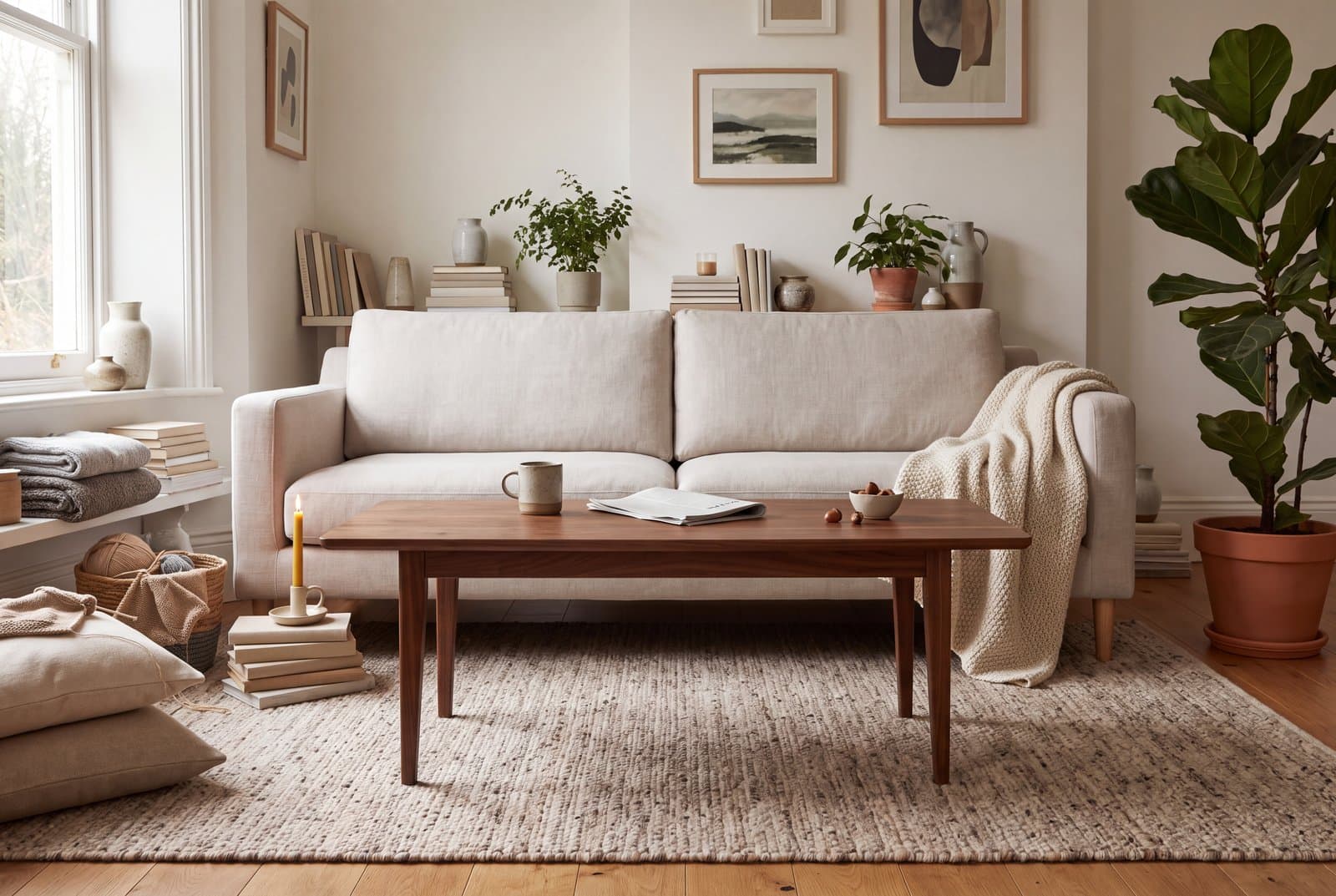
A coffee table is one of the few pieces of furniture where getting the dimensions wrong is visible from across the room and cannot be fixed by styling it better. Too tall and the room looks crowded. Too far from the sofa and nobody can reach it. Too short and it disappears.
The good news is that the numbers are simple and there are only four of them: height, length, distance from the seating, and clearance to walk. What follows is each one, where it comes from, and what to do when your room does not cooperate.
Standard Coffee Table Height
Standard coffee table height is 16 to 18 inches, measured from the floor to the top surface. Most tables sold today sit at 17 or 18 inches.
That range is not arbitrary. It exists because it matches the seat height of a normal sofa, which is usually 17 to 19 inches. A table at the same height as the seat you are sitting on is the height your hand naturally falls to.
Older and more traditional tables run slightly higher, around 18 to 20 inches. Mid century designs run lower, often 14 to 16, which is part of why mid century modern rooms read as more horizontal than others.
The Rule That Beats the Standard
Ignore the standard if it conflicts with this: match the height of your sofa seat, or go up to two inches below it.
Sit on your sofa and measure from the floor to the top of the seat cushion with your weight on it, because cushions compress and the unweighted number is misleading by an inch or more. That figure is your target.
Level with the seat is the safest choice and works in almost every room. Slightly below reads as more relaxed and more modern. Above the seat height is the one to avoid: a table taller than the surface you are sitting on feels like it is in the way, and it is the single most common coffee table mistake.
If your sofa is unusually low, which many contemporary and mid century sofas are, you need a lower table than the shop standard rather than the one that looks right on the showroom floor.
What Length to Buy
Aim for roughly two thirds the length of your sofa.
A 84 inch sofa wants a table around 56 inches. A 72 inch sofa wants around 48. This proportion is what makes the arrangement look deliberate rather than accidental, and it is the second thing people get wrong after height.
Going shorter than half the sofa length makes the table look lost. Going the full length of the sofa makes the seating area feel blocked, and it usually breaks the walking clearance covered below.
Depth matters less and is more forgiving. Somewhere between 18 and 30 inches suits most rooms, with deeper tables suiting deeper sofas.
How Far From the Sofa
Leave 14 to 18 inches between the edge of the sofa and the edge of the table.
That gap is doing two jobs at once. It is close enough that you can reach a cup without standing up or leaning uncomfortably, and it is wide enough to walk through to reach a seat in the middle of the sofa.
Sixteen inches is the number to use if you do not want to think about it. Below 12 inches the gap stops being usable as a route. Above 20 inches you have to stand up to reach your own drink, which people discover only after living with it.
Walking Clearance Around the Table
Leave at least 30 inches between the table and any other furniture or wall on the sides you actually walk past.
This is the measurement most often sacrificed in a small room, and it is the one that makes a room feel cramped rather than cozy. If the choice is between a table that hits the proportion rule and one that preserves the walkway, keep the walkway and buy the smaller table.
In a small room, a round table helps here more than any other change, which is the next section.
Round, Rectangular, Square or Oval
Shape is a functional decision before it is an aesthetic one.
Rectangular suits a standard sofa facing a wall or a television, which is most living rooms. It is the default for a reason.
Round is the right answer in a small room, in a room with a tight walkway, or in a household with small children. With no corners it takes up less usable floor than its diameter suggests, and you can pass it closely without catching a hip. A round table also works well against a curved or L-shaped seating arrangement.
Oval does what round does while suiting a longer sofa, and it is the most forgiving shape overall.
Square suits a sectional or two sofas facing each other, where the seating surrounds the table on more than one side. In front of a single sofa a square table usually looks under-scaled.
Coffee Table for a Sectional
A sectional changes the geometry, because you are no longer working against one straight edge.
Measure the inside of the L rather than the length of the longest side, and aim for a table around two thirds of the shorter run. Square and round tables both work here where a long rectangle usually does not, because the table has to be reachable from two directions.
Keep the same 14 to 18 inch gap from both faces of the sectional. That often means a smaller table than the room appears to have space for, and the alternative, sliding a large table against one arm, leaves half the seating with nothing in reach.
Small Living Rooms
In a small room the coffee table is the piece most worth reconsidering entirely.
Options that work better than a scaled-down rectangle: a round table, a pair of small nesting tables that separate when needed, an upholstered ottoman with a tray, or two matching side tables used together. Each of these gives you the surface without the fixed footprint.
If you keep a conventional table, prioritize the 30 inch walkway over the two-thirds proportion, and choose a table with visible legs and no solid base. Seeing the floor underneath makes a small room read as larger, which is the same principle that makes mid century modern furniture suit small spaces.
When the Sofa Is Unusually Tall or Low
Two common situations the standard does not cover.
A tall traditional sofa, with a seat at 20 or 21 inches, wants a table at 19 or 20, which is above the retail standard. Look at side tables and end tables, which are made taller, or at traditional tables described as cocktail height.
A very low modern sofa, with a seat at 15 or 16 inches, wants a table around 14 to 16. Mid century and Japanese-influenced designs cover this range, and a japandi style table will usually sit lower than a mainstream one.
Height Relative to the Rug
A small detail that changes how the arrangement reads.
If the rug runs under both the sofa and the table, which is the arrangement most rooms want, the table height is measured from the rug rather than from the floor. A thick pile rug can raise the table by half an inch to an inch, which is enough to push a level table above the seat line.
If you are ordering both, measure with the rug in mind rather than after it arrives.
Materials, and What They Cost You in Practice
Material changes the usable dimensions more than it appears to, which is why it belongs in a sizing guide.
Solid wood is the most forgiving. It takes marks, it can be sanded, and a wooden top at the right height suits almost any room. It is also the material most likely to be available in non-standard heights, because small makers work in wood.
Glass makes a table visually disappear, which is genuinely useful in a small room: a glass top at 18 inches reads as lower than a solid one at 16. The costs are fingerprints, and a hard edge at shin height that is invisible to guests and to children.
Stone and marble are heavy enough that the table becomes permanent, which matters if you rearrange. They also usually come on a solid base rather than legs, so they consume more visual floor than their footprint suggests.
Upholstered ottomans used as tables sit lower than a hard table would, typically 14 to 17 inches, and they compress. If you are using one as a table, buy a tray, and measure the height with weight on it.
Height and Clearance for a Television
One more relationship worth checking if the room has a television.
A coffee table sitting between the sofa and a wall-mounted screen should not break the sight line, which it will not at any standard height. But a table with a tall centerpiece, a lamp or a stack of books can, and the threshold is lower than people expect when the screen is mounted low.
The practical check: sit down, look at the bottom third of the screen, and see what crosses it. If the table's contents do, the fix is a lower arrangement rather than a lower table.
The Mistakes Worth Naming
Four failures cover most of them.
Buying the table before the sofa. The sofa sets the height and the length the table has to answer to, and a table bought first is a guess. If you already own the table, buy a sofa whose seat is level with it or slightly above.
Choosing by top surface rather than by base. A solid plinth base of the same dimensions takes up far more visual room than four legs, and in a small space that difference is the whole outcome.
Ignoring the compressed seat height. Measure with your weight on the cushion.
Filling it. A coffee table needs usable clear surface, and the styled arrangements in reference photography usually leave two thirds of the top empty. That emptiness is not an oversight.
Quick Reference
The numbers in one place.
- Height: 16 to 18 inches standard, or level with your compressed sofa seat height, up to 2 inches below it
- Length: about two thirds the length of the sofa
- Depth: 18 to 30 inches
- Distance from sofa: 14 to 18 inches, 16 if you want one number
- Walking clearance: 30 inches minimum on the routes you use
- Sectional: measure the shorter run, prefer square or round
If you are still choosing the sofa and the table together and want a direction to shop in first, our style quiz takes about three minutes and returns a profile with a palette and a material direction attached, which narrows the field considerably before you start comparing dimensions.
Not sure where to start?
Take the style quiz and get a design profile you can actually furnish against. About three minutes.
Take the Find Your Room