
Japandi Style: What It Is, and How It Works Room by Room
Japandi is the overlap between Japanese restraint and Scandinavian warmth. Here is what defines it, what it costs to get wrong, and how it lands in each room of a house.
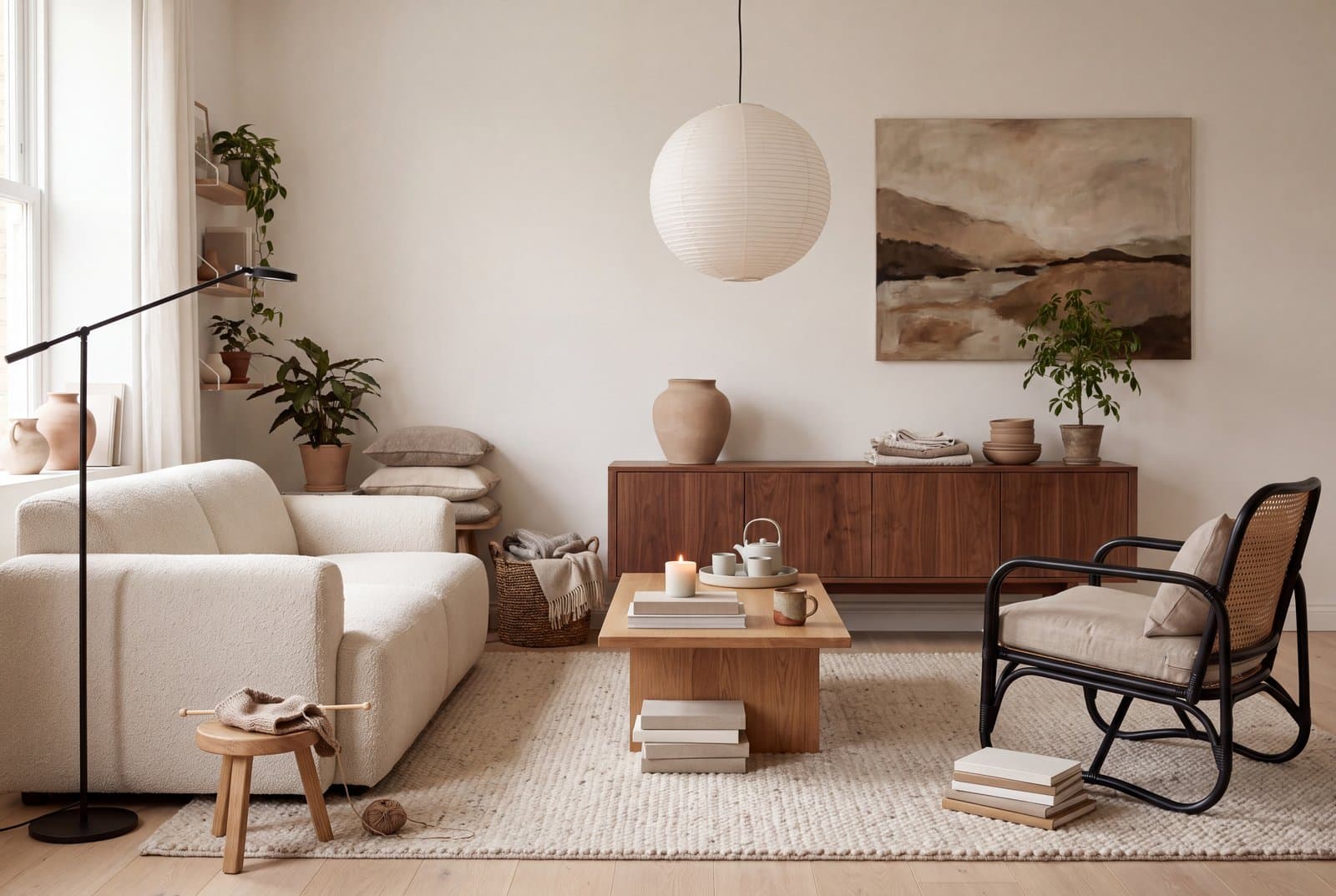
Japandi is what happens when Japanese interiors and Scandinavian interiors are asked to agree with each other. They agree more than you would expect. Both were built around long dark winters, small homes, expensive materials used sparingly, and a dislike of clutter that is practical before it is aesthetic. Japandi is the overlap, and the overlap is unusually easy to live in.
It is also the interior style most often described badly. Most of what circulates under the name is a beige room with one plant in it. That is not the style, it is the style with everything interesting removed. What follows is the actual grammar of it, and then how the grammar plays out in each room you would have to furnish.
What Japandi Style Actually Is
Japandi is a hybrid of Japanese and Scandinavian design that keeps the warmth of one and the discipline of the other.
From the Japanese side it takes negative space treated as a material in its own right, low horizontal lines, natural finishes left visibly natural, and the idea that an object should be worth looking at before it is allowed into the room. From the Scandinavian side it takes light woods, soft textiles, functional furniture that does not announce itself, and a tolerance for comfort that Japanese minimalism does not always allow.
The practical consequence is that Japandi rooms hold fewer things than most rooms, and the things they hold are better. That trade is the whole style. If you are not prepared to make it, you will end up with a Scandinavian room, which is a perfectly good outcome, just a different one.
Three tests tell you whether a room is genuinely Japandi rather than beige-adjacent:
- Is there deliberate emptiness? Not a gap where furniture has not arrived yet. A stretch of wall, floor or surface that is empty because emptiness is doing work there.
- Are the materials honest? Solid wood that reads as wood, linen that creases, ceramics with visible throwing marks, paper, rattan, wool. Not printed wood grain and not high-gloss anything.
- Is the palette warm-neutral rather than gray? Japandi lives in oatmeal, clay, warm white, oak, black. Cool gray is the single most common thing that turns the look cold and flat.
The Rules Japandi Interior Design Runs On
Four constraints do almost all the work.
A palette of five, and one of them is black. Warm white or oatmeal on the walls. A light wood, usually oak or ash. A darker grounding tone, walnut or charcoal. One muted natural color, clay, sage, or a soft ink blue. And black, in small quantities, on legs, frames, handles and lamp arms. The black is not optional. It is what stops the room reading as a bland beige box, and it is the element most often left out.
Low horizontal lines. Sofas sit lower than average. Beds are platform-style or close to it. Sideboards are long rather than tall. This is the most reliably Japanese element and it is the one that makes a photograph of a room read as Japandi at a glance.
Texture instead of pattern. Almost no pattern. Instead, bouclé against linen against oak against a wool rug against unglazed ceramic. When you remove pattern and color from a room, texture is the only variable left carrying interest, so it has to be doing more than usual.
One focal object per surface, and empty space around it. A single ceramic vessel on a sideboard, not a vignette of nine things. This is the rule people find hardest, because it feels like an unfinished room until you have lived in it for a week.
Japandi Living Room
The Japandi living room is the room the style was designed for, and the one where the low-line rule matters most.
Start with a low, deep sofa in a warm neutral, oatmeal, greige, or undyed bouclé. Avoid high backs and avoid anything with visible chrome. Ground it on a wool or jute rug that is large enough for the front legs of every seat to sit on it, which is the single most common proportion mistake in any style and is more visible here because there is less else to look at.
The coffee table should be solid wood, low, and either a simple rectangle or a soft organic shape. Pair it with one accent chair that contrasts rather than matches: a black-framed lounge chair, or a rattan and wood piece. Contrast is how a restrained room avoids looking like a showroom set.
Lighting is where most Japandi living rooms fail. Overhead light alone will flatten the whole scheme. You want a paper or linen shade pendant, a floor lamp with a slim black arm, and a table lamp on the sideboard, so the room can be lit at three different heights.
For a Japandi living room, keep the surfaces clear. One book, one vessel, one plant. That is a complete arrangement, not a starting point.
Japandi Bedroom
A Japandi bedroom is the easiest room in the style to get right, because bedrooms already want to be quiet.
The platform bed is the defining piece: low, wide, with a slim solid-wood or upholstered headboard and no footboard. Dress it in washed linen in warm white, oatmeal or clay. Linen is worth the cost here because its creasing is the point; crisp cotton reads as hotel rather than home and works against the style.
Flank it with two small wood nightstands, ideally with a visible grain and no handles or with small black pulls. A single low bench at the foot of the bed adds a horizontal line and somewhere to put things, which is the only piece of furniture in the room doing two jobs.
Keep the walls almost bare. One large piece of art or one grouping of two, hung lower than instinct suggests so it relates to the bed rather than floating above it. Blackout linen curtains hung close to the ceiling and running to the floor will do more for a Japandi bedroom than any object you can put in it.
If the room is small, the low bed helps you more than it does in a large room: the lower the horizontal line, the more wall you can see, and visible wall reads as space.
Japandi Kitchen
A Japandi kitchen is defined by its cabinetry more than by anything you can add later, which makes it the most expensive room to convert and the one worth planning first.
Flat-slab fronts, no shaker detailing, no raised panel. Light oak or ash on the lower run, warm white or a soft clay on the uppers, or the reverse. Handleless fronts with a routed finger pull, or slim black bar handles. Japandi kitchen cabinets should read as a continuous surface, so the fewer interruptions the better.
Countertops in honed stone, warm-toned quartz, or solid timber. Avoid high-gloss and avoid heavily veined marble, which brings a pattern the style does not have room for.
Open shelving works here specifically because Japandi restricts what goes on it: a short stack of matte ceramics, a wooden board, one vessel. If you know your open shelving will fill up with packaging, use closed cabinets instead; the style does not survive visual noise at that scale.
Keep the appliances integrated where budget allows, and choose matte black or unlacquered brass for faucets rather than chrome.
Japandi Bathroom
The Japandi bathroom borrows most directly from the Japanese side, where bathing is treated as something you do slowly rather than something you get out of the way.
The elements that carry it: a deep soaking tub if the room can take one, a timber vanity with a stone or ceramic basin, matte black or brushed brass fittings, and large-format tile in a warm off-white, clay or sand. Avoid small glossy white tile with bright white grout, which will pull the room cold immediately.
Wood in a bathroom is the question everyone asks. It works if you use a species that tolerates humidity, teak, oak or ash properly sealed, and if the room ventilates. A teak duckboard on the floor by the tub is the highest-impact, lowest-commitment version of the idea.
For a Japandi small bathroom, the moves that matter are a wall-hung vanity so you can see floor underneath, one large mirror rather than a cabinet, and a single continuous tile run rather than a feature wall. Fewer horizontal breaks make a small room read longer.
Japandi Dining Room
The Japandi dining table is almost always solid wood, rectangular or a soft-cornered oval, with a visible grain and either a trestle base or slim tapered legs. Light oak is the default. A darker walnut works if the room is bright enough to carry it.
Japandi dining chairs are where the style earns its keep. Look for a low back, a woven paper cord, rattan or cane seat, and a slim frame in wood or black metal. The classic Scandinavian dining chair silhouette is already most of the way there. Chairs do not need to match the table's wood tone, and a slight mismatch reads as considered rather than sloppy.
Over the table, one pendant in paper, linen or a woven natural fiber, hung low, around 30 to 34 inches above the tabletop. A single large pendant beats three small ones in this style.
On the table itself: nothing, or one low arrangement. A runner in undyed linen if the wood needs breaking up.
Japandi Home Office
A Japandi office is a small problem because offices generate exactly the clutter the style cannot absorb.
Solve storage before you solve looks. A closed sideboard or a run of low cabinets along one wall, then a simple solid-wood desk with slim legs and no visible cable. A single task lamp with a black arm. One chair that you can actually sit in for six hours, which in practice means accepting a contemporary task chair and choosing it in black or a muted neutral rather than pretending a dining chair will do.
One shelf of books, faced neatly. One plant. Nothing on the desk at the end of the day. That last part is a habit, not a purchase, and it is what makes the room work.
Buying Japandi Furniture
There is no Japandi label to shop by, which is why this is the hardest part. What you are actually looking for is a set of attributes, and they cut across brands and price points.
What to look for:
- Solid or veneered light wood with a visible, matte grain. Not a printed finish.
- Low seat heights and long horizontal lines.
- Slim black metal or tapered wood legs.
- Undyed or muted natural textiles: linen, wool, bouclé, cotton canvas.
- Handmade or handmade-looking ceramics, rather than uniform glossy ones.
What to avoid: chrome, high gloss, tufted upholstery, ornate turned legs, cool gray, and anything with a pattern larger than a weave.
Affordable Japandi furniture is genuinely findable, and IKEA Japandi furniture is a real strategy rather than a compromise: the light-wood ranges, paper pendants and linen textiles are close enough to the grammar that they can carry a room, particularly if you spend the saved money on one good sofa and one good dining table. Japandi is forgiving about mixed price points precisely because it is strict about form. A cheap object of the right shape disappears into the scheme; an expensive object of the wrong shape does not.
Japandi homeware is where to spend your attention rather than your money: a few well-made ceramics, a good linen throw, one wooden board. In a room this sparse, the small objects are seen properly, which is both the risk and the pleasure of it.
Japandi in an Apartment or Small Space
Japandi suits a Japandi apartment better than it suits a large house, which is worth saying plainly because most of the imagery shows large houses. The layout rules in our guide to small apartment decorating apply on top of everything below.
The style was formed in small homes. Low furniture, a tight palette, honest materials and deliberate emptiness are all space-making devices before they are aesthetic ones. In a small Japandi living room, a low sofa and a wall-hung sideboard will buy you visible floor, and visible floor is the thing that makes a small room feel finished rather than crowded.
For a Japandi studio apartment, use the palette to unify rather than to zone. One wall color throughout, one wood tone throughout, and then let furniture placement do the zoning. Fighting a studio with contrasting paint makes it read as several small rooms rather than one calm one.
In a Japandi small bedroom, drop the bed height, hang the curtains high and wide, and resist the built-in wardrobe with mirrored doors. A simple wardrobe painted the wall color disappears more effectively than a reflective one.
Japandi vs Scandinavian, Minimalism and Wabi-Sabi
These four get used interchangeably and they are not the same thing.
Scandinavian is the warmer, more forgiving parent. It allows more color, more pattern, more objects, and it does not require the empty space. If Japandi feels too austere, what you actually want is Scandinavian.
Minimalism is about reduction as a goal. Japandi reduces in order to make room for material quality and warmth, which is a different motive and produces a softer result. A minimalist room can be cold on purpose. A Japandi room that is cold has failed.
Wabi-sabi is the Japanese half of Japandi taken further: it prizes age, irregularity and visible repair. Japandi tidies wabi-sabi up and adds Scandinavian comfort. If you find Japandi slightly too neat, wabi-sabi is the direction to move in.
Organic modern overlaps heavily with Japandi on materials but is more sculptural, more curved, and less restrained about scale.
Where to Start
If you are furnishing a whole home rather than styling one room, the order that works is: settle the palette, buy the two anchor pieces (sofa and dining table, or sofa and bed), then let everything else follow those. Japandi punishes a mixed-up palette more than most styles because there is nothing else going on to distract from it.
If you are not certain Japandi is the right direction, our style quiz takes about three minutes and resolves you against six defined profiles. Japandi sits closest to the Scandinavian and Modern profiles, and the result gives you a palette, materials and reference rooms concrete enough to judge a real piece of furniture against, which is more useful than a mood board.
Not sure where to start?
Take the style quiz and get a design profile you can actually furnish against. About three minutes.
Take the Style Quiz