
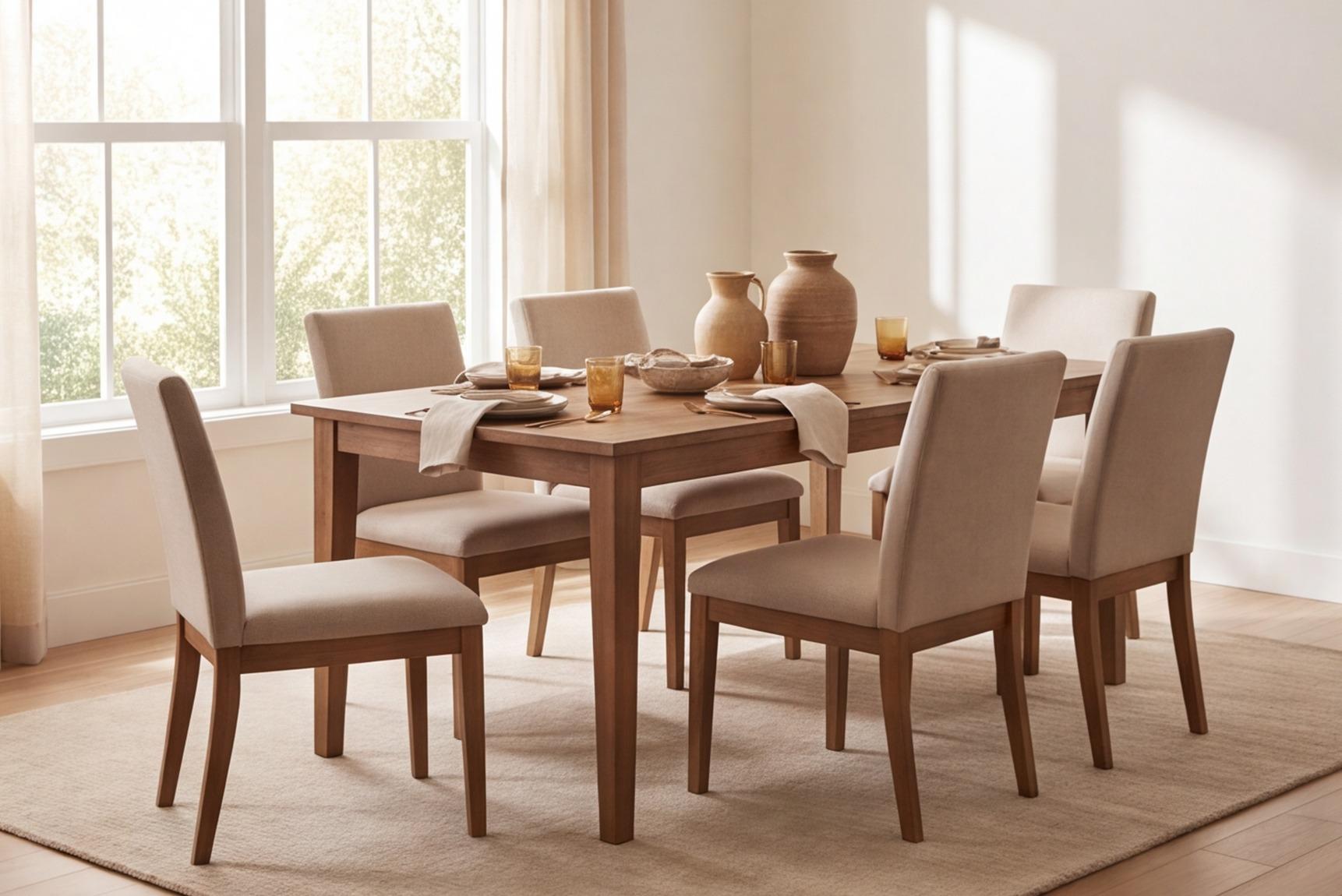
This guide sizes a dining table for 6 in the order the decisions depend on each other: table edge per diner, extra seats for guests, clearance around the table, round versus rectangle for tight rooms, and finally the rug and chair seats. One measurement feeds the next, so you can work through it with a tape measure and your own room.
How Many Inches of Table Edge Each Diner Needs
Each diner needs about 24 inches of table edge at minimum and 28 inches for comfort. Multiply by the number of seats and you have the total edge your table has to provide, which turns a seat count into a size.
The Two Numbers Behind Every Sizing Chart
According to The Spruce, each diner needs 24 inches of table edge, shoulder to shoulder. RoomSketch3D describes 24 inches as a minimum baseline, 28 inches as comfortable, and 30 or more inches as generous. The gap between 24 and 28 inches explains why two charts can give different table lengths for the same number of people.
Working Through 4, 6 and 8
Total edge is not the length of one side. A practical rectangle seats people along both long sides and sometimes at the two ends, so the edge is shared across the whole perimeter. The number of seats per long side, not the total seat count, sets how long the table has to be.
|
Seats |
Edge at 24 inches |
Edge at 28 inches |
Typical layout |
|---|---|---|---|
|
4 |
96 inches |
112 inches |
Two per long side |
|
6 |
144 inches |
168 inches |
Two per long side plus one at each end, or three per side |
|
8 |
192 inches |
224 inches |
Three per long side plus one at each end |
Choosing a Dining Table for 6 That Still Seats Guests
A rectangular table is about 60 inches long for four to six people and 78 inches for six to eight, both 36 inches wide. Households that host more people than they seat daily can choose an extending table with leaves, a leaf being a removable panel that lengthens the top, and size it at 24 inches per seat when open.
Table Length at 24 Versus 28 Inches
A six-seat rectangle usually runs 60 to 78 inches long. Divide the length by the chairs on a side to see the space each person gets: on a 72-inch rectangle, two chairs per long side (with one at each end) leave each about 36 inches, which is generous, and three per side leave 24 inches each, which works but leaves little elbow room.
The 28-inch comfort rule needs about 84 inches if you want three per side. If you rarely seat all six at once, 60 to 66 inches is a sensible daily size.
Extending Tables for Occasional Hosting
Many people seat two or four on a normal evening and six or eight twice a year. An extending table solves that without a permanently oversized top. According to Livingetc, designers recommended extendable tables for small dining rooms because they add guest capacity without taking up as much everyday floor area.
An extending table lets everyday life stay compact while holiday gatherings still get a proper seat for everyone.
Size the open table the same way as any other: 24 inches per seat with the leaves in. Closed, the same table can stay at a 60 to 72 inch footprint.
Extending tables have tradeoffs. Leaves need a closet or wall space to rest in, and the extension mechanism adds moving parts to a piece you will use every day. A table with a solid wood top and a simple drop-in leaf has fewer parts to wear than one with a pull-out slide.
Measuring the Room Around a Dining Table for 6
Size the table to the room. NKBA guidance states that 32 inches of clearance from the table edge to a wall or obstruction is enough behind seated diners when no traffic passes behind them. Where traffic does pass, allow at least 36 inches to edge past and 44 inches to walk past.
Which Clearance Number Applies to Your Room
- 32 inches: a wall or sideboard sits behind the chair and nobody walks there.
- 36 inches: someone needs to edge past a seated diner.
- 44 inches: someone needs to walk past a seated diner.
Measure each side of the room separately. A doorway side usually needs 44 inches. A blank wall side can use 32.
A Worked Example With Your Own Numbers
Take a 72-by-36-inch table. Add 32 inches on each blank-wall side and 44 inches on the side next to a hallway. The width of the room needs to be at least 36 plus 32 plus 44, or 112 inches. The length needs 72 plus 64, or 136 inches, if both ends have 32 inches.
If your room falls short by a few inches, shorten the table before you shrink the clearance.
The Painter's Tape Test
Before you buy, mark the table footprint on the floor with painter's tape. Add a second outline 24 inches beyond it for the chair pull-out zone. Then walk the routes you actually use, with a laundry basket or a tray, and see whether the tape outline blocks a door swing, a vent or a path to the kitchen. Write down three numbers before you shop: maximum table length, maximum width, and which side needs 44 inches.
Tight Nooks and Small Dining Rooms: When Round Wins
A round table with a pedestal or tripod base is usually the easiest fit for a tight nook, because chairs tuck in from any side and no corner legs get in the way. A pedestal base is a single central column. A tripod base has three angled legs that meet under the center of the top.
Why Round Works in Narrow Spaces
Soft edges also help movement. Livingetc reports that designers recommended round, oval or racetrack tables for small dining rooms because soft edges can improve navigation. In a corner nook, a round top removes the sharp corner someone brushes against, and the central base removes the four corner legs from the clearance math.
How Many Seats a Round Table Holds
The Spruce lists round-table diameters of 54 to 72 inches for six to eight seats and 44 to 54 inches for four to six seats. A 60-inch round sits inside that six-to-eight range. A diameter that large takes up a square of floor, so check your room dimensions first. A 60-inch round with 32 inches of clearance all around needs a space about 124 inches square.
Round tables trade serving reach for conversation, and they fit best where floor space is tight.
A round table seats the same number of people with less table, but each person has a wedge of edge that widens toward the rim, and the center is far to reach. It is a good fit for conversation and a poor fit for serving many large dishes.
Where a Rectangle Still Makes Sense
A rectangle is the better pick in a long, narrow room, against a wall, or when the table must double as a work surface. It also seats more people per square foot of floor when you can use both ends. If your room is square or close to it, a round table is easier to place. If it is long, a rectangle follows the room.
Sizing the Rug and Choosing Chair Seats for a Family Kitchen
A dining room rug should extend at least 24 inches beyond the table on every side, according to The Spruce, so chair legs stay on it when pulled out. That makes the rug 48 inches longer and wider than the table.
Rug Dimensions From Your Table Size
For a 72-by-36-inch table, extending the rug 24 inches past each table edge gives a rug of about 120 by 84 inches. Your own calculation is simple: table length plus 48, table width plus 48. A rug of that size usually has to be ordered at the next standard size up, so check that the rug still clears the 32, 36 or 44 inch clearance zones.
Low-Pile Polypropylene, Washable Flatweave or Wool
Polypropylene is a synthetic fiber that resists moisture and wipes clean. A low-pile version has short loops that do not trap crumbs the way a thick rug does. A washable flatweave is woven flat with no pile at all, so a dropped plate of pasta shakes out or goes in the machine.
Wool is a natural fiber with a soft hand and good insulation, and it stains more easily than synthetics. It suits a dining room used mostly by adults for occasional meals. For a household with a toddler, a low-pile or flatweave rug is the better match, and a shag rug of any fiber is a poor match because food settles deep into the pile.
Chair Seats for Everyday Meals
In a family kitchen, chairs with wood, metal or wipeable seats are easier to live with than fully upholstered ones. A solid wood seat can be wiped with a damp cloth and refinished if it scratches. A metal seat with a powder-coated finish wipes clean and does not hold crumbs. A wipeable seat has a coated or vinyl-type surface over a foam cushion.
If you keep a cat, skip leather seats, since claws mark leather. A woven or hard seat is a calmer pairing. Fine Woodworking adds that for a family, a table height of 28 to 29 inches can feel more informal and relaxed compared to the standard 30 inches, provided chair height and leg clearance permit.
For a look that pairs a solid wood top with sturdy chairs, our farmhouse dining room is a good place to see how the table, rug and seats go together.