
Look at how a renovated kitchen gets lit and you learn something about every other room. Recessed lighting, under-cabinet lighting, pendants and island lighting are rarely treated as separate decisions. Ambient light (the general glow), task light (focused light where you work) and focal light (the pendant that draws the eye) are planned alongside the counters, the island and where people stand.
That is the useful lesson for the rest of the house. Lighting shows you where a layout works and where it does not. A dark reading corner, a sofa with no lamp within reach, or a dining table lit by one ceiling fixture are layout problems that look like lighting problems.
This guide uses the same idea for every interior design mistake: most are decisions made in the wrong order. We walk through the common ones in the sequence that prevents them, then finish with a low-cost recovery order for the mistakes already in your rooms. None of them mean you have poor taste. An empty house simply asks for a hundred decisions at once.
The Interior Design Mistakes That Start Before You Buy Anything
The most expensive interior design mistakes happen before any purchase: no style direction, no plan for how rooms will be used, and buying one piece at a time with nothing connecting them. The cheapest fix is a short written brief for the house, made before you open a single shopping tab.
Why Piece-by-Piece Buying Goes Wrong
Most furniture buying is planned. Provoke Insights' Summer 2024 report found 77% of furniture purchases are pre-planned, while nearly 23% are spontaneous. The planned ones still go wrong when the plan is only a single item, such as a sofa, with no view of the room it joins.
A new homeowner often buys the first big piece in a hurry because an empty living room feels urgent. Six weeks later the rug, the side table and the lamp all have to work around a sofa chosen in isolation. That is how a house ends up with good pieces that do not belong to each other.
Define Your Style and Your Habits First
Style direction is a short list of the colors, materials and shapes you keep reaching for. Daily habits are the practical half: whether you eat at the table or the couch, whether guests stay over, whether a dog sleeps on the sofa. Habits decide fabric, size and storage, and style decides everything you see.
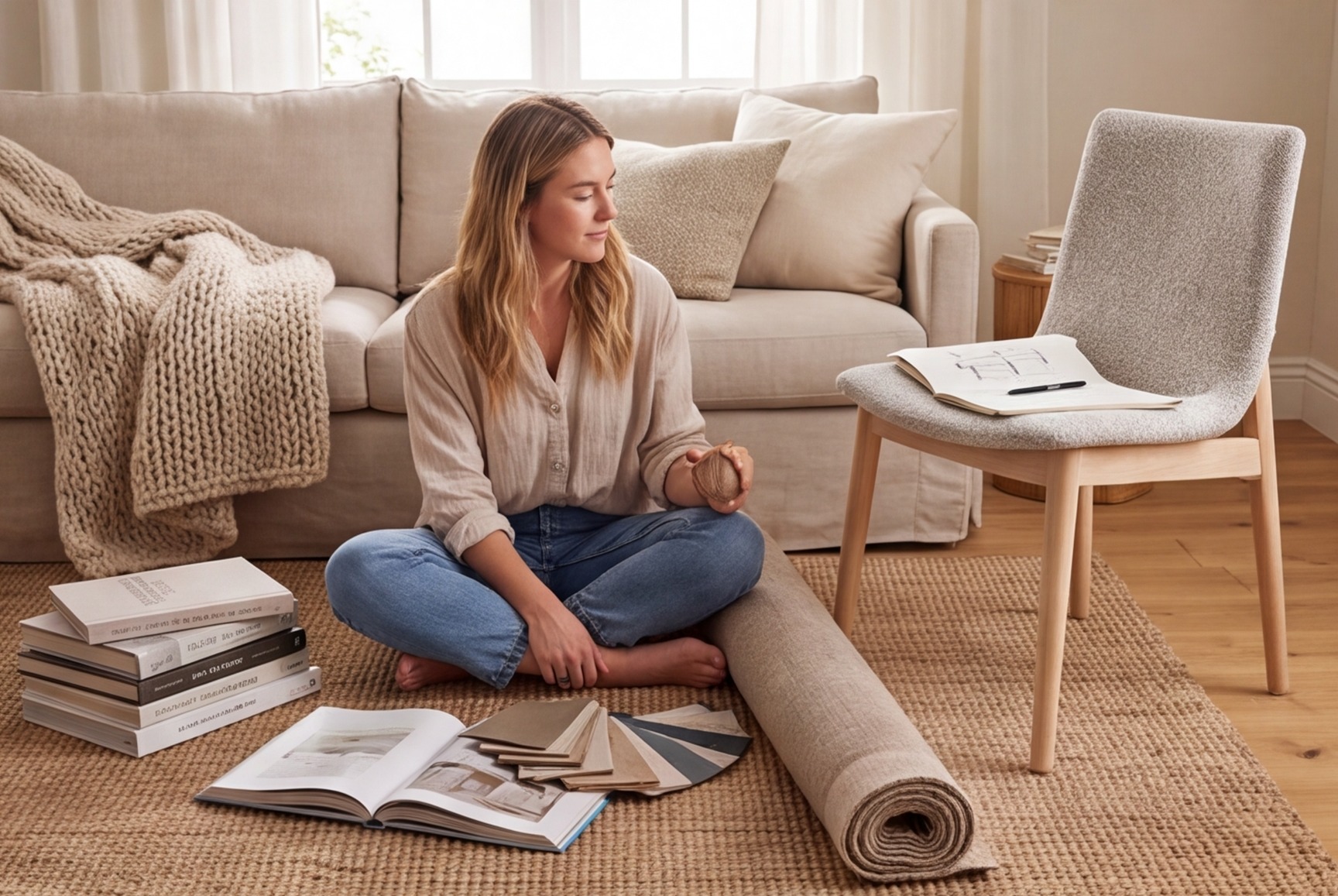
Interior designer Lauren Saab puts the order well: observe before you shop, and decide which existing pieces are worth keeping because of good lines, solid materials or sentimental value.
The Sequence That Prevents Most Regrets
- Write down your style direction and three daily habits for each room.
- Rank the rooms by how often you use them (covered in the next section).
- Measure each room and mark walkways before choosing furniture.
- Choose the largest pieces, then the rug, then lighting and accessories.
Paint belongs late in that list for most people. Fabric, rug and wood tones are harder to change than a wall color, so choose them first and pick paint to suit.
Regret rarely comes from bad taste; it comes from buying before you've decided how the rooms will be lived in.
Spending on the Wrong Rooms First: Budget Mistakes That Stall a New Home
Splitting a budget evenly across every room, or putting most of it into one showpiece, leaves the rest of the house unfinished. A better rule funds rooms by daily use, then by what blocks other work, and keeps a reserve for surprises.
Why Equal Splits and Showpieces Both Stall
An even split sounds fair, but it gives a guest room the same money as the room where you spend six hours a day. A single dramatic purchase has the opposite problem. A statement sofa leaves nothing for the bedroom, and you sleep on a mattress on the floor.
Cost anxiety is real here. Opendoor's 2023 Home Decor Report found 33% of homeowners feel intimidated by decorating costs, and 29% struggle to find decor they like within budget. The goal is to spend where it matters and wait elsewhere without guilt.
A Room Priority Framework for Cash-Flow Risk
Fund rooms in this order, adjusting for your own household:
- Bedroom: sleep affects everything else, so a bed, mattress and basic lighting come first.
- The main living space: the place you sit every evening, with a sofa, rug and two light sources.
- Kitchen and dining: a table and seating you will actually use.
- Entry and storage: a hook, a bench or a shelf that stops clutter at the door.
- Guest rooms, offices and secondary spaces: furnish these last, using what you already own.
Moving costs and new-house surprises drain savings quickly, so protect some cash before spending on any room. Budgets slip often. Angi's 2024 report found 1 in 5 homeowners adjusted their budget for rising labor costs, and another 1 in 5 hit unexpected material costs. Furnishing is gentler than renovation, but the pattern holds, so hold back a reserve.
Where Spending More Pays Off
Quality is worth the money on pieces that take daily wear. CIN research found about 56% of consumers plan to pay more for quality when buying a sofa or sectional. One designer interviewed by House Beautiful said cheap bedside tables felt like a small win at the time but meant replacing them again and again. Spend on the sofa, mattress and dining chairs. Save on frames, lamps and decor.
Scale, Layout, and Lighting: The Interior Design Mistakes That Make Rooms Feel Off
Scale is how big a piece is relative to the room and to the pieces around it. When a room feels off, the cause is usually an oversized sofa, a rug that is too small, art hung too high, or a single overhead light. Each has a measurable fix.
Furniture Size and Walkways
Designer Peggy Haddad calls a sectional or sofa that does not fit the space the biggest offender in living rooms. To check, tape the footprint on the floor with painter's tape and live with it for a day.
Tape the footprint on the floor before you buy; a piece that fits on paper can still swallow a room.
Pushing every piece against the wall is a related habit that feels safe but makes a room look like a waiting area. Designer Jennifer Cataldo starts by pulling pieces away from walls and re-centering seating around a focal point to improve flow. Stivale Graffam suggests floating the sofa, angling chairs toward each other and even shifting a rug a few inches to make a room feel considered.
Rug Size and Art Height
A rug that is too small makes furniture look like it is floating. In a living room, at least the front legs of every seat should rest on the rug, which usually means 8 by 10 feet for a standard sofa arrangement. In a dining room, the rug should extend about 24 inches past the table edge so chairs stay on it when pulled out. Haddad says the rug dictates the palette, the style and the visual boundaries of the room, so choose it early.
For art, the center of the piece should sit at roughly 57 inches from the floor, which is average eye level. Over a sofa, hang it about 6 to 8 inches above the back, and keep it about two thirds the sofa's width.
People often ask about the 3-5-7 rule, which is a styling guideline for grouping objects in odd numbers so arrangements look natural. It is a useful habit for shelves and tables, though it does not replace measuring.
Lighting as a Test of Your Layout
This is where the kitchen example earns its place. A room lit by one ceiling fixture has no focal point, no task light and flat ambient light, so it looks bad however good the furniture is. Apartment Therapy's 2024 Designer Survey found 96% of interior designers prefer warm lighting over cool, so look for bulbs around 2700K.
|
Layer |
Job |
Living room example |
Kitchen example |
|---|---|---|---|
|
Ambient |
General glow |
Ceiling fixture on a dimmer |
Recessed lights |
|
Task |
Light where you work or read |
Floor lamp beside the reading chair |
Under-cabinet lights |
|
Focal |
Draws the eye |
Lamp or picture light near art |
Pendants over the island |
If a seat has no task light within reach, the layout needs a table or lamp there. If a corner stays dark, it is probably the wrong place for furniture.
Why Matching Everything Still Doesn't Feel Like Home
A fully matched set looks organized but flat, while a house of unrelated purchases feels scattered. Cohesion comes from a controlled mix: a limited palette, a few repeated materials and room for pieces that carry personal history.
The Problem With Perfect Matches
Matched sets are tempting when you are furnishing an entire house, because they remove decisions. The tradeoff is a room that looks catalog-perfect and says little about the people living in it. The Spruce has covered how designers now treat matching furniture as optional, and Katherine Moore of Murphy & Moore recommends approaching furniture the way you build an outfit: pieces that work well together without being identical.

Taste also splits down the middle. CIN's style research found 48% of consumers prefer a consistent style theme throughout the home, while 52% prefer varying styles by room. Neither is wrong. Both need a thread.
A Simple Way to Build the Thread
- Choose three or four colors for the whole house and repeat them in different amounts.
- Repeat two or three materials, such as warm wood, linen and black metal, across rooms.
- Vary shapes and finishes so no two pieces compete.
- Keep one or two items per room that are vintage, inherited or handmade.
Designer Kim Dee describes a curated space as lived-in and personal, built by mixing materials, finishes and even styles, like a sleek sofa with a vintage armchair. A home that grows slowly often becomes more personal and more timeless, as designer Nina Lichtenstein notes. A home looks tacky rarely because of any one style, and more often because of too many unrelated items competing with no shared palette or material. Edit, and repeat what you love.
How to Fix Interior Design Mistakes You've Already Made
Most mistakes can be fixed cheaply if you work in order of reversibility: rearrange and edit first, swap small items second, and replace large furniture last, only after you have tested the room in daily use.
The Reversibility Ladder
- Edit. Remove anything that is only filling space, and clear surfaces. This costs nothing.
- Rearrange. Pull furniture off the walls, re-center seating, and move lamps to where you sit. Opendoor's 2023 Home Decor Report found nearly 49% of homeowners use this low-cost fix, and The Spruce shows how far a room can change without buying anything.
- Swap small items. Change bulbs to warm white, add a lamp, hang art at eye level, or replace a too-small rug with a larger one.
- Live with it for a few weeks. Notice what still bothers you.
- Replace large pieces last, and only the ones that still fail after steps one to four.
A Quick Self-Audit for a Room That Feels Off
Walk in and check four things. Is there a path through the room wide enough to walk without turning sideways? Do the front legs of seating sit on the rug? Is there light at every seat, from more than one height? Does the room repeat at least two colors or materials from the rest of the house? A no on any of these tells you which rung of the ladder to start on.
Preventing Repeats
Repeat mistakes usually trace back to missing direction, not missing money. Having a written style profile, a room priority order and a budget with a reserve turns each purchase into a quick check instead of a fresh guess. If you want that in one place, the free style quiz at Cradle & Hearth takes about three minutes and produces a named style profile with room priorities, budget and timeline attached. It needs no account, and the advice above works just as well without it.
Furnishing a whole house is slow, and that is fine. Start with the bedroom and the room you sit in most, get the light and the walkways right, and let the rest follow.