
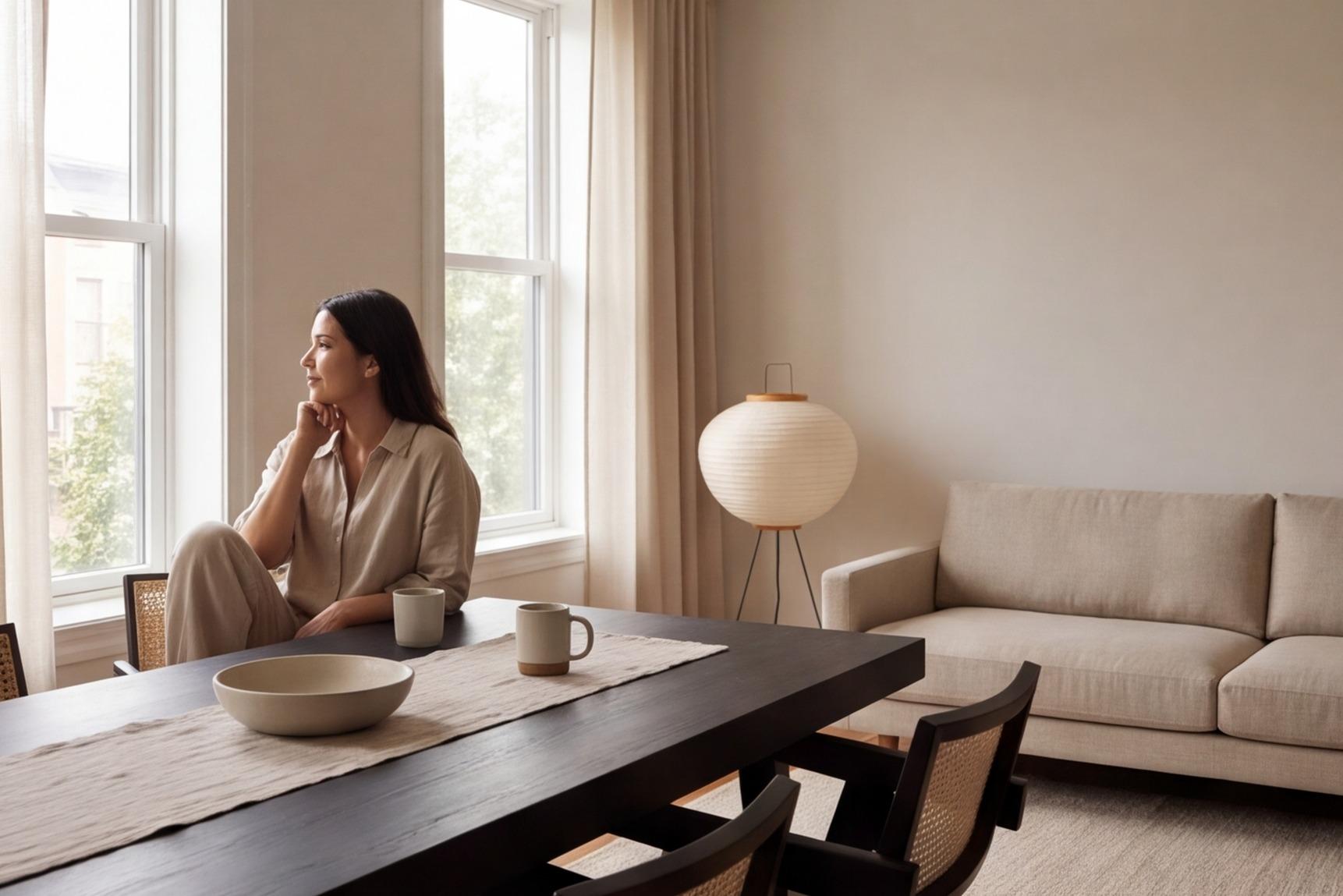
Japandi is a blend of Japanese and Scandinavian design, and the version most people saw online is already changing. This guide explains the style's roots, separates it from neighboring looks, gives seven rules with measurements, adapts it to difficult spaces, and ends with a room-by-room buying order.
The glossy, hyper-polished rooms that spread between 2020 and 2023 are being corrected. According to DecorQuarter, 2026 brings a "Wabi" variant, where visible wear, organic texture and artisan imperfection replace hyper-polished surfaces, and mushroom tones are displacing greige as the neutral anchor. Oiled wood that darkens, linen that softens and a bowl with a slightly uneven glaze all gain value with use. That is good news if you are furnishing a house slowly, because the style rewards time instead of demanding a finished room on day one.
What the style means and where its two halves come from
The term means a fusion of Scandinavian functionalism and Japanese minimalism. According to the Danish Architecture Center (DAC), the term first emerged in the mid-2010s, and the style emphasizes calm spaces, a few carefully chosen high-quality pieces, and natural materials in a warm, muted palette.
The short version:
- Function comes first, and every piece earns its place.
- Natural materials such as wood, linen, clay and stone do most of the decorating.
- Color stays muted and warm.
- Craft matters more than ornament.
- Empty space is treated as part of the design.
Why the two traditions fit together
The pairing is less random than it looks. Frederik Werner and Jonas Bjerre-Poulsen of Norm Architects in Copenhagen describe shared qualities, including respect for natural materials, a fondness for muted palettes and a humble approach to expression through genuine craftsmanship. Two cultures arrived at similar answers to the same question: how do you make a home feel settled without filling it?
Wabi-sabi, ma and hygge in plain terms
Three ideas sit underneath the look. Wabi-sabi is the Japanese practice of finding beauty in imperfection. Ma is the Japanese sense of meaningful empty space, the pause between objects. Hygge is the Nordic word for the homely feeling of coziness.
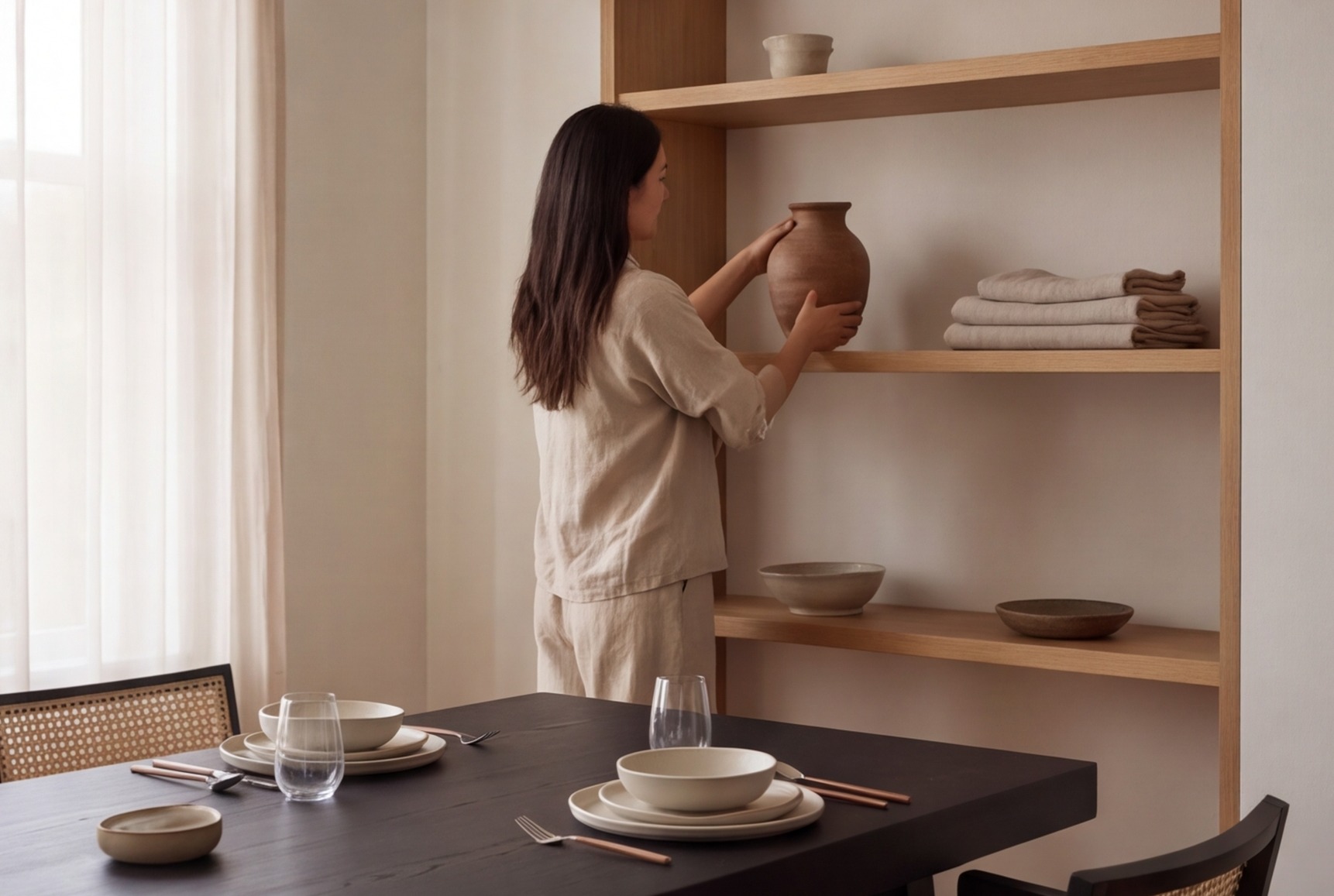
According to BBC, hygge and wabi-sabi harmonize to create a stress-free atmosphere. Hygge supplies the warmth, wabi-sabi supplies the acceptance of wear, and ma supplies the restraint that keeps a warm room from becoming a crowded one.
Japandi vs wabi-sabi, minimalism, and Scandinavian design
The style sits between three neighbors. It is warmer than plain minimalism, more restrained and earthier than pure Scandinavian design, and a decor style, whereas wabi-sabi is a philosophy of imperfection that this look borrows from. Knowing the differences helps you tell a calm room from one that is merely bare or beige.
|
Style |
What it is |
How it differs from japandi |
|---|---|---|
|
Plain minimalism |
Reduction for its own sake, often cool and hard-edged |
Japandi keeps warmth, texture and a few handmade pieces |
|
Scandinavian design |
Bright, light-wood, cozy, functional |
Scandi uses more white, pattern and layered coziness; this style is quieter, with deeper earth tones and lower furniture |
|
Wabi-sabi |
A philosophy of beauty in imperfection and impermanence |
It guides the style, but it has no required furniture, palette or layout |
|
Japandi |
Scandinavian function plus Japanese restraint |
A usable decor style with repeatable rules |
Japandi vs wabi-sabi in one sentence
Wabi-sabi is a way of seeing, and this style is a way of furnishing. You can practice wabi-sabi in a cluttered farmhouse kitchen with chipped plates. The decor style asks for specific choices: low furniture, natural wood, a muted palette and open floor.
Interest in the philosophy is rising alongside the style. The Straits Times reports that in Singapore, search interest in wabi-sabi has eclipsed search interest in the style itself, and the shift is described as moving from visual coherence in 2025 to emotional coherence in 2026.
A quick self-check for your room
A room reads as part of this style when it has warmth, texture and at least one object with visible craft. If it has white walls, one grey sofa and nothing handmade, it is minimalism. If every shelf is full of cozy layers and bright white painted wood, it leans Scandinavian. If it is gently worn and everything is imperfect but nothing is arranged, it may be wabi-sabi without the structure.
A calm room needs warmth, texture and one handmade object; without those, it's just bare or beige.
Seven rules with colors, woods, and proportions
The seven rules are a restrained earthy palette, low-profile furniture, natural wood, organic textures, one handmade piece per room, warm light and deliberate empty space. Each one has a measurable version, which makes the style easier to follow than a mood board.
- Keep the palette restrained and earthy. A 60-30-10 split works well. According to GENROOM LLP, that means 60% warm whites and parchment on walls and large surfaces, 30% mid-tones such as sand, greige and clay on furniture and cabinetry, and 10% dark accents such as charcoal, moss green and rust ochre.
- Choose low-profile furniture. Per Curatedbyhower, sofa seats sit around 15-17 inches (38-43 cm) instead of the usual 18-19 inches (46-48 cm), coffee tables are 14-16 inches tall, and platform beds have a mattress top of roughly 16-20 inches. The lower lines calm sightlines and make ceilings feel higher.
- Use natural wood, and oil it. Light oak, ash and walnut are the usual choices. An oiled finish ages visibly and can be refreshed, while heavy lacquer chips and cannot be repaired the same way.
- Layer organic textures. Linen, wool, jute, rough plaster and unglazed clay add depth without color.
- Give each room one handmade piece. A hand-thrown vase, a woven lamp shade or a joinery-built table is enough. One is a focal point, five is a collection.
- Keep light warm. Circadian-style adjustable LEDs between 3000K and 4000K, a range cited by The Decor Mag in connection with the WELL Building Standard, keep wood and linen looking rich. Cool white bulbs flatten both.
- Leave deliberate empty space. This is ma in practice. Clear one third of a shelf, one wall or one corner on purpose, and the objects around it read better.
Where color still fits
The 10% accent share is where moss, rust or charcoal belong, so the style handles color if it stays muted and earthy. Pottery, a single cushion or a framed print can carry it without breaking the calm.
Making it work in small, dark, or lived-in homes
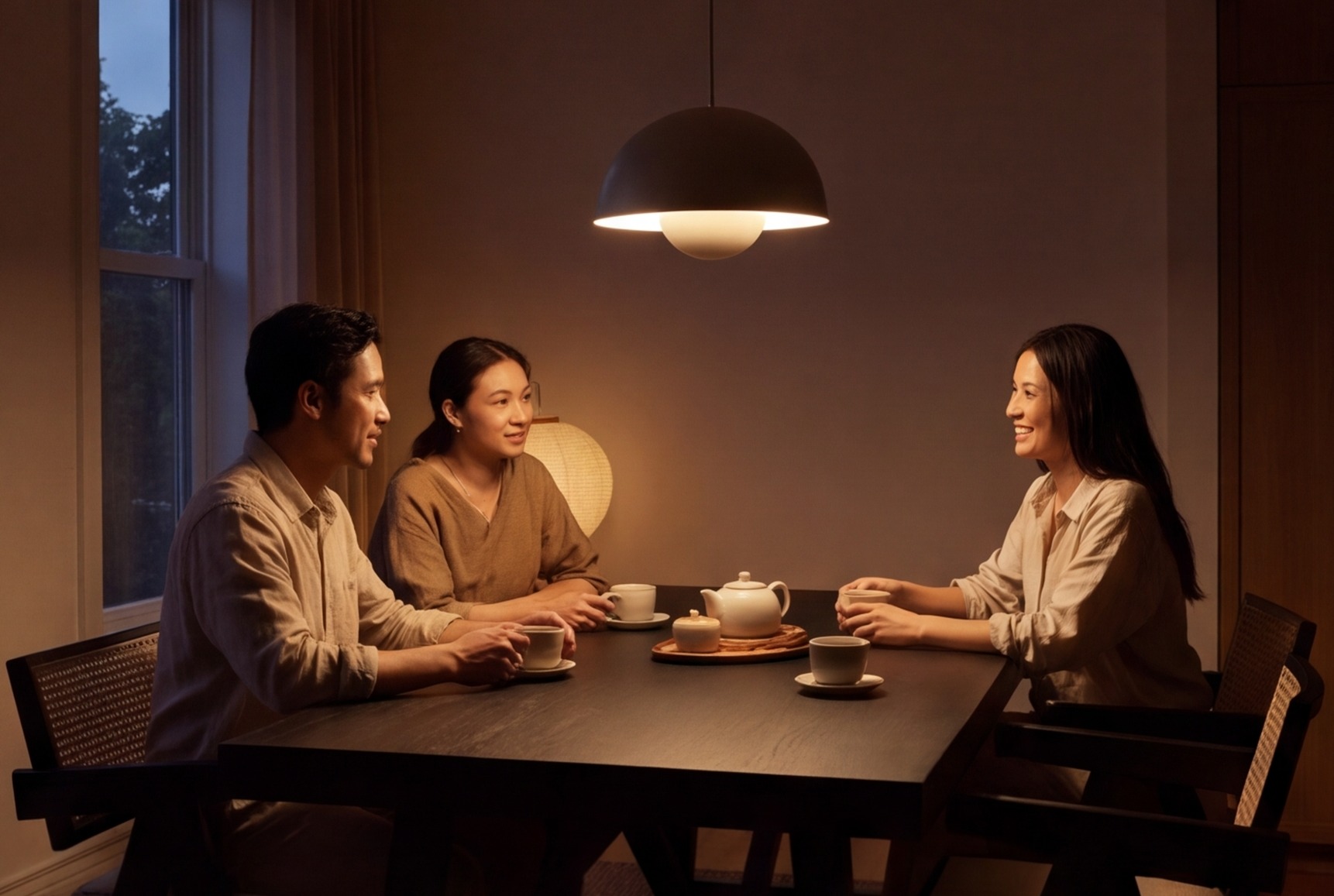
The style adapts well to small, dark and busy homes because it already relies on low furniture, closed storage and warm light. The adjustments are practical: choose multi-use pieces in small rooms, rely on lamps in dark ones, and pick durable natural-looking materials where kids and pets live.
Small apartments and open plans
In a 260-325 sq ft studio, a low-profile sofa with hidden storage becomes seating, guest bed and organizational hub, as ERYLIN notes. Sliding panels inspired by shoji screens can hide clutter, and in an open plan, a rug, a low shelf or a change of wood tone can mark zones without walls. Keep the 60% light base unbroken so the space reads as one calm room.
Dark rooms and north-facing light
Rooms with little daylight should not be painted stark white to compensate, because that tends to look grey. Choose warm parchment on walls, add layered lamps at 3000K, and use pale oak and linen to bounce what light there is. In bright south-facing rooms, deeper clay and mushroom tones feel richer and less washed out.
Kids, pets and everyday mess
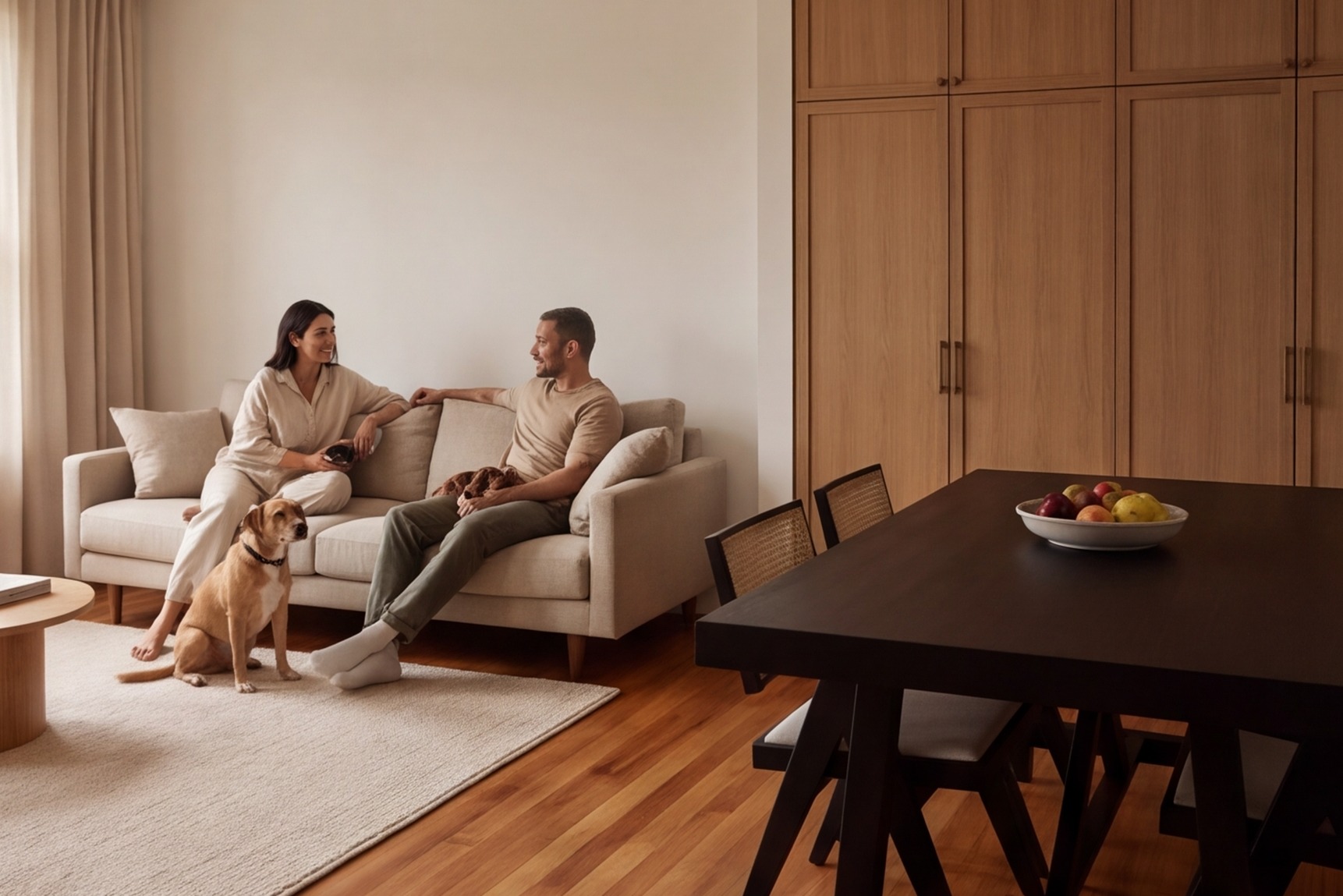
Durable materials suit this style well. Pet Friendly House points to light oak cabinetry that hides coats, shoes, leashes and grooming supplies behind clean fronts, and to durable stone or matte tile floors that handle muddy paws and wet shoes. For sofas, performance fabrics that look like linen are a sensible compromise, and closed storage at floor level gives children a place to put things back.
A lived-in home in this style is easier to maintain than a staged one. Wear on oiled wood and a softened linen cover belong to the style, so a scratch is part of the finish. The bathroom is a good place to see this calm surface approach, and our bathroom room design in this style uses a soft plaster surface with just three wood pieces: a vanity, a wall cabinet and a mirror.
Furnishing room by room on a real budget
Start with the rooms you use daily, put your money into one anchor piece in each, and fill the rest with simple swaps. A new home does not need every room finished at once, and this style is forgiving of a slow build because empty space is part of the look.
A buying order that holds up
RenderedbyDesign recommends this sequence: linen and organic textiles first, then ceramics, then a living plant, and only then platform furniture and a hidden storage system. Its entry path for the textile, ceramic and plant layers comes to $472, spent before any furniture. The logic is sound. Textiles and pots are cheap to change, and they show you which tones you actually like.
Japandi rewards patience: buy in a deliberate order, and let wood, linen and clay earn their character over time.
- Living room. Spend on the sofa, the piece you sit on most. Low, oak-framed, with a neutral linen-look cover.
- Bedroom. A platform bed and good bedding. Add warm bedside lamps instead of a full furniture set.
- Kitchen and dining. Keep what you have and add a table in light wood or walnut later. Ceramics and wooden utensils do the styling.
- Entry, bar corner and secondary rooms. Last. A walnut bar table, two stools and a single pendant can turn an overlooked alcove into a destination, as in our bar room design in this style.
The renter-friendly path
Renters can follow the same order with reversible tools. Tension rods and no-drill shelving give flexibility, and neutral Command hooks support light hanging storage without damaging walls, according to ERYLIN. The caution from RenderedbyDesign is worth heeding: reversibility is not permission to buy disposable furniture, so spend properly on four or five pieces that will work in the next place.
Why the style should last
The style's basis is function and natural materials. Research published through Cambridge University Press on furniture longevity names technical, functional and emotional durability, and includes aesthetic durability and biophilic qualities under the emotional kind. Trends will change the surface, but oiled wood, a low sofa and a handmade bowl will not date quickly.