
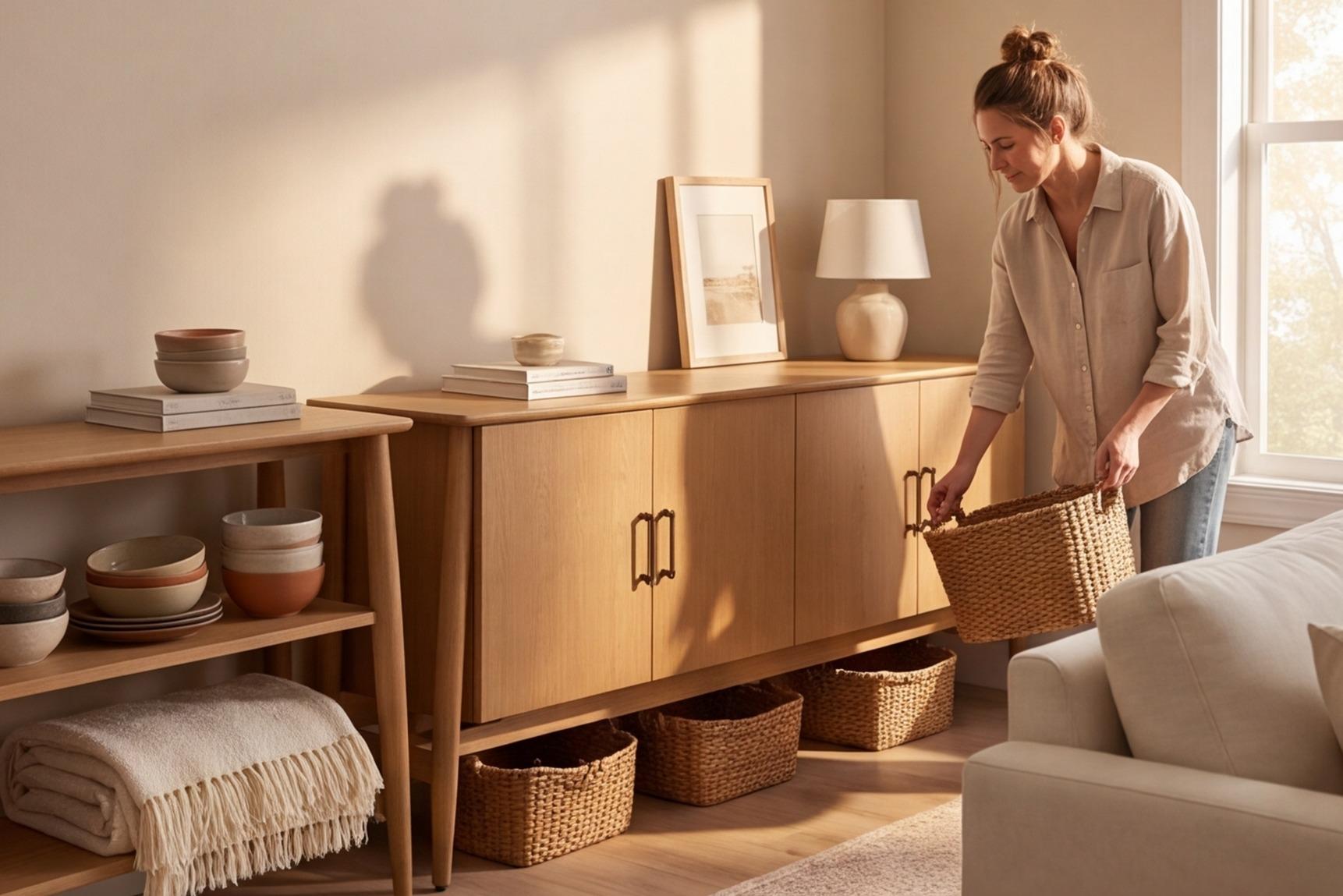
Good living room storage starts with reach: the things you use daily belong where your hand lands without bending or stretching. This guide follows the order that works in an empty or half-furnished house. Audit what you own, split open and closed storage, fit pieces to your layout, solve toys and media gear, then buy in budget order.
Sort What You Need to Store Before You Buy Anything
Sort every item by how often you touch it, because frequency decides the storage type, the quantity and the height. Daily items go at easy reach, weekly items go higher or lower, and rarely used items belong in closed storage or another room entirely.
Run a Ten-Minute Audit
Gather what lives, or will live, in the room: remotes, media gear, books, throws, toys, chargers, paperwork, board games. Put each item into one of three piles: daily, weekly, or occasional. Be honest about the occasional pile, since that is where most overflow comes from.
The numbers explain why this step comes first. According to YouGov, 46% of Americans cite not enough storage space as a top organization challenge, while 41% say they simply have too many belongings. Those are two different problems, and only one of them is solved by buying furniture.
Match Each Pile to a Height
Think of the zone between your hip and your shoulder as prime real estate. Remotes, current books and the throw you reach for every evening belong there. Heavy items go low, where they are stable and easy to lift. Seasonal or occasional things go up high or into lidded boxes.
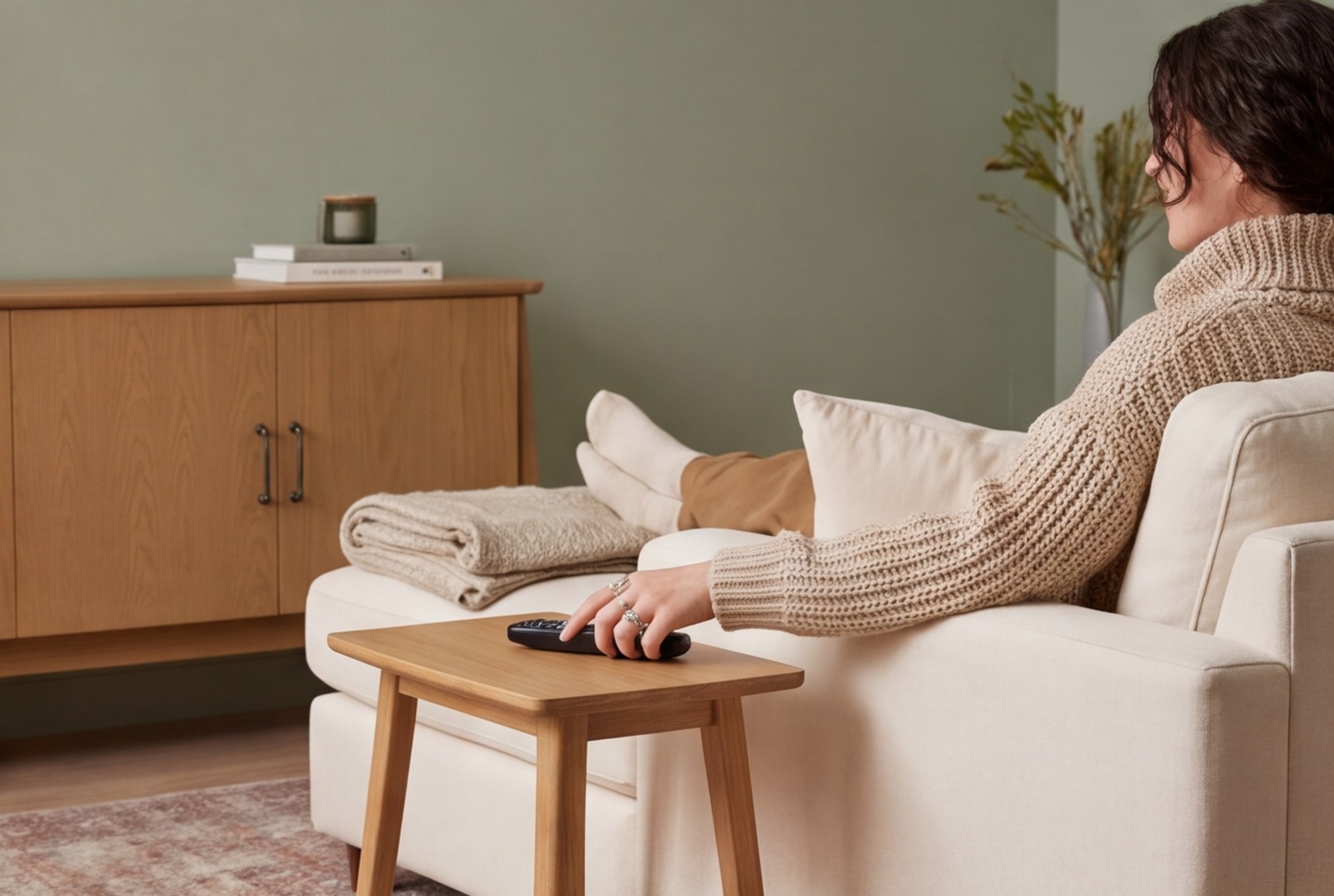
Seated reach matters as much as standing reach. If you cannot grab an item from the sofa or step to it in one move, it will end up on the coffee table instead. Test this by sitting where you normally sit and noting what you can reach without leaning.
Give Every Item One Home
Talker Research reports that 77% of Americans agree every item should have a designated space, and that the living room is the room people find easiest to organize. That is encouraging. A room that is easy to organize mostly needs a clear decision for each category, which is the work of the next section.
Write the audit down as a short list with a count for each category. Counts keep you from buying a ten-bin system for a three-bin problem, and they make the budget section at the end much simpler.
Open or Closed Storage: How to Decide for Each Category
Use open shelving for things you want to see and reach daily, and closed storage for anything visually busy, dusty or used occasionally. Designers commonly suggest roughly two-thirds closed to one-third open, according to Nordic Design Blog. That ratio keeps a room calm without making it feel sealed.
The 2/3 Rule for a Living Room
The 2/3 rule is a balance guideline: about two-thirds of your storage is closed (doors, drawers, lidded boxes) and about one-third is open. The same source describes a 60/40 split as an acceptable variation. A related guideline from Nordic Design Blog says open shelves should stay 30-40% empty, so the objects you do display have room to read as choices.
A calm room comes from hiding most of what you own and leaving some shelf deliberately bare.
On a bookcase, that means a few grouped books, one or two objects and some bare shelf. Fill every inch and it reads as clutter even when everything is tidy.
A Simple Rule by Category
- Open: current books, a few favorite objects, plants, frequently used throws in a basket
- Closed: media gear, cables, game controllers, paperwork, kids' toys, spare chargers
- Lidded boxes on open shelves: anything you want on a shelf but not on display
Do Open Shelves Crowd a Small Room?
Open shelves do not crowd a small room by default. Shallow open shelving is 10-12 inches deep according to Nordic Design Blog, and that slim profile takes less visual and physical space than a deep cabinet. The crowding comes from a full, mixed-up shelf, not from the shelf itself. Keep the open portion shallow, light in color and partly empty.
Adding Closed Storage Without Bulk
Closed storage depth runs 15-20 inches for media consoles and credenzas, per Nordic Design Blog. If your room is tight, choose a console at the shallow end of that range, raise it on legs so you can see floor underneath, and match its color to the wall. A piece that visually disappears into the room feels noticeably smaller.
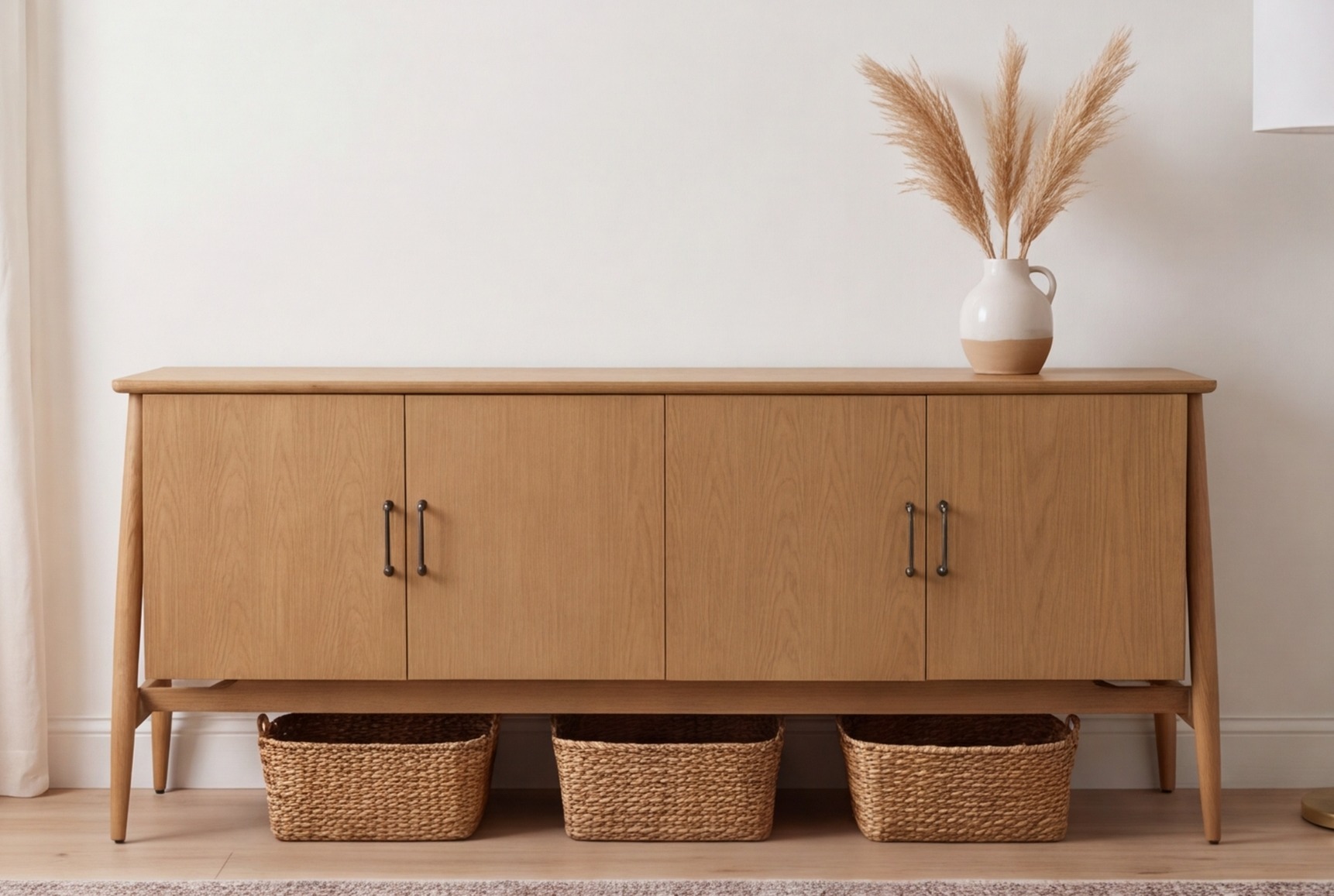
Doors with solid fronts hide the most, while woven or fabric-front baskets inside open cubbies are a softer middle path. The closed pieces you choose are part of the room's style.
Hidden Storage That Fits Your Layout, Not Just Your Wishlist
Hidden storage works when the piece suits the room's shape and leaves a clear path. Choose by layout first: long rooms want low, continuous pieces along one wall, open plans want pieces that define zones, and small rooms want furniture that does double duty.
Keep Walkways Open
Before any purchase, mark the footprint of each piece with painter's tape on the floor and walk around it. If you have to turn sideways to pass, the piece is too deep or in the wrong place.
Depth is the number to check first. A 15-20 inch media console is fine against a wall, but the same depth in a narrow room can eat the walkway.
Match Pieces to Room Shapes
- Long, narrow rooms: a low sideboard or console along the long wall, with the sofa kept off it
- Open-plan spaces: a back-of-sofa console or open-backed shelf that marks the living zone and holds lamps and baskets
- Alcoves: built-in shelving or a fitted cabinet that fills the recess flush, so nothing sticks out
- Small apartments: storage ottomans, coffee tables with storage and wall-mounted shelves that keep the floor clear
Storage Ottomans and Coffee Tables
A storage ottoman holds throws, controllers and magazines in a seat you already need. A coffee table with a lower shelf or lift-top does the same job at the center of the room. The tradeoff is capacity, since both hold less than they look like they will.
People do not always buy for this function. In a survey of 612 people from House Digest, 14.38% chose an ottoman as their coffee table and only 9.15% chose a trunk or storage coffee table, which suggests style often outranks storage at the center of the room. If you need the storage, make it a deciding factor on purpose.
Wall-Mounted and Vertical Options
Floating shelves and wall-mounted cabinets use height instead of floor. They suit small rooms, but they only work when mounted where you can reach them, and they need proper fasteners in studs for anything heavy. Tall units in a corner use vertical space well, as long as heavy items sit low and the unit is anchored, which the next section covers.
If you are furnishing a whole house at once, our Biophilic living room shows how seating, light and storage can be planned together in one coordinated room.
Storage for Toys, Media Gear and Everyday Living Room Mess
Shared rooms need storage that a child can use and an adult can reset in two minutes. Give toys a low closed home, give media gear ventilated space and cable routes, and anchor anything tall. These three decisions handle most of the everyday mess.
Toys in a Shared Room
Pick one low, closed unit for toys, such as a cubby with fabric bins or a lidded bench, so tidying means dropping things in. Keep it at child height and let the rest of the room stay adult. In a long room, put it at the end nearest the play area so the mess stays in one zone.
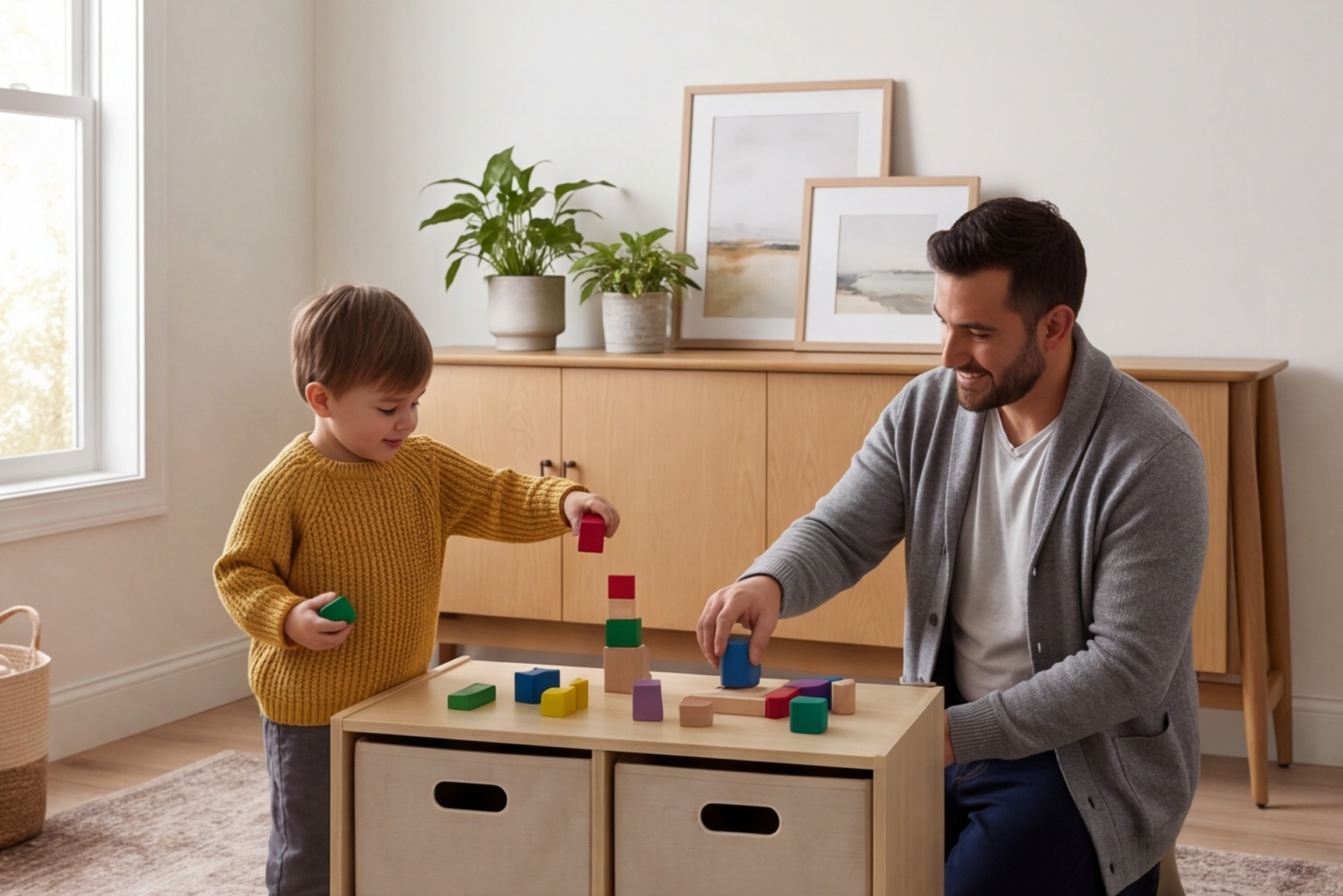
A rotation helps. Keep only what fits in the unit out, and store the rest elsewhere, since a toy collection that outgrows its container will spill into the room.
Books, Movies and Kids' Art
Shallow open shelves at 10-12 inches suit books, per Nordic Design Blog. Add a few lidded boxes for loose movies and a shallow drawer or portfolio box for kids' art, with one or two favorite pieces displayed at a time. Stacking art in a closed spot keeps it from taking over the walls.
Cables, Routers and Console Airflow
Media gear needs air. Leave open space around consoles and set-top boxes, choose a console with a ventilated or open back, and look for cable cutouts so cords exit cleanly. Routers and power strips can sit in a closed cabinet only if it has ventilation openings. Bundle cables with ties and label each end so you can find them later.
Anchor Tall Units
This part is a safety issue. CPSC reports that 17,800 people are injured annually in furniture, TV and appliance tip-over incidents, and children under 18 account for 44% of injuries. The agency advises anchoring bookcases and consoles, keeping remotes and toys off tops where kids climb, and storing heavier items on lower shelves.
Renter-Friendly, No-Drilling Options
Freestanding units, over-the-door organizers, under-sofa bins and ottomans all work without drilling. Adhesive hooks and strips suit only light items, so check the weight rating on the package and stay well below it. For tall furniture, ask your landlord about anchoring, since a few small screw holes are usually easier to patch than an injury is to undo. According to Rently, 25% of renters choose multifunctional space-saving furniture, which is a sensible route when walls are off limits.
Which Living Room Storage to Buy First on a Budget
Buy first the single piece that hides the most clutter from your audit, which is usually a closed console, sideboard or cabinet. Add smaller pieces after that, one category at a time, so money goes where the clutter actually is.
A Buying Order That Follows the Audit
- One closed piece for the biggest pile: a console, sideboard or cabinet sized to your counts
- A storage ottoman or coffee table with storage for the daily small items
- Baskets and lidded boxes for open shelves and cubbies
- Shallow open shelving or floating shelves for display and books
- Cable management and anchoring hardware, which cost little and should not be skipped
Bins and baskets are the cheapest fix. Bins alone only move clutter around, so pair them with one closed piece.
Spread Spending Room by Room
When you are furnishing an empty house, it is tempting to spend the whole storage budget in the living room. Resist that. Entry, bedrooms and kitchen each need a working storage plan too, and a modest piece in each often beats one big unit in the living room. Rently found that 38% of renters cap décor spending at $101-$500 and 29% at up to $1,000, so planning per room is how a limited budget stretches.
Keep Storage From Refilling
Storage fills to its edges unless you set a limit. Keep open shelves 30-40% empty, as Nordic Design Blog suggests, and do a five-minute reset each week: return items to their homes, and move anything that has gone unused out of the room. Selfstorage found that 67% of Americans say lack of storage space contributes to clutter, but a good system also needs a rule about what stays.
If you want help sequencing the whole house, a free home profile with Cradle & Hearth lets you set your style, room priorities and budget before you buy a single piece.