
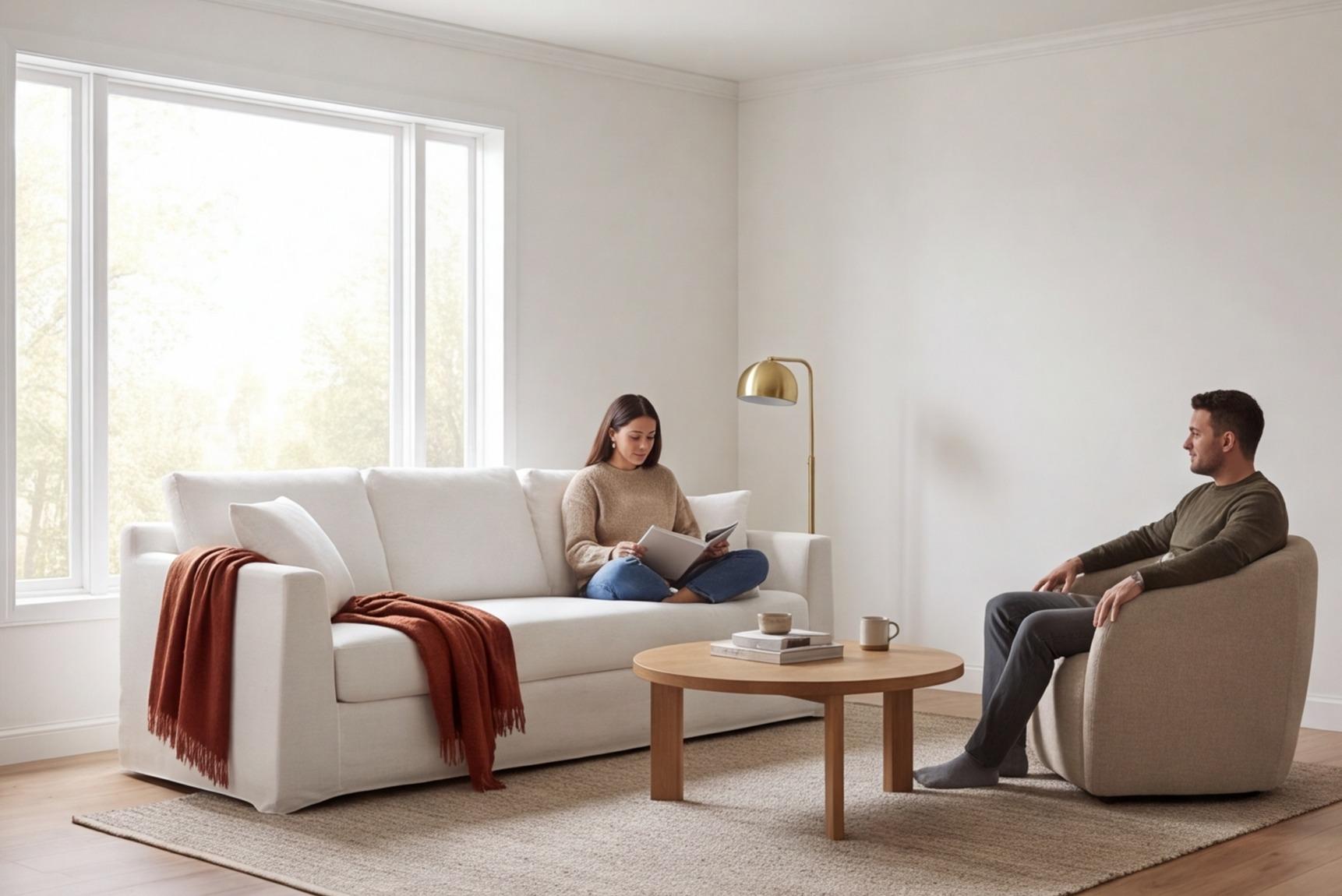
Mid century modern living room ideas work best when they match the people using the room. This page starts with what defines the style, then moves through small rooms, tight walkways, easier seating, and family rooms with kids and pets, and ends with color, lighting and mixing eras.
What Makes a Living Room Mid Century Modern
Mid century modern is a design style built on clean lines, low profiles, tapered legs, warm wood and gently curved forms. It is easiest to live with in a "soft" version: keep those period details, then layer in modern lighting, textured fabrics, calm neutrals and a single saturated accent.
The build details that define the look
Mid century modern is defined by simplicity and function, space-conserving furniture, clean lines such as tapered legs, organic fluid forms, natural woods, warm earthy neutrals and saturated hues. Those are construction facts you can check on a piece. Look at the legs, the profile and the wood before you look at the label.
The Interior Design Institute describes the style as having a "low and lean" profile, and advises choosing sofas and sideboards with tapered peg legs to keep sightlines and floor space clear. A tapered leg narrows toward the floor, which lifts the piece visually. That lift is why a room full of this furniture feels open instead of heavy.
Why it still works, and how to keep it warm
Interest in the style has not faded. VERANDA reported mid century modern furniture returning to the spotlight in 2025, with renewed interest in warm woods, straightforward lines and chrome details. Vogue's 2024 guide frames the style around functionality, pared-down design and warm natural wood paired with newer manmade materials.
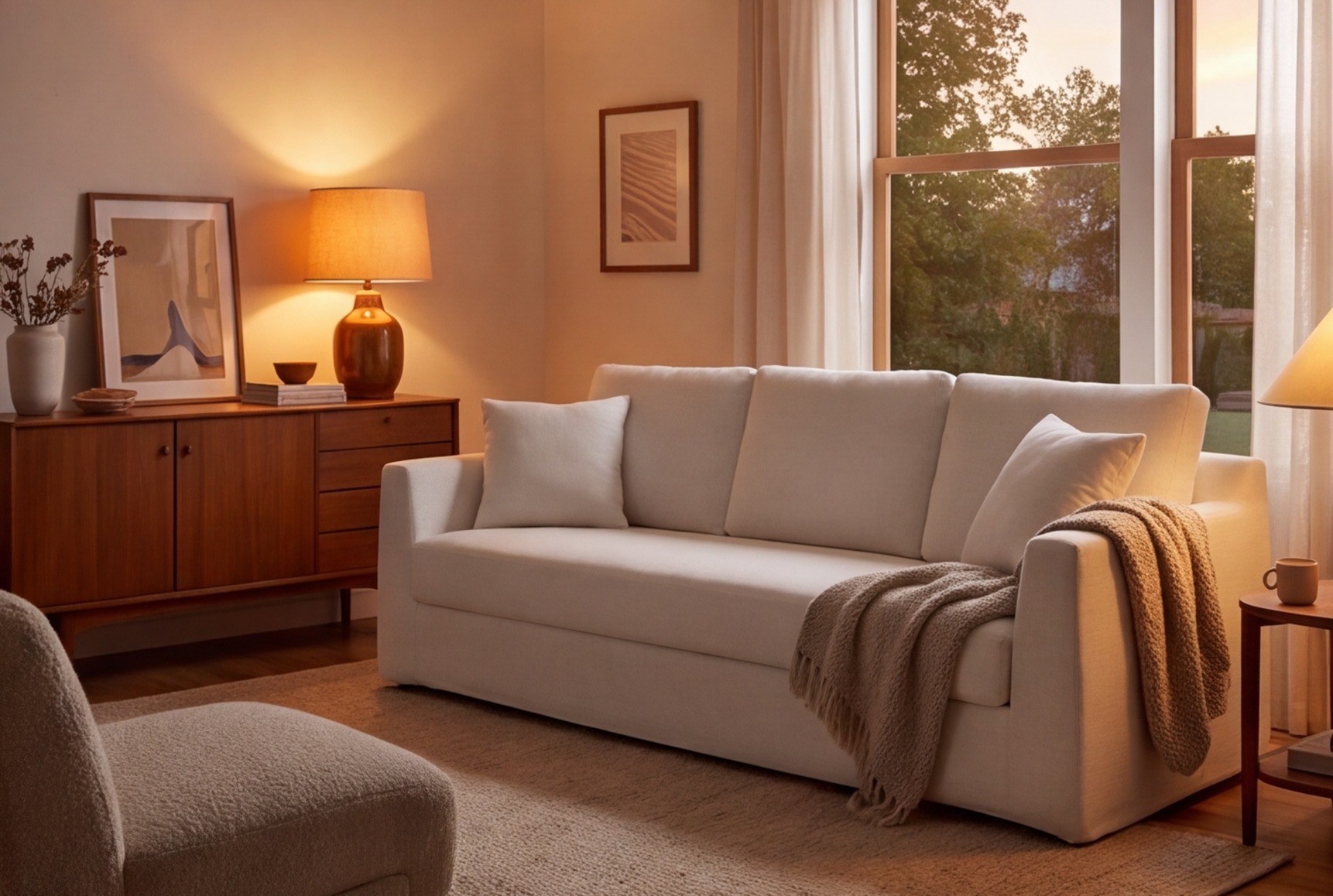
A mid century modern living room can be cozy. The clinical look comes from matching everything and leaving every surface smooth. Warmth comes from wood tones in more than one shade, a nubby wool-blend or bouclé throw, a rug with some texture, and lamps that give a low, amber light.
The theme-park look comes from buying the whole era at once: teak everywhere, matching sets, period-correct everything. Choose two or three anchor pieces with real mid century construction and let the rest be plain and modern. The sections below show how to choose those pieces for your household.
A Small Living Room Needs Visible Floor and Slim Silhouettes
In a small living room, a sofa with a tight back on tapered legs keeps the floor visible, and slim-arm or armless accent chairs take up less visual room than bulky rolled arms. The more floor you can see, the larger the room reads.
- Sofa: tight back, tapered legs, low back height
- Accent chairs: slim arms or armless, with open space beneath
- Storage: a leggy credenza instead of a boxy cabinet
- Light: one sculptural fixture, not a crowd of small ones
- Palette: restrained neutrals with one accent
Choose the sofa by its back and legs
A tight back means the cushions are sewn or fixed in place and the back is not a pile of loose pillows. It holds a clean line and takes less depth. According to RoomSketch3D, low-back contemporary or mid century style sofas typically have a back height of 28 to 32 inches, compared with 36 to 40 inches for traditional high-back designs.
That 8-inch difference matters in an apartment. A lower back lets sightlines run across the room and leaves a window or wall visible behind it. Tapered legs finish the job by showing the floor underneath, which is the visible floor that makes a small room feel less crowded.
Swap rolled arms for slim ones
Rolled arms are thick, rounded and heavy at the sides, so they add width without adding seating. A slim-arm or armless accent chair gives you the same seat in a narrower footprint. Wood-framed chairs with open sides let you see through them, which helps a small room feel less full.
In a small room, slim arms and visible floor make furniture feel lighter and the whole space feel larger.
Pair the sofa with a credenza on slim legs for media or storage. Raised on legs, it shows floor beneath it and sits lower than a bookcase, so the wall above stays open for art. Keep a single sculptural pendant or floor lamp as the main light, and let plain lamps do the rest.
A palette that suits renters
Renters often cannot add wood paneling or paint bold walls. You can get the same effect with furniture and textiles: warm white walls left as they are, a wood coffee table, a wool-blend rug in oatmeal or gray, and one saturated cushion or chair in rust, mustard or deep green. Everything you buy this way moves with you.
Keep Main Walkways 36 Inches Wide, Side Paths at Least 30
Main walkways in a living room should be 36 inches wide, and 30 inches can be enough for secondary routes, according to Crane Manor. When the room is too full to hold those widths, scale the furniture down before you give up the path.
- Main paths: 36 inches wide
- Secondary routes: 30 inches can work
- Sofa to coffee table: about 14 to 18 inches
- Sofa to TV: about seven feet
Measure paths before you buy
Crane Manor recommends 36 inches for main walkways and says 30 inches can be enough for secondary, less-used routes. Keep anything narrower for a tight corner only.
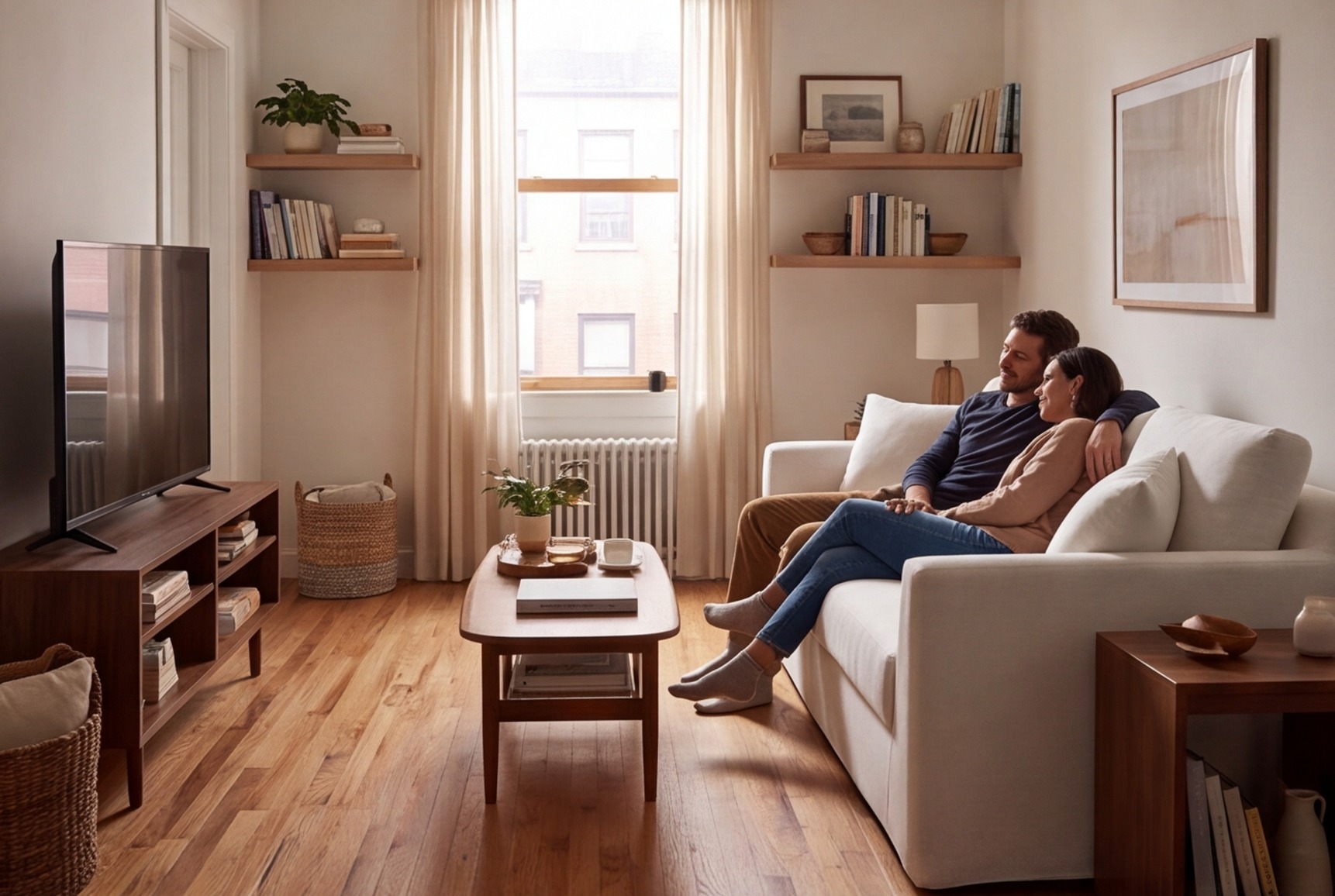
Lay painter's tape on the floor where each piece will stand, then walk the room. The tape shows whether a path from the door to the sofa, or from the sofa to the window, stays open. It costs nothing and catches the problem before delivery.
Scale down the sofa, table and rug
Mid century furniture is usually lower and slimmer than modern oversized pieces, which helps. Choose a sofa that is shorter in length if the path is tight, and a coffee table with rounded corners or a slim oval. Leave about 14 to 18 inches between the sofa and the coffee table.
Size the rug so at least the front legs of the sofa and chairs sit on it, and keep it clear of the main path. A flat rug that stops short of the doorway leaves the route open and keeps edges from catching feet.
Arrange the room and place the TV
Float the sofa so it faces the focal point and leaves a path behind or beside it. Place two accent chairs at an angle across from it. Low furniture suits a TV on a credenza at a low height. Allow about seven feet between sofa and TV, and measure your seat-to-screen distance before choosing the screen size.
Choosing Seats That Are Easier to Get Out Of
Many mid century seats sit low, which makes standing harder for adults who want an easier time getting up. Look for a seat height of about 18 to 20 inches, sturdy armrests to push against, and textured fabric or matte leather in place of slick upholstery.
- Seat height: about 18 to 20 inches
- Arms: firm and at a height you can push against
- Surface: textured weave or matte leather, not slick
- Seat depth: not so deep that you sink back
Why the seat height matters
According to RoomSketch3D, standard sofa seat heights are 17 to 19 inches, while lower modern or mid century styles often measure 15 to 17 inches. That is the gap to watch. A seat at 15 inches asks your knees and hips to do more work on the way up than one at 19.
A low seat looks sleek but costs you effort every time you stand, so check the height before falling for the style.
Seating that is too low or too deep is harder to rise from. As a rule of thumb, look for a seat height near 18 to 20 inches and a seat depth that lets your feet rest flat while your back stays near the cushion.
Arms, cushions and surface
Sturdy armrests give your hands something to press against as you stand. Look for wood or firmly padded arms set at a comfortable height, and check that the frame is solid when you lean on it. Slim arms can work well here if they are wood-framed and sturdy.
Firmer cushions hold their shape better than very soft ones, which let you sink and make standing harder. A textured weave grips clothing lightly, and matte leather has a bit of friction. Slick upholstery, such as polished leather or silky fabric, lets you slide forward on the seat, which makes getting up less predictable.
Choose a mid century look with higher seats
The style does not need to be low. Many mid century inspired sofas and lounge chairs are made at standard or slightly higher seat heights while keeping tapered legs and clean lines. Try the seat in person where you can, or check the listed seat height against a chair you already find comfortable.
Family Rooms With Kids and Pets: Fabrics and Finishes That Fit
For a family room with kids and pets, match materials by how they are made: a tight-weave performance fabric with a known ACT abrasion rating, a cleaning code that suits your spills, a cared-for wood finish, and a flat-weave rug for toddlers. These are construction facts, not guarantees.
- Upholstery: tight-weave performance fabric with an ACT rating
- Cleaning code: read the tag before you buy
- Wood: care for the finish with a soft damp cloth and mild soap
- Rug for toddlers: flat weave, not wool shag
- With cats: skip leather, since claws mark it
What the ACT rating tells you
ACT is the Association for Contract Textiles, which publishes performance guidelines for upholstery fabric. It defines 15,000 Wyzenbeek double rubs as suitable for commercial low-traffic private spaces and 30,000 double rubs for high-traffic public spaces (Association for Contract Textiles). A double rub is one back-and-forth pass of an abrasive over the fabric in a lab test.
ACT's 2025 guideline gives the same benchmark and cautions that abrasion results are not a reliable indicator of product lifespan (Association for Contract Textiles). Treat the number as one data point about how the weave is built. ACT's minimum crocking guidelines for woven indoor upholstery, meaning how much dye rubs off, are grade 4 dry and grade 3 wet (Association for Contract Textiles). A family sofa with a higher double-rub count and those crocking grades is built for more wear than one without them.
Read the cleaning code
The cleaning code is a letter on the fabric tag. An S or X code means the fabric should not get water or water-based cleaners. Check the code before the first spill, not after. A tight weave gives crumbs and pet hair less to catch on than a loose, nubby one.
Finishes and rugs by household
Wipe up rings from glasses quickly and use coasters on a teak or walnut coffee table.
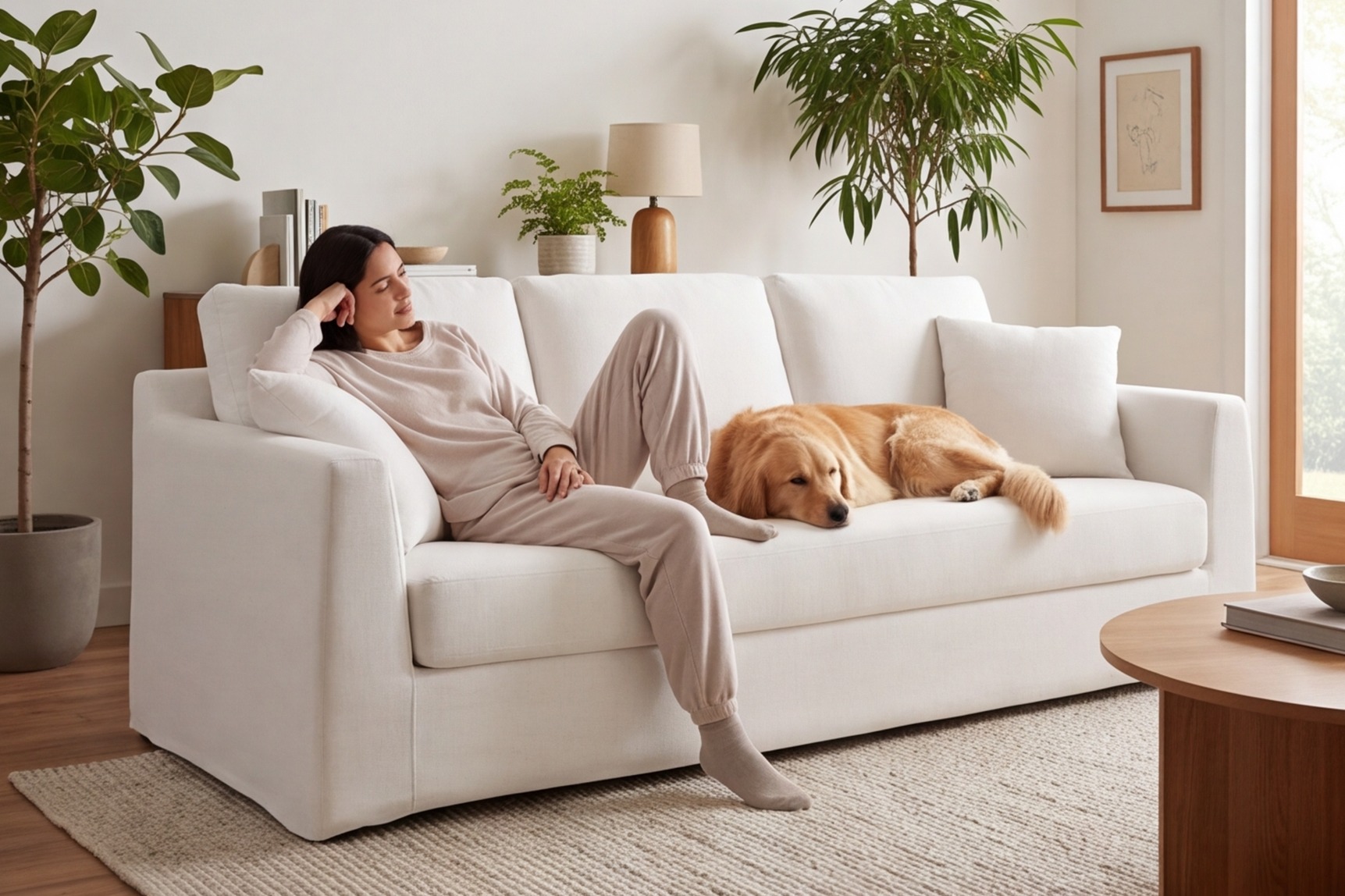
With toddlers, choose a flat-weave rug in cotton or a synthetic blend. It has no loops or long pile, and it is easy to vacuum and spot clean. Leave wool shag and deep-pile rugs for a room without toddlers. With cats, avoid leather sofas, because claws can scratch or mark the surface, and choose a tight weave instead. With dogs, a performance fabric with a tight weave and a washable throw works well.
Mid Century Modern Living Room Ideas for Color, Lighting and Mixed Eras
Finish the room with warm neutrals and one saturated accent, layered lighting, a textured rug, and a few pieces of art. Eras can mix freely when the shapes and woods agree, which is how a room avoids looking like a theme park.
Color that works with wood
Start with warm neutrals on the walls and sofa: cream, oatmeal, warm gray or soft greige. Add one saturated accent in a rich tone like rust, mustard, teal or deep green. Repeat it two or three times, in a cushion, a chair and a piece of art, and keep everything else quiet. If your wood furniture is orange-toned, gray-greens and cream sit well beside it. If it is darker walnut, rust and mustard glow against it.
Layer the lighting
Use three levels of light: a central or statement fixture such as a sputnik-style chandelier or arc floor lamp, a table lamp for reading, and a small accent light. Warm bulbs matter more than the fixture style. They are the quickest fix for a room that feels clinical.
Warm, low lighting does more than any single furniture piece to keep a mid century room from feeling cold.
Rug, art, pillows and curtains
Choose a rug with texture or a simple geometric pattern, in a color close to the sofa so it grounds the room. Hang art low and in a loose group, with one large piece above the sofa. Pillows in two textures, such as a nubby weave and a smooth linen, add warmth without extra colors.
For windows, curtains soften hard surfaces and warm the room. Hang them near the ceiling in a plain linen or cotton in a warm neutral. Keep blinds if you need the light control, and add side panels in a textured fabric so the window has some softness.
Can eras mix?
Yes. A mid century credenza beside a contemporary lamp and a newer rug looks collected. Choose one thing for pieces to share, such as tapered legs, warm wood or a curved form, and let the rest vary. If you want to start with what you already own, add one tapered-leg piece and one sculptural light and see how the room changes.
If you would like to see how one coordinated room puts mid-toned wood, a deep sofa and soft neutrals together, the mid century modern living room page shows it piece by piece.