
Reading Nook Ideas: Where to Put One, and What to Put in It
A reading nook fails for one of five reasons, and only one of them is the chair. Here is what a nook actually needs, then every place in a house one fits, from a window to a closet.
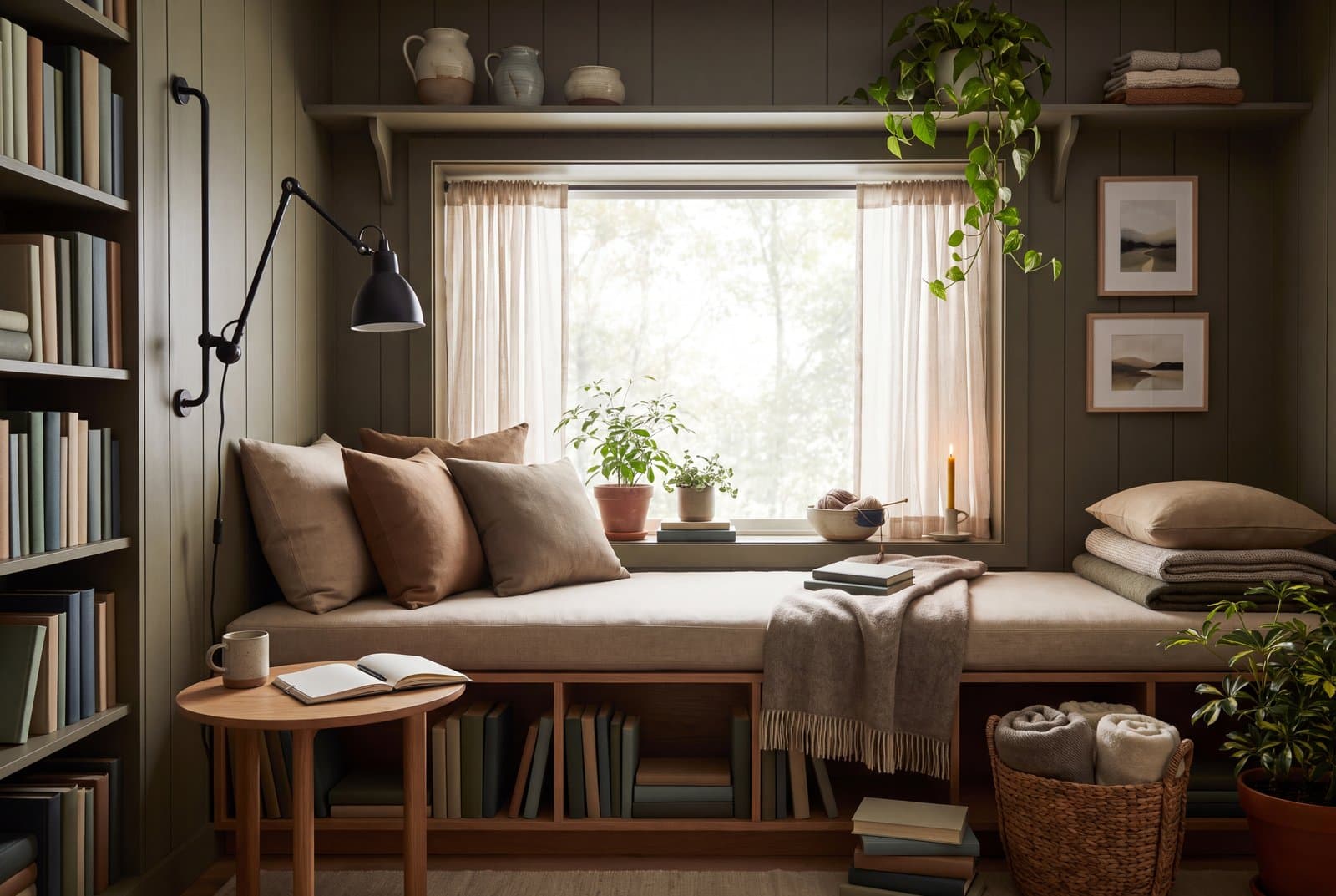
A reading nook fails for one of five reasons, and only one of them is the chair.
Most people build one by buying an attractive armchair, putting it near a window, and then quietly never reading in it. The chair is usually fine. What is missing is somewhere to put a cup, light coming from the right direction, support in the right place, or a sense of enclosure. Nooks are a comfort engineering problem before they are a decorating one.
This covers what a nook actually needs, then the specific version for every place in a house one plausibly fits.
What Makes a Reading Nook Work
Five requirements. A nook that has all five gets used daily. A nook missing two gets used twice.
1. A chair you can stay in for an hour. Not a chair that looks comfortable. The specific requirement for reading is support behind the lower back and somewhere for your head, because reading tilts your head forward and your neck fatigues before anything else does.
2. Light from behind or beside your shoulder. Not from in front, which puts glare on the page, and not from overhead, which puts your own shadow on it. This single detail is the most common reason a beautiful nook goes unused after dark.
3. A surface within arm's reach. For a cup, a phone, a second book, glasses. It needs to be at roughly the height of the chair arm, and it needs to be reachable without standing up. A nook without one fails immediately and quietly.
4. Somewhere for your legs. An ottoman, a footstool, a deep seat you can pull your legs onto, or a window seat. People do not read sitting upright with both feet on the floor for very long.
5. Enclosure. A corner, an alcove, a high-backed chair, a curtain, a bookcase at your shoulder. Something that gives your back and one side a boundary. A chair in the middle of a room is not a nook regardless of how good the chair is. This is a documented spatial pattern rather than a preference, and biophilic design names it refuge.
Reading Nook Chairs
The chair is the largest purchase and the one worth the most attention, so here is what actually distinguishes a comfortable chair for a reading nook from a chair that merely looks the part.
Back height. A comfortable reading armchair should support your head, or at least reach the base of your skull. Low-backed accent chairs are the single most common mistake in reading nooks. They look better in photographs and they are why your neck aches after thirty minutes.
Seat depth and angle. Deep enough to pull your feet up, with the seat sloping slightly back rather than being flat. A flat, shallow seat pushes you into an upright posture that is fine for a dinner party and wrong for a novel.
Arms at the right height. Arms you can rest a forearm on with your shoulder relaxed. Too high and your shoulders ride up; too low and you have nowhere to hold the book.
Some give, but not too much. A chair you sink irretrievably into becomes a nap. Firm foam with a soft top layer is the useful compromise.
The shapes that reliably work:
- A wingback. Purpose-built for this. High back, head support, and the wings give the enclosure requirement for free.
- A high-backed lounge chair with an ottoman. The most comfortable option if you have the space, and the ottoman solves requirement four.
- A deep swivel or barrel chair. Good if you want to be able to turn toward the window or the room. Check the back height; many barrel chairs stop too low.
- A recliner, if you can find one you can live with looking at. The best reading posture available, and worth reconsidering if your objection to them is aesthetic rather than practical.
- A chaise or daybed. Excellent for reading, poor at everything else, and it needs a cushion at the back to work.
What to avoid: dining-height chairs, hard-backed accent chairs, anything with a fixed low back, and beanbags, which are comfortable for twenty minutes and then not.
For a cozy reading nook, upholster in something with texture you want to touch: bouclé, chenille, wool, corduroy, or a soft brushed cotton. Leather is durable and looks the part but is cold in winter and sticky in summer, which is why every leather reading chair in a photograph has a throw over it.
Window Reading Nook
A window reading nook is the best version if the window is right, and the wrong choice if it is not.
What makes it work: daylight from the side rather than straight into your eyes, a view worth glancing at, and a sill or ledge deep enough to be useful.
What makes it fail: a cold single-glazed window, a radiator directly under it, or a west-facing window that becomes unusable for three hours a day. Sit in the spot at the time you actually read before committing furniture to it.
If the window has a bay or a deep recess, build a window seat: a plywood box the depth of the recess, a foam cushion cut to fit, and storage inside. This is the highest-value version of the whole idea, because it uses space that was doing nothing.
If it does not, place a chair at right angles to the window rather than facing it, so light comes over your shoulder. Add a small table on the side away from the window, and a lamp for evening.
Curtains matter here more than usual. Hang them wide enough to clear the glass completely when open, so the nook is not in a permanent shadow at the edges.
Corner Reading Nook
A corner reading nook is the easiest to build and the most reliable, because the corner supplies the enclosure requirement at no cost.
Angle the chair across the corner at roughly forty-five degrees rather than pushing it flat into it. This looks deliberate rather than left over, and it gives you space behind for a floor lamp.
Add a floor lamp with an arched or adjustable arm behind and to one side, a small round side table, and a rug that reaches under the front legs of the chair. The rug is what turns the corner into a defined area rather than a chair in a room.
If the corner is between two blank walls, put a tall narrow bookcase on one side. It gives the nook a purpose beyond seating and adds to the enclosure.
Reading Nook in a Bedroom
A reading nook in a bedroom is often the most-used nook in a house, because it is where people already end their day.
The constraint is floor space, and the answer is usually a chair rather than a chair plus ottoman. A high-backed armchair or a small swivel in the corner furthest from the door, with a floor lamp and a small table.
If there is no corner, the alternative is a bed reading nook: not a separate chair at all, but making the bed itself work for reading. That means a headboard you can actually lean against, which rules out most low upholstered headboards and all metal ones. Add a large firm cushion or a wedge pillow, a wall-mounted or clamp reading light on each side rather than a table lamp, and a shelf or narrow nightstand at the right height.
This is the honest answer for small bedrooms, and it is cheaper and gets more use than a chair that becomes a laundry pile.
Under the Stairs Reading Nook
An under the stairs reading nook is the best use most understairs spaces will ever find, and it is genuinely straightforward if the space is open rather than boxed in.
The constraint is the sloping ceiling, so build for sitting rather than standing. A built-in bench along the back wall, the depth of a seat cushion, with drawers or open cubbies underneath for books. Cushion on top, several pillows against the back and the low end.
Light it with wall-mounted sconces or a clamp light, because there is no ceiling to hang from and a floor lamp will not fit under the slope.
Line the back wall with something warm, wood paneling, a deep paint color, or wallpaper. Understairs spaces are usually the darkest part of a hallway, and fighting that with white makes them read as gloomy. A reading nook under a staircase is one of the few places where painting a space dark unambiguously improves it.
If the space is currently a boxed-in cupboard, opening it up is a joinery job rather than a structural one in most houses, but check whether the panel is doing anything before you remove it.
Turning a Closet Into a Reading Nook
A closet reading nook is the highest-impact conversion available in a small home, and it takes a weekend.
Remove the door and the hanging rail. Build or fit a bench at seat height across the width, with storage below. Cushion the bench, and put a firm bolster or several pillows against the back wall and the side walls.
Then treat the inside as its own small room: paint or paper it a different color from the surrounding wall, fit a small sconce or a battery puck light, and add a curtain on the outside if you want to be able to close it.
The reason this works so well is that a closet already satisfies the enclosure requirement completely. It is the only nook type where you get all four walls.
Sizing: a bench depth of about twenty inches works for sitting upright with pillows; thirty inches or more lets you lie down. Most closets are somewhere between, which is fine.
Reading Nook Bench
A reading nook bench, whether in a window, an alcove or against a wall, follows the same rules regardless of where it goes.
Seat height around eighteen inches, the same as a dining chair. Cushion at least four inches thick in high-resilience foam. Thinner than that and it compresses to nothing within a month.
Back support is the part people skip. A bench against a bare wall is uncomfortable within ten minutes. You need either an upholstered back panel, a bolster, or three or four large firm pillows. Soft decorative cushions do not do this job; they compress and you end up against the wall anyway.
Storage underneath, either drawers or open cubbies. Books are the obvious content and they make the bench read as a reading space rather than as spare seating.
If you are building rather than buying, a plywood box with a hinged or removable top is a beginner-level build, and the cushion can be cut to size by an upholsterer inexpensively.
Reading Nook Ideas for Small Spaces
A small reading nook has to earn its floor, so the versions that work are the ones that use space that was already wasted.
- A window recess. Already there, already unusable for furniture.
- A closet. Converts dead storage into a room.
- Understairs. Almost always underused.
- A landing or a wide hallway. A single chair at the end of a landing, with a lamp and a shelf.
- A corner of a bedroom you were not using anyway.
- The bed itself, with a proper headboard and reading lights.
If none of those exist, the smallest workable freestanding nook is a compact high-backed chair, a floor lamp with a slim base, and a small round side table, in a footprint of roughly three feet by three feet. Skip the ottoman and choose a chair with a deep enough seat to pull your feet up instead.
What does not work in a small space: a chaise, a daybed, or a chair plus ottoman plus side table plus bookcase. Reading nook ideas for small spaces are mostly about deciding which two of the five requirements you will solve with furniture and which three you will solve with the architecture.
Reading Nook Ideas for Adults
Most reading nook imagery is built for children, which is why so much of it is unhelpful if you are over about eleven.
The differences that matter:
- Seat height and back support are the whole game for an adult and barely matter for a child. Floor cushions and teepees are fine at seven and unusable at forty.
- Adults read for longer in one sitting, so lumbar support and a footrest go from optional to necessary.
- Adults need the surface. Coffee, glasses, a laptop, a phone. Children do not.
- The aesthetic has to survive being in a shared room. An adult reading nook usually sits in a living room or bedroom that has other jobs, so it needs to look like part of the room rather than like a separate zone with its own theme.
A reading nook for adults, put plainly: a high-backed upholstered chair, an ottoman, a side table at arm height, a directional floor lamp behind one shoulder, a wool throw, and a bookcase or shelf within reach. That is the whole specification, and it works in any style.
Lighting a Reading Nook
The most common failure and the cheapest fix.
Position: behind and to one side, at head height or slightly above. Not in front, not directly overhead. An arched floor lamp, a wall-mounted swing-arm sconce, or a floor lamp with a directional head all achieve this.
Warmth: 2700K to 3000K. Warm enough to be pleasant at night. Cool white light is easier to read by in daylight conditions and feels clinical in an evening nook.
Brightness: enough, and adjustable. A dimmable lamp, or a bulb around 800 lumens with a shade that directs rather than diffuses in all directions. Reading needs meaningfully more light than ambient sitting does, which is why a single ambient lamp is rarely sufficient.
Avoid glare on the page. If you can see the bulb from the chair, the position is wrong.
A wall-mounted swing-arm lamp is the best answer in a tight nook, because it uses no floor and can be positioned exactly.
Cushions, Throws and the Soft Layer
Cushions for a reading nook fall into two categories that get confused, and getting them wrong is why a lot of nooks look right and sit badly.
Structural cushions do a job. A firm lumbar bolster, a wedge, a large square back cushion on a bench. These should be dense, firm-filled, and chosen for support rather than appearance. Feather-filled cushions are the wrong choice here; they compress.
Soft cushions are comfort and texture. Two or three, in mixed textures, feather or fiber filled. These are the ones you can choose by how they look.
A bench or window seat needs both. An armchair usually needs only one lumbar cushion and one soft one.
Then a throw, wool or a heavy knit, over the arm or the back. This is a functional item in a nook rather than a decorative one, since sitting still for an hour makes you colder than moving around does.
Reading Nook Bookcase and Storage
A reading nook bookcase does two jobs: it holds books, and it walls the nook in.
The most effective placement is directly beside or behind the chair, at shoulder height or taller, so it supplies the enclosure requirement while being reachable from the seat. A tall narrow bookcase does this better than a wide low one.
Alternatives when there is no floor space: a pair of floating shelves above the chair, a wall-mounted magazine rack, a shelf built into a window seat, or drawers under a bench.
You need less than you think within reach. Somewhere for the current book, the next two, and whatever accumulates over a week. The rest of the library can live elsewhere.
Outdoor Reading Nook
An outdoor reading nook has the same five requirements plus two more: shade and somewhere for everything to go when it rains.
Shade is the binding constraint. Reading in direct sun is unpleasant within ten minutes and hard on the eyes. A tree, a parasol, a pergola, an awning, or a position that is shaded at the hour you actually read.
Seating should be deep, with a real back. An outdoor lounge chair or a hanging egg chair, both with a cushion. Avoid upright patio dining chairs.
Cushions must be genuinely weatherproof, or you will carry them in and out and eventually stop going out. Solution-dyed acrylic fabric and quick-dry foam are worth the premium here specifically.
Add a small side table, an outdoor rug if the surface is hard, and a lantern or solar light for the evening. A corner of a wall or fence gives the enclosure for free, which is why balcony and courtyard nooks often work better than open-garden ones.
Where to Start
Sit in the place before you buy anything for it. An hour with a book in a dining chair in the intended spot will tell you about the light, the temperature, the draft and the view, and those are what decide whether the nook gets used.
Then buy the chair, and buy it for back height and seat depth rather than for looks. Everything else on this page costs a fraction of the chair and can be added over time.
If the nook is part of furnishing a whole home rather than a standalone project, our style quiz takes about three minutes and returns a palette and reference rooms you can choose seating against. For a nook specifically, hygge is the most useful thing to read next, since enclosure, warm low light and layered texture are exactly what it is about.
Not sure where to start?
Take the style quiz and get a design profile you can actually furnish against. About three minutes.
Take the Style Quiz