
Dark Academia Decor: How to Get the Look Without Losing the Light
Dark academia is the only aesthetic on this list built around a verb. It is a room for reading and working in, which is why the version that fails is the one that is too dark to read in. Here is how to build it room by room.
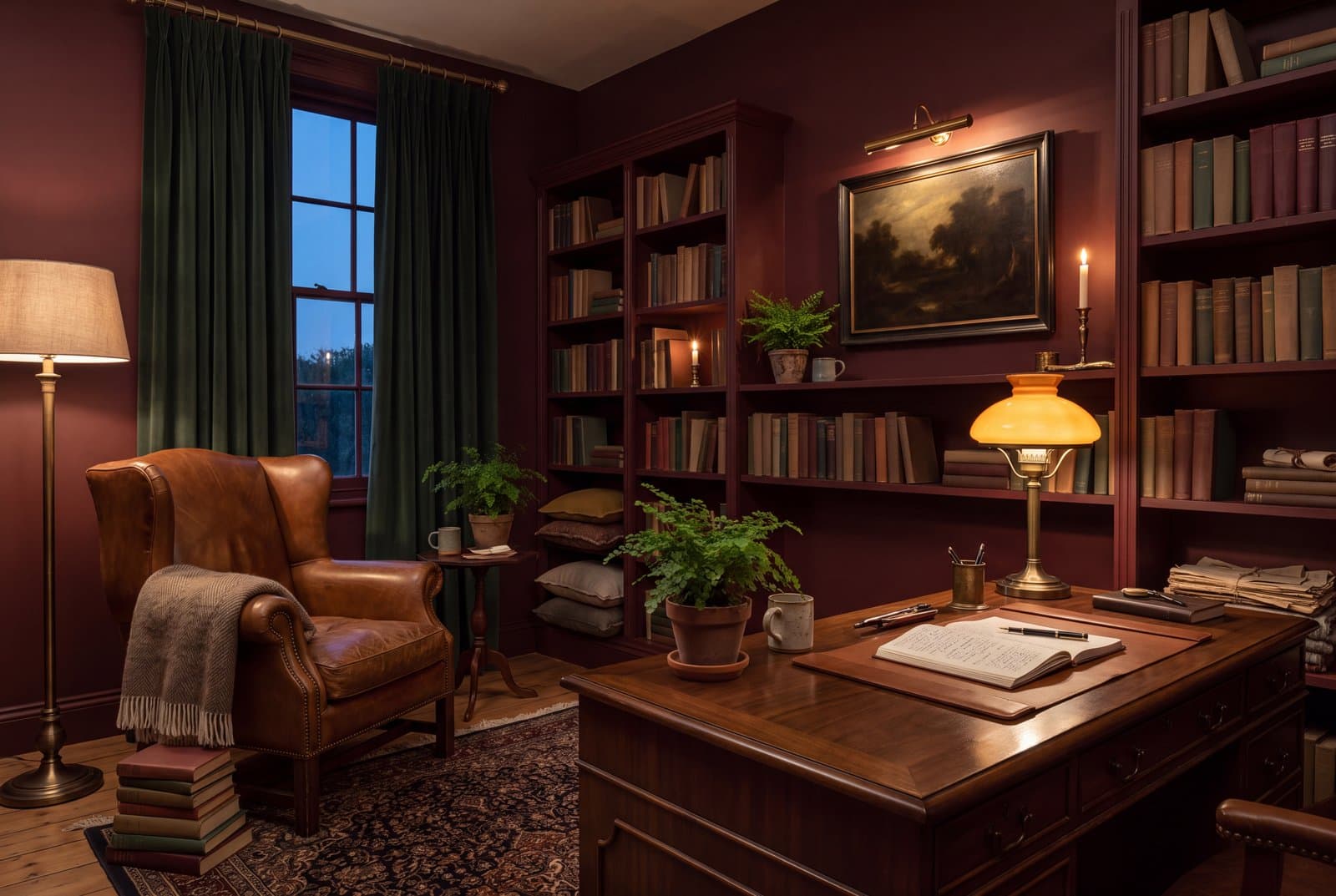
Dark academia is the only aesthetic here organized around a verb. Cottagecore is about a life you imagine living, japandi is about a set of proportions, hygge is about a feeling. Dark academia is about reading, and that single fact decides everything about whether a dark academia room works or fails.
It fails in one very specific way, and it is not the way people expect. The failure is not that the room looks silly. It is that the room becomes too dark to do the thing it is themed around. A study you cannot read in is a stage set with a desk in it. What follows is the version that survives contact with actual use.
What Dark Academia Actually Is
Dark academia is a romanticized vision of old university life: libraries, lamplight, long reading, tweed, rain outside, and the pleasure of being surrounded by books. In a house it shows up as deep saturated wall colors, dark wood, leather, brass, plain-bound books in quantity, oil-painting-style art, and lighting that comes from lamps rather than from the ceiling.
Underneath the imagery it has three principles that actually govern a room:
- Depth instead of brightness. The walls are dark, the wood is dark, and contrast comes from warm metal and lamplight rather than from white. This is the opposite instruction to almost every other style on this site.
- Evidence of study. Books that look read, papers, a lamp positioned for work, an object that implies a hobby. A dark academia room without visible intellectual activity reads as a hotel bar.
- Age over polish. Worn leather, patinated brass, foxed paper. Nothing here should look like it was bought this year, which makes the style unusually friendly to secondhand furniture.
The wider dark academia aesthetic covers clothing, literature and a great deal of pure atmosphere. The interior portion is the part you can actually furnish, and it is more livable than its reputation suggests.
Where the Aesthetic Came From
Dark academia is genuinely internet-native, in the same way cottagecore is. It coalesced on Tumblr and later TikTok around 2015 to 2020, assembled out of a fairly narrow set of references: Donna Tartt's *The Secret History*, *Dead Poets Society*, the architecture of old European universities, and a general nostalgia for a version of scholarly life that was never as widely available as the imagery implies.
That origin matters practically. The reference images are overwhelmingly photographs of institutional buildings: college libraries, lecture halls, stone corridors with twenty-foot windows. Those rooms have ceiling heights and window areas that a normal house does not, and they are the reason so many dark academia rooms fail when copied directly. The buildings supply enormous quantities of daylight, which is what makes their dark surfaces read as rich rather than as gloomy.
You are not going to get that window. So you have to replace it deliberately, which is what the lighting section below is about.
The Dark Academia Color Palette
The palette is narrow and it does most of the work.
The base is a deep saturated color on the walls: forest green, oxblood, dark teal, chocolate brown, charcoal, or a very dark warm navy. Choose warm-leaning versions of all of these. A cool charcoal reads as an office; a warm one reads as a study.
Wood is mid to dark brown, ideally walnut, mahogany or a stained oak. Avoid gray-washed or orange-toned wood, which fights the palette in two different directions.
Metals are brass, antique bronze or aged nickel. Chrome is the single most out-of-place material you can introduce, because it belongs to a bright modern language and there is no version of dark academia that survives a chrome fixture.
Then the accents, and there should be very few of them: cognac leather, ecru or cream paper, deep burgundy, olive, and the mixed browns of book spines. A dark academia color palette has no bright color in it at all, which is unusual and is what gives the style its coherence.
The Line Between a Study and a Stage Set
Worth naming directly, because it is the difference between a room you use and one you photograph.
A dark academia room becomes a set when everything in it is a prop. Stacks of books arranged rather than read, a globe nobody spins, a typewriter that does not work, candles that are never lit, a skull. Each object is defensible. All of them at once is set dressing, and set dressing is subtly depressing to live with because it advertises an activity that is not happening.
The version that works is functional. The books are books you own and intend to read. The desk is a desk you use. The lamp is positioned for a task rather than for a photograph. The chair is comfortable enough to sit in for two hours.
The test: remove every object that is purely decorative and ask whether the room still reads as dark academia. If the walls, wood, leather and lamplight carry it on their own, the bones are right. If it collapses without the globe and the skull, you have built a set.
Lighting, Which Is the Whole Problem
This is the section that decides whether the room works, so it comes before the rooms themselves.
Dark surfaces absorb light instead of bouncing it. A room painted forest green needs substantially more light than the same room painted white, and it needs that light at low level rather than from a single ceiling fitting. Overhead light on a dark room is the exact failure mode: it flattens everything, kills the depth that the dark walls were supposed to create, and makes the room look muddy.
Use three or four separate warm sources at different heights. A desk lamp with a real shade, a floor lamp beside the reading chair, a picture light or a pair of wall sconces, and something low on a shelf. Warm bulbs throughout, in the 2200K to 2700K range. This is the same discipline that makes a hygge room work, and dark academia needs it more, not less, because it is starting from a darker base.
Then keep the daylight you do have. Curtains hung wide enough to clear the glass entirely when open, and no furniture blocking the window. A dark room with the daylight thrown away is the version everybody complains about.
Candles genuinely belong here, and unlike in most styles they are not decorative. Firelight is the light source the whole aesthetic is nostalgic for.
Dark Academia Bedroom
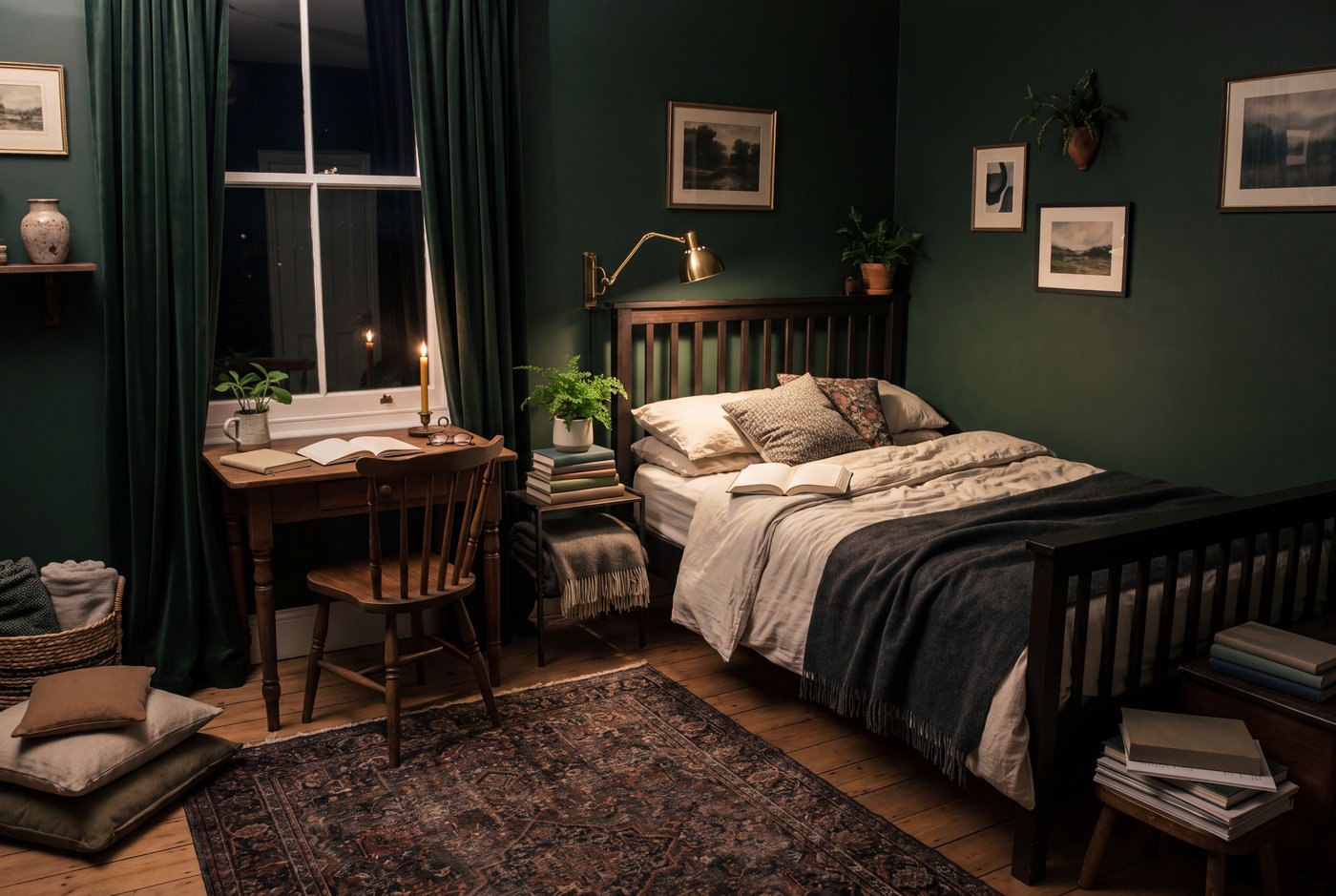
A dark academia bedroom is the easiest of the rooms, because bedrooms want low light anyway and because the style's textile requirements suit a bed.
Paint the walls in one of the deep palette colors. A bedroom is the safest place in a house to commit to a very dark color, since you are mostly in it when it is dark outside.
The bed should be wood or metal rather than upholstered: a dark stained frame, a spindle bed, or a simple iron frame. Dark academia bedding runs to layered neutrals rather than to the wall color, so ecru or cream sheets, a wool blanket in charcoal or olive, and a quilt or throw in something with visible weave. Avoid a matched bedding set, which reads as a hotel.
Then the study element, because a dark academia bedroom without one is just a dark bedroom. A stack of real books on the nightstand, a small desk or a writing table if the room takes one, a reading lamp positioned so you can actually read in bed rather than an ambient lamp on the far side of the room.
Curtains in a heavy fabric, velvet or lined linen, hung high and wide. Dark academia curtains are one of the few places the style genuinely wants weight rather than lightness.
Dark Academia Living Room
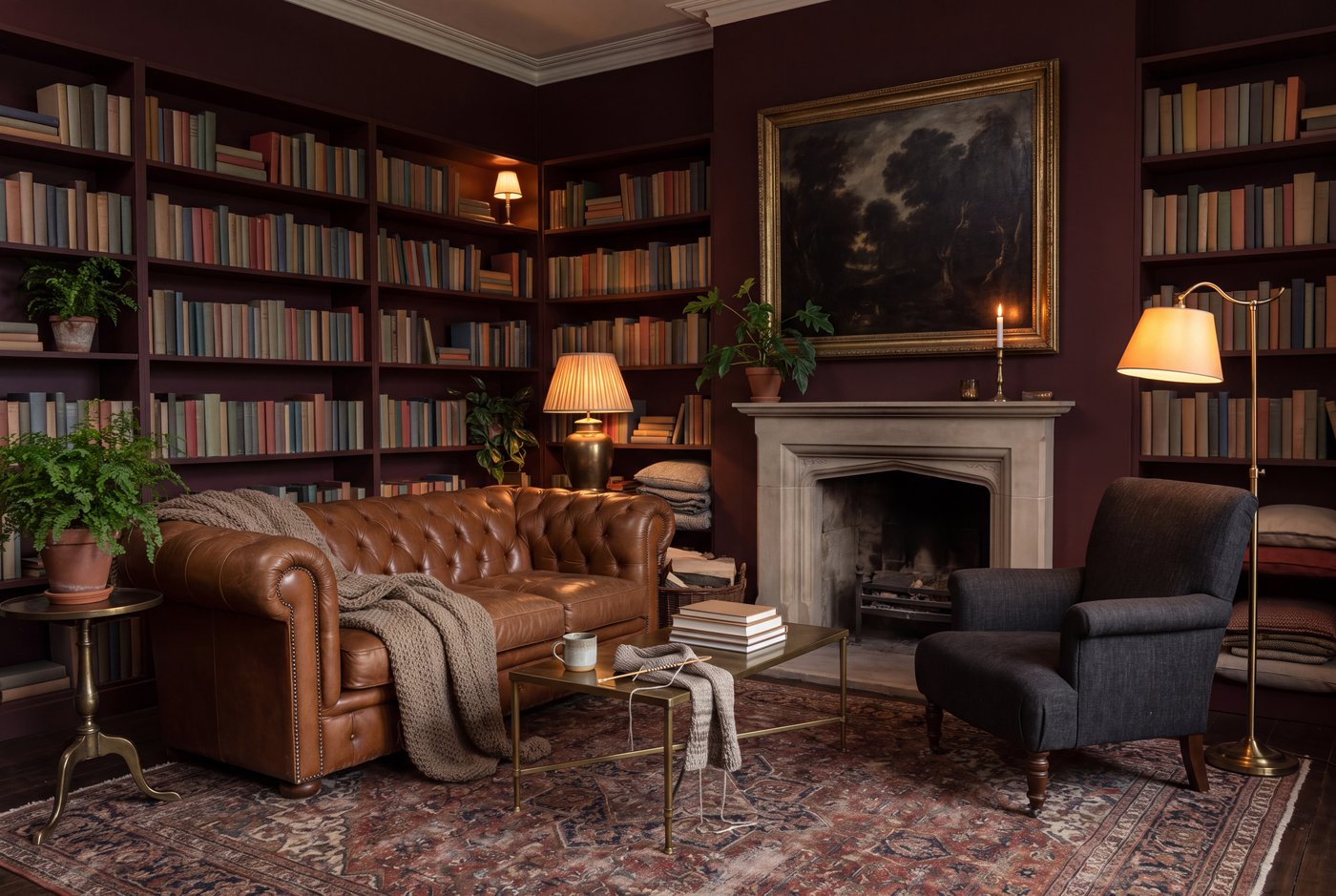
The living room is harder, for the same reason it is hard in every style: the television.
Deal with it first. A dark room is actually the best possible setting for a large black screen, which is a rare advantage, but only if the screen is not the visual center. Put it on a dark wall where it disappears when off, and give the room a competing focal point: a fireplace, a full bookcase, or a large dark-toned painting.
For the rest: a leather sofa or a deep upholstered one in a dark textured fabric. Cognac leather is the signature and it does a lot of work, because worn leather is one of the few materials that carries age visibly. Add a wingback or a club chair that does not match, positioned for reading with a lamp beside it.
A patterned rug in dark tones over whatever floor you have. A wooden coffee table with visible wear. Bookcases, genuinely full, ideally on more than one wall. A dark academia living room can carry more books than any other style on this site and still look correct.
Dark Academia Office and Study
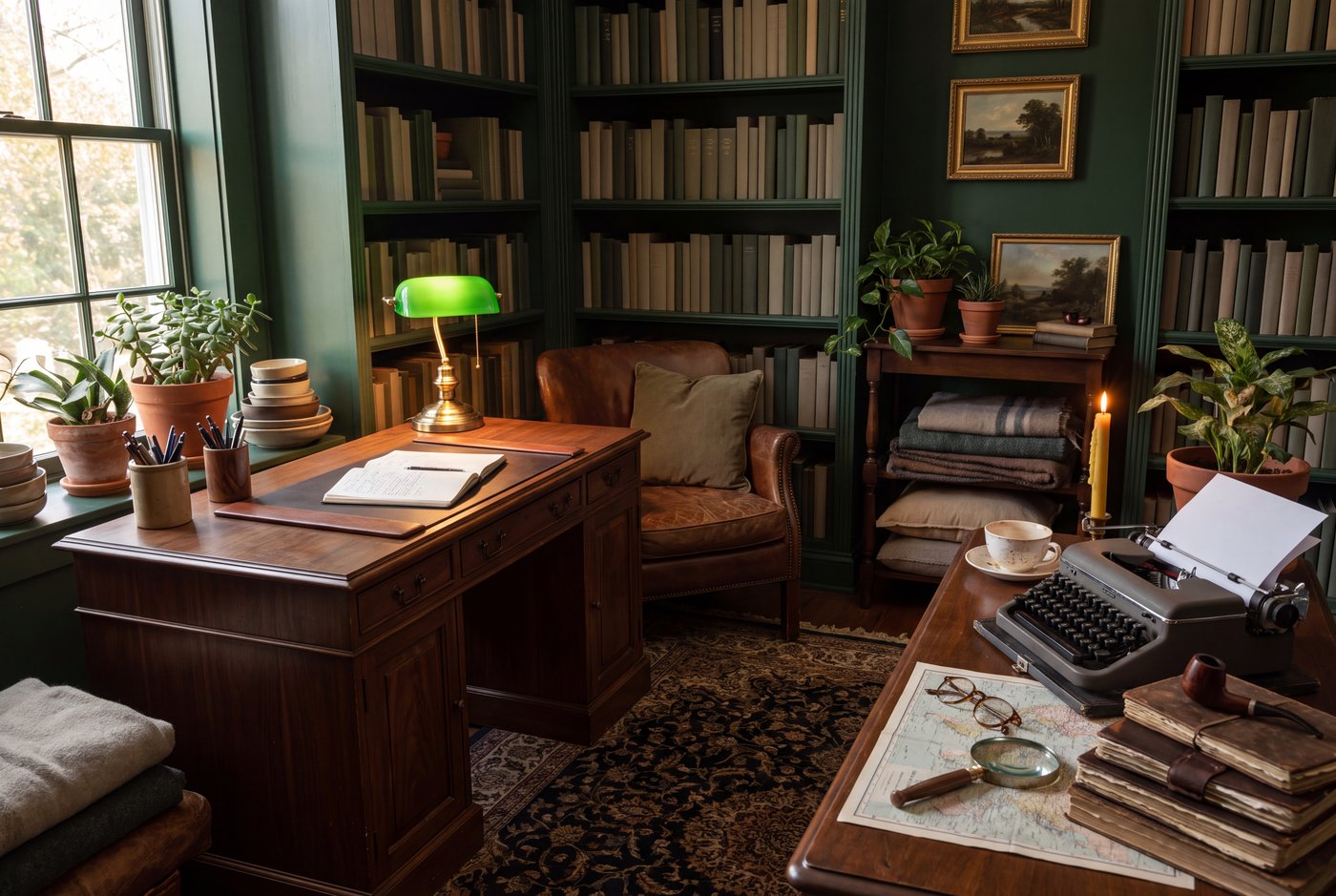
This is the room the aesthetic was actually designed for, and it is where it is most convincing.
Position the desk perpendicular to the window rather than facing it or backing onto it. That gives you daylight on the work surface, a view when you look up, and no glare. It is the highest-value decision in the room and it costs nothing.
The desk itself should be wood with some presence: a pedestal desk, a writing table with turned legs, or a plain slab of solid timber. A leather desk pad, a brass lamp with a green or amber shade, a wooden or leather chair you can tolerate for real working hours.
Shelving matters more here than anywhere. Floor to ceiling if the wall allows, filled with plain-bound books rather than color-coordinated ones. A dark academia office reads as authentic in direct proportion to how much of it is genuinely in use.
Dark Academia Library, Without a Library Room
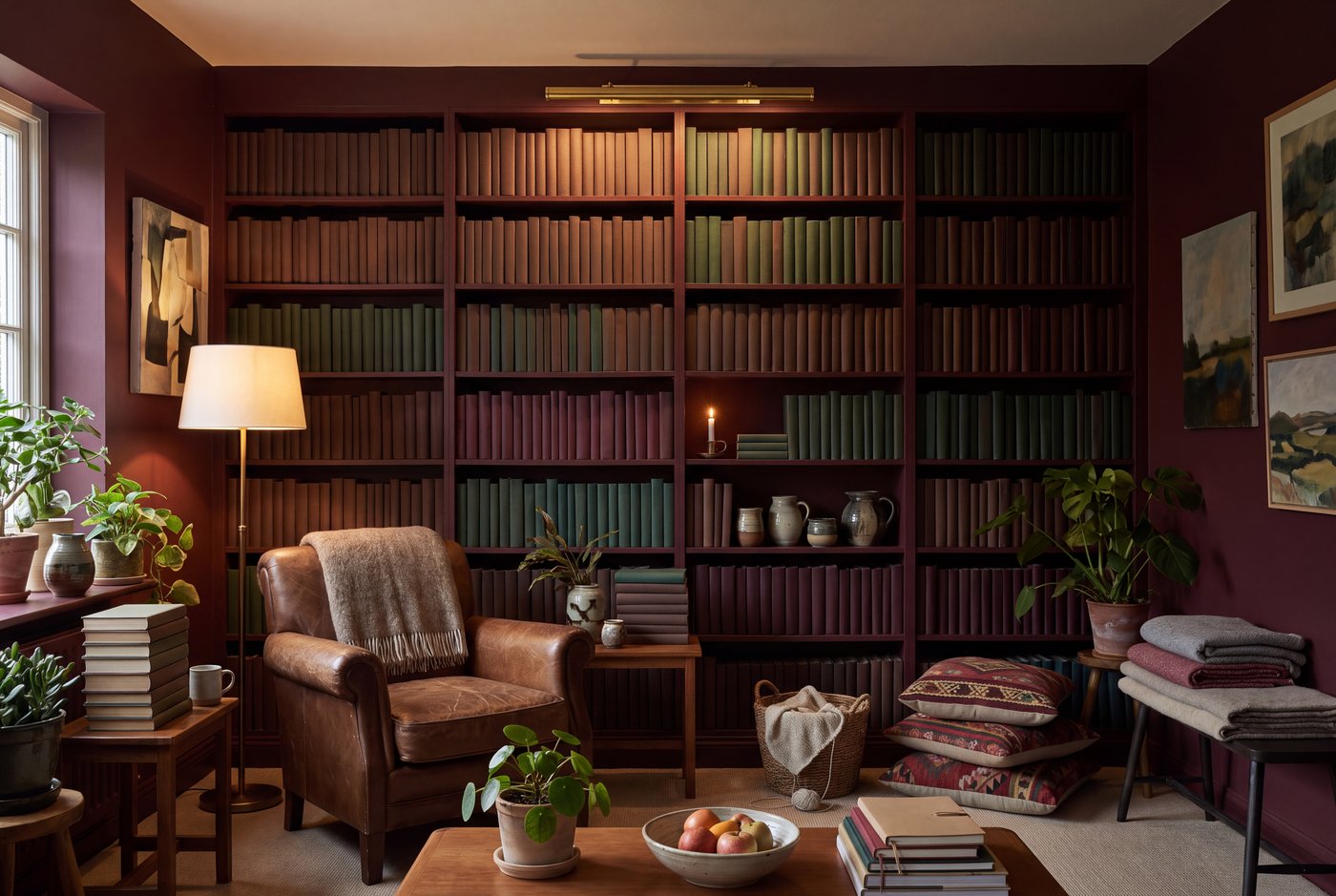
Almost nobody has a library. The good news is that a library in this aesthetic is a wall, not a room.
What produces the effect is density and height. Shelves that run to the ceiling rather than stopping at picture-rail level, filled edge to edge, with the books upright rather than artfully stacked. Paint the shelves the same color as the wall so the whole plane reads as one dark mass with the book spines as its texture. Add a picture light or a shelf-mounted light above, and a chair with a lamp in front of it.
That is the entire trick. A single well-lit full-height bookwall in a normal living room produces more of the dark academia library feeling than an entire room of half-empty shelves.
If you are buying books to fill shelves, buy secondhand hardbacks in mixed browns, greens and burgundies, and take the dust jackets off. Plain cloth spines are the look.
Dark Academia Kitchen
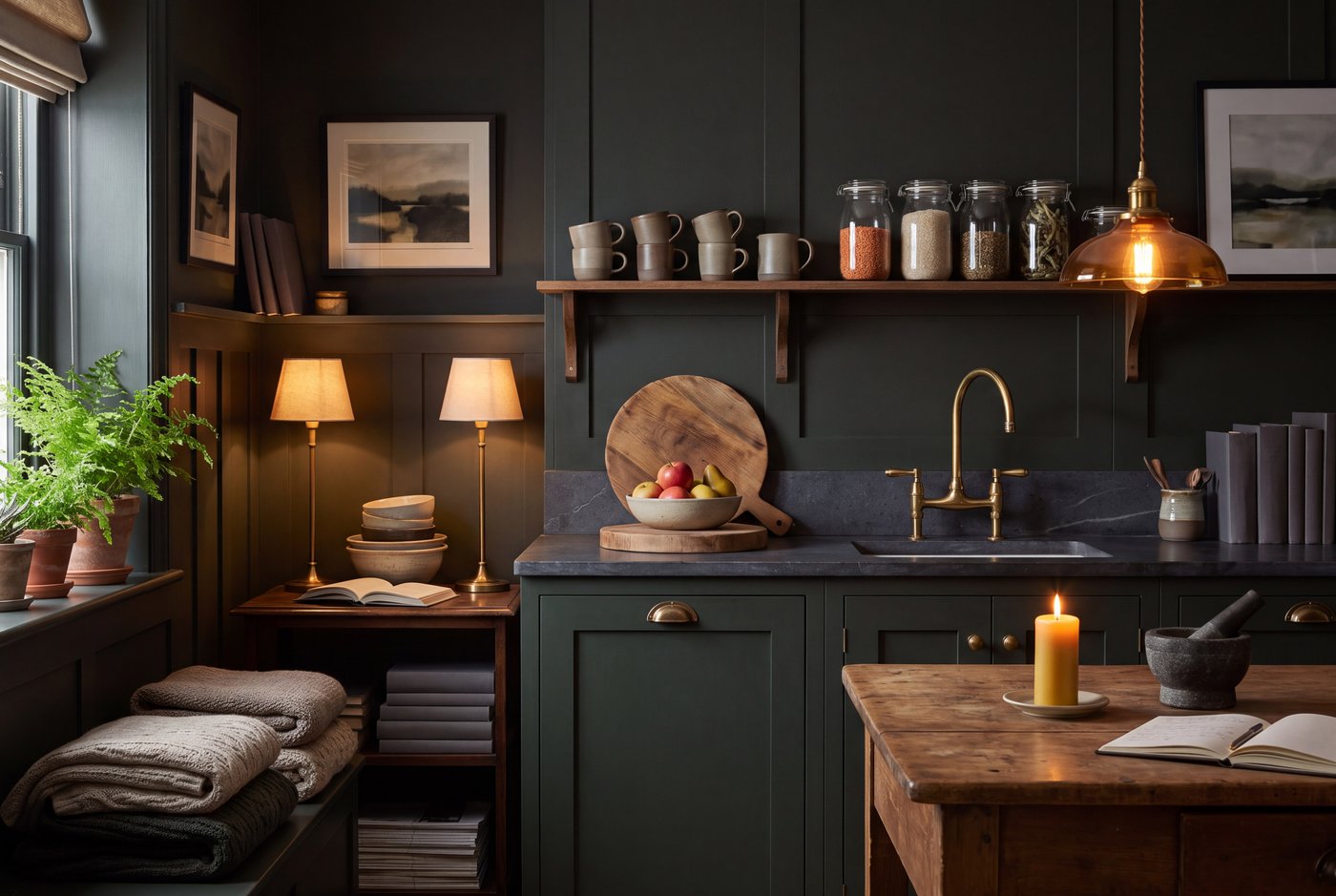
The kitchen is where the aesthetic has the least to say, which is worth being honest about rather than inventing an answer.
Kitchens are bright, functional and full of engineered surfaces, and dark academia has no functional opinion about cooking the way cottagecore does. What transfers is limited: dark green or deep brown cabinetry, brass hardware and a brass faucet, a timber or dark stone countertop, open shelving with plain stoneware and glass jars, and warm lighting at low level rather than bright ceiling panels.
Skip the theming beyond that. A dark academia kitchen with apothecary jars and Latin labels is the costume failure in its most obvious form.
Furniture and Where to Find It
Dark academia furniture is a secondhand category first and a retail category second, and buying it in the wrong order is the most common expensive mistake.
The pieces that define it are dark wood case goods, leather seating, glass-fronted or open bookcases, pedestal desks, and wooden chairs with some formality to them. New furniture that reads correctly exists, but the age has to be simulated, and simulated age is what tips a room into pastiche.
Practical sourcing order: buy the upholstery new if comfort matters to you, because old sofas rarely deliver structure, but buy leather secondhand if you can, since worn leather is the single hardest thing to fake. Buy the wooden pieces secondhand, because that is where the patina is doing the work. Buy the brass, the lamps and the books wherever you like, and let them accumulate rather than arriving in one delivery.
If you are buying new, look for dark stained finishes rather than painted, solid timber rather than veneer, and traditional shapes rather than tapered mid-century legs, which pull the room into a different decade.
Art and Wall Decor
Dark academia wall art is narrow and easy to get right.
The categories that work: oil-painting reproductions, particularly portraits and dark landscapes; botanical, anatomical and astronomical plates; old maps; architectural drawings; and framed text such as manuscript pages or letters. Frame everything in dark wood or antiqued gold, and hang it lower and denser than feels natural. A salon-style cluster on a dark wall is the signature arrangement.
What does not work: anything with a white mat and a thin black frame, which is a modern gallery language, and anything printed on bright white paper. Warm-toned paper and heavy frames are the difference.
Dark Academia in a Rental or a Dorm
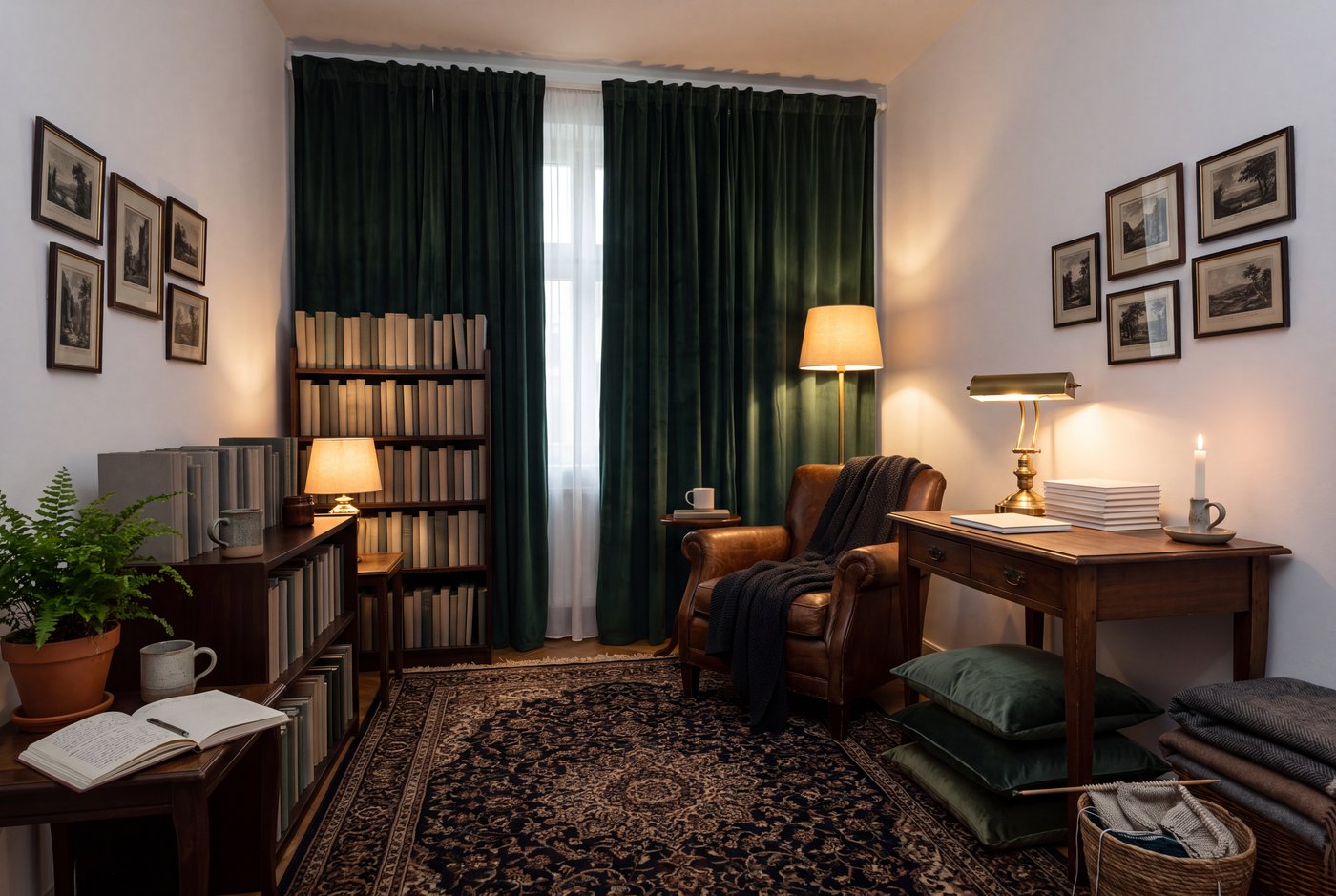
This is a very rental-friendly aesthetic, which is unusual for a style built on wall color.
If you cannot paint, put the darkness into the large soft objects instead and go heavier than you would otherwise: floor-length curtains in a deep color hung high and wide, a large dark patterned rug, a dark throw over the sofa, and a full bookcase, which is itself a large dark surface. Four dark planes in a white room will carry the feeling further than you expect.
Then do the lighting, which is entirely portable. Three warm lamps at different heights transform a white rental room more completely than paint would.
For a dorm, the whole aesthetic compresses to one wall: a desk positioned for light, a lamp with a real shade, a densely filled shelf, and a cluster of dark-framed prints above it. Dark academia is the rare style that works better in a small room than a large one, because density is easier to achieve.
Where to Start
Start with lighting, not with paint. Three warm lamps at different heights in the room you use most will tell you whether you actually want to live in this palette, and they are the one purchase that is not wasted if you decide you do not.
Then paint one room, and make it a room you occupy in the evening. Then fill a wall with books.
Dark academia sits closest to the Traditional and Industrial profiles in our style quiz, which takes about three minutes and returns a palette, a material direction and reference rooms you can hold a real piece of furniture up against. If you find the palette appealing but want the warmth without the formality, look at the dark variant of cottagecore as well, which runs on the same tonal range with entirely different objects in it.
Not sure where to start?
Take the style quiz and get a design profile you can actually furnish against. About three minutes.
Take the Find Your Room