
Maximalist Decor: The Rules That Keep More From Becoming Mess
Maximalism is not the absence of rules, it is a different set of them. The rooms that work are held together by repetition and a tight palette, and the rooms that fail are the ones that mistook abundance for permission.
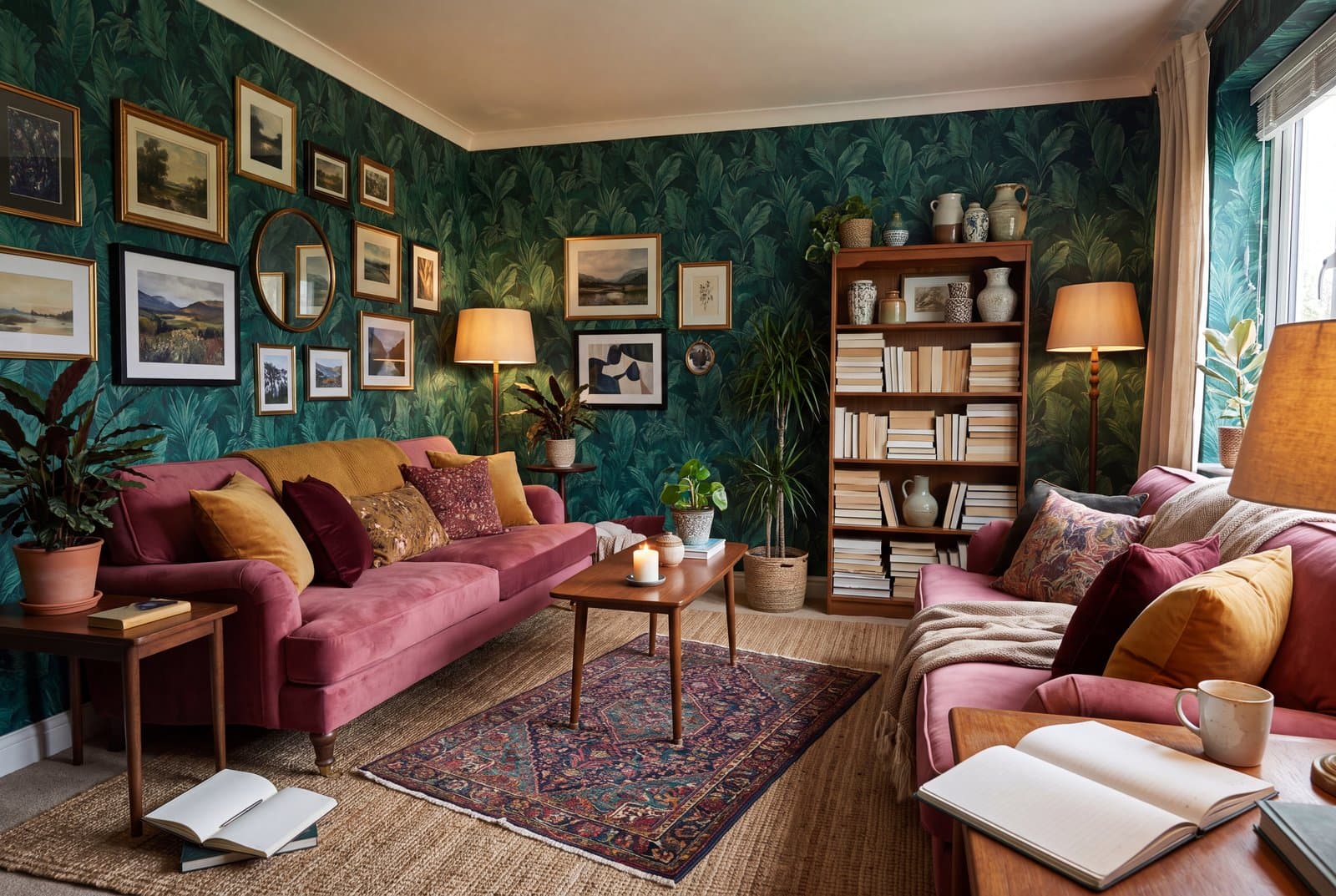
Maximalism is not the absence of rules. It is a different set of rules, and they are stricter than the ones minimalism runs on, which is the opposite of what almost everyone assumes when they start.
That assumption is the reason most maximalist rooms fail. If you believe the style means "more is allowed," you end up adding until the room is full, and a full room without a system is just clutter with good intentions. The rooms in the reference photographs are not unedited. They are held together by repetition, a tight color palette and a deliberate hierarchy, and once you can see those three things you can see them in every maximalist room that works.
What Maximalism Actually Is
Maximalism is a design approach built on abundance, layering and personal accumulation, in which a room is filled deliberately rather than pared back. Pattern is layered on pattern, color is saturated, walls are covered, and objects are displayed in quantity rather than curated down to a few.
The maximalist meaning that matters for a house, as opposed to the art-historical one, is this: the room is a record of a person rather than a demonstration of restraint. Where minimalism removes until only the essential remains, maximalism adds until the room feels like someone in particular lives there.
It has three governing principles underneath the abundance:
- Repetition creates order. A color that appears once is a mistake; the same color appearing five times across the room is a scheme. This is the single mechanism that separates maximalism from mess.
- The palette is limited, not unlimited. Successful maximalist rooms usually run on four or five colors used at high saturation, not on every color. The density is in the pattern and the objects, not in the number of hues.
- Everything is intentional. Each object is there because it was chosen, and ideally because it was collected over time. Buying an entire maximalist room in one order produces something that reads as a showroom of chaos.
Maximalist vs Minimalist
Worth doing directly, because the comparison clarifies both and because the two are usually presented as opposites when they are better understood as different solutions to the same problem.
Both styles are trying to make a room feel coherent. Minimalism achieves it by subtraction: remove enough and whatever remains is automatically in harmony. Maximalism achieves it by systematic repetition: add a great deal, but make the additions rhyme.
The practical differences:
- Palette. Minimalism runs on a narrow, desaturated range. Maximalism runs on a narrow, highly saturated range. Both are narrow, which surprises people.
- Surfaces. Minimalism leaves surfaces empty as the primary visual gesture. Maximalism treats an empty surface as unfinished.
- Failure mode. A failed minimalist room feels cold, unfinished and slightly hostile. A failed maximalist room feels anxious and tiring. Neither failure is about quantity; both are about coherence.
- Cost profile. Minimalism spends a lot on a few pieces, because with nothing to distract the eye every flaw shows. Maximalism spends less per object across many, and rewards secondhand shopping heavily.
If you are drawn to both, the honest answer is usually that you want a saturated palette and a lot of texture but not a lot of objects, which is closer to what organic modern does.
The Rule That Makes Maximalism Work
If you take one thing from this page, take this: every color and every pattern must appear at least three times in the room.
A single emerald cushion in a room of ochres and reds looks like an error. Five emerald things distributed around the room, at different scales and in different materials, look like a decision. The eye reads repetition as intent, and it reads a one-off as an accident, and it does this instantly and without your permission.
This is why maximalist rooms that work do not actually contain unlimited variety. Pick four or five colors. Distribute each one at three or more points, at varying scale: a wall, a large upholstered piece, a cushion, a book spine, a picture frame, a vase. Do the same with your two or three patterns.
The moment a room follows this rule it stops looking cluttered, even when nothing has been removed. That is the whole technique.
The Maximalist Color Palette
Saturation is the requirement, not brightness. Maximalism works on deep jewel tones and rich earth tones rather than on pastels or primaries. This is the one palette instinct it shares with art deco, though deco pairs those tones with hard geometry and strict symmetry where maximalism does neither.
The reliable combinations: emerald with ochre and oxblood; teal with mustard and terracotta; deep pink with olive and burnt orange; navy with rust and brass. Notice that each of these is three or four colors, not ten.
Then add a fifth color as the accent that appears least often but most sharply. This is where a hot pink, a chartreuse or a cobalt earns its place, precisely because it is rationed.
Neutrals still exist in maximalism and they matter more than people expect. Warm wood, brass, cane and unbleached linen give the eye a rest between the saturated planes, and a room with no rest in it is the one that becomes exhausting after a week.
Pattern Mixing Without It Becoming Noise
Pattern is where the style is won or lost, and there is a mechanical rule that works.
Mix patterns by scale, not by type. Use one large-scale pattern, one medium and one small. A big floral wallpaper, a medium-scale stripe on a chair, a small geometric on a cushion. All three at the same scale fight each other; all three at different scales read as layers.
Keep the patterns inside the palette. Three patterns that share two colors will always work together, regardless of whether they are florals, stripes or geometrics. Three patterns in different color families will not, no matter how carefully chosen.
Then vary the density. Something busy, something moderate, something nearly plain. A room where every pattern is equally dense has no hierarchy and the eye has nowhere to land.
Maximalist Living Room
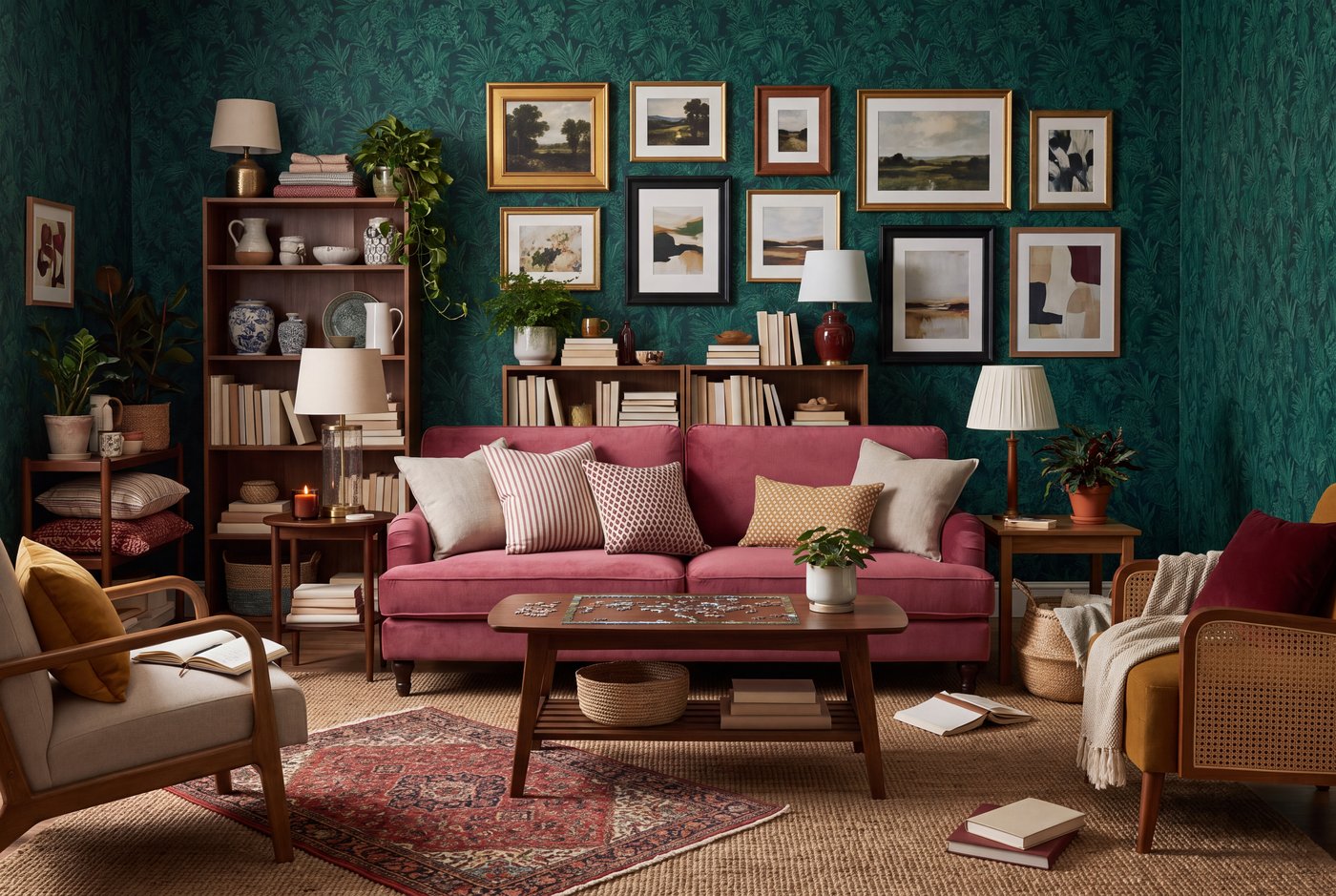
The living room is the room maximalism suits best, because it has the most surfaces to work with.
Start with the walls, since in maximalism they are a primary surface rather than a background. Either a saturated paint color or a large-scale wallpaper. This is the decision that sets everything else, and it is also the one people postpone, which is why so many attempted maximalist living rooms look like an ordinary room with too much furniture in it.
The seating should be upholstered in something with texture and color: velvet, a bold weave, or a print. A patterned sofa is a genuinely maximalist move and it solves a lot of the pattern-mixing problem in one purchase. Add chairs that do not match it.
Layer the rugs, which is one of the style's signatures. A large flatweave with a smaller patterned rug over it, at an angle. Then a coffee table with objects on it, a densely hung gallery wall, plants at more than one height, and lamps rather than an overhead light.
Bookcases should be full and styled in horizontal and vertical stacks with objects between them.
Maximalist Bedroom
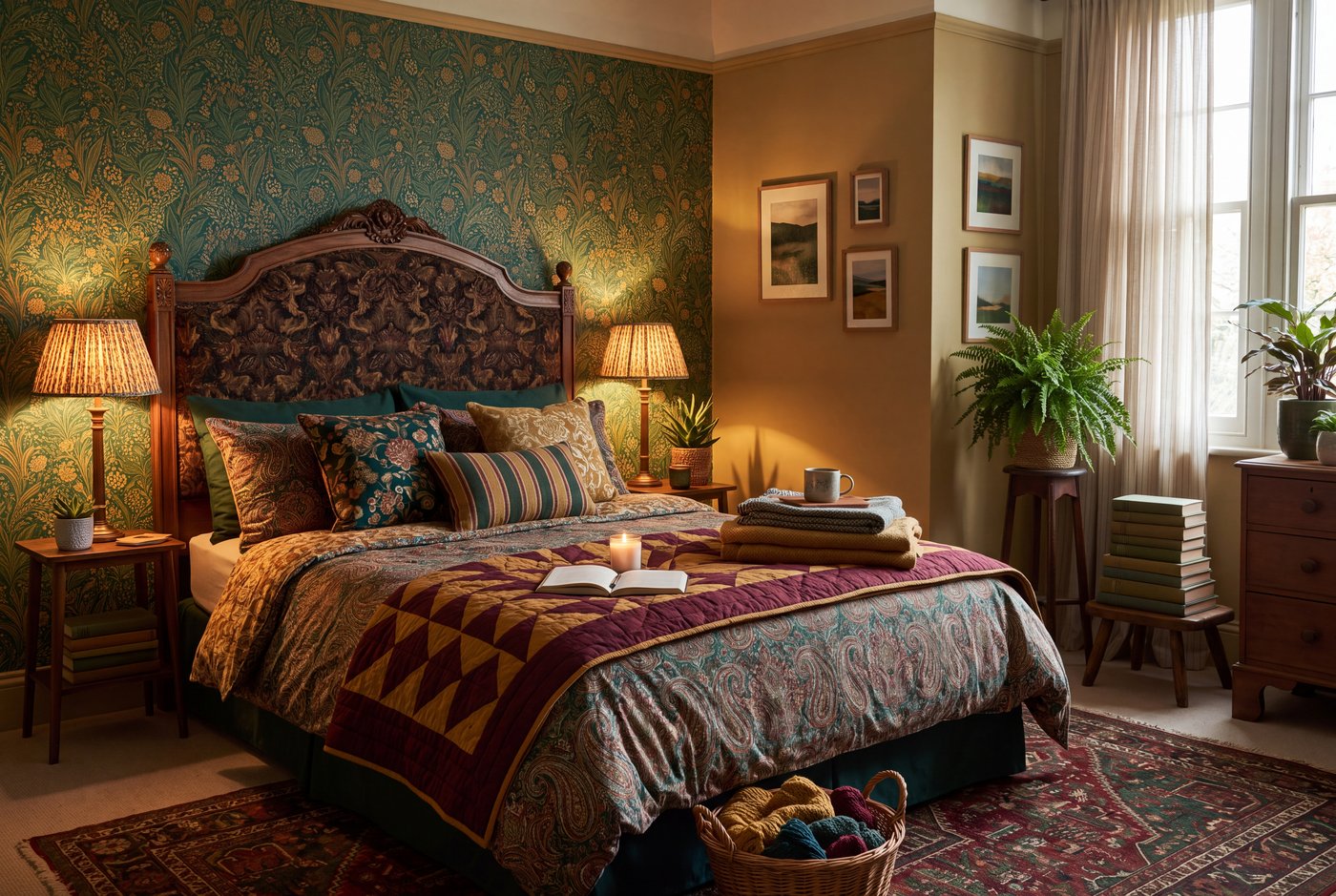
A maximalist bedroom has to negotiate one thing the living room does not: you have to be able to fall asleep in it.
The solution most successful maximalist bedrooms use is to concentrate the intensity behind the bed and to calm down as you approach the window. A patterned wallpaper or a strong paint color on the headboard wall, an upholstered or carved headboard, layered bedding in three or four patterns that share a palette, and then a quieter zone on the far side of the room.
Bedding is where the layering happens: a patterned duvet, a contrasting quilt folded across, cushions in at least three fabrics, and a throw. This is one of the few places where a matched set actively hurts you.
Keep the lighting warm and low. A maximalist bedroom with bright overhead light is unrestful in a way that has nothing to do with the pattern.
Maximalist Kitchen
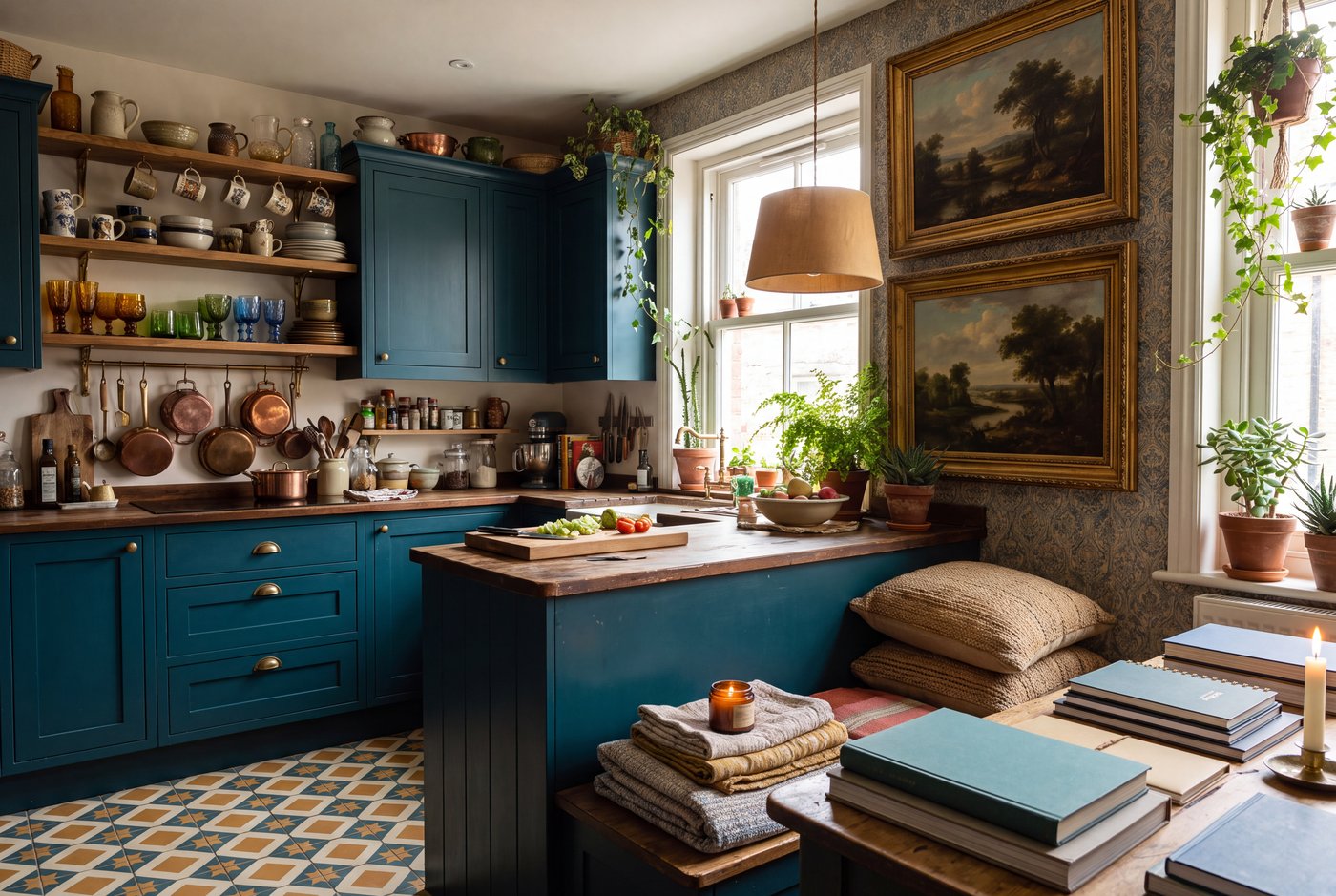
Kitchens resist maximalism because they are mostly engineered surfaces, but three moves get most of the way.
Color the cabinetry, ideally in a deep saturated tone rather than a neutral. Add a patterned tile, either as a backsplash or on the floor, where a bold geometric or an encaustic pattern does a great deal of work. Then open shelving with genuinely mixed ceramics on it rather than a matched set.
Beyond that, the kitchen carries maximalism through what is visibly in use: colored glassware, copper and brass pans, plants, and art on the wall. A maximalist kitchen with art in it reads correctly almost immediately, because most kitchens have none.
Maximalist Bathroom
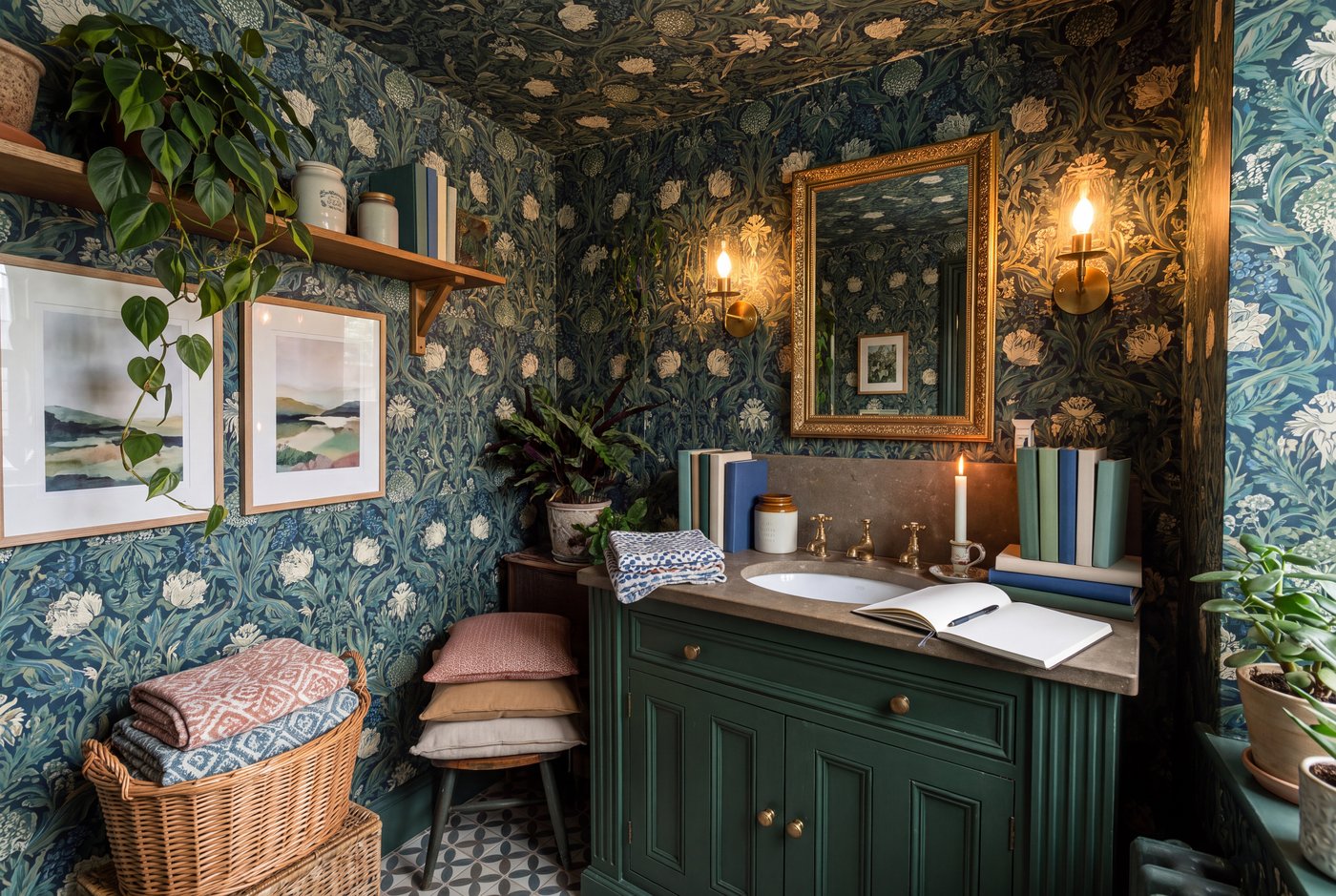
The bathroom is the best possible room to try maximalism in, and it is the one I would suggest starting with if you are unsure.
It is small, which makes bold decisions cheap. It is a room you are in briefly, which makes intensity easy to tolerate. And it has few furniture constraints.
Wallpaper the whole room including the ceiling, or tile it in a strong pattern. Add a colored or antique vanity, brass fittings, a gilt mirror, framed art, and a plant. A maximalist bathroom is one weekend and one roll of wallpaper away, and it will tell you honestly whether you want to live in this style.
Maximalist Wallpaper
Wallpaper is close to mandatory in this style, because painted walls alone rarely supply enough density.
The categories that work: large-scale botanicals and chinoiserie; damask and other historical repeats; murals and scenic papers; and bold geometrics. Choose a paper whose colors match the palette you have already picked, rather than picking the paper first and building the room around it, which is how people end up trapped.
For a first attempt, paper one wall or one small room rather than a whole living room. The style's density means a single papered wall in a saturated room reads as fully committed.
Art, Gallery Walls and Wall Decor
Maximalist wall art follows one rule: hang it densely, in mixed frames, closer together than feels comfortable.
A maximalist gallery wall differs from a minimalist one in spacing rather than in content. Two or three inches between frames, not eight. Mixed frame finishes, gold with black with wood. Mixed sizes and mixed media, so paintings alongside prints alongside plates alongside a mirror.
Fill the wall to its edges rather than centering a neat rectangle in the middle. The arrangement should look like it grew, and the most reliable way to achieve that is to actually let it grow: start with six pieces and add over a year.
Plates, mirrors, textiles and objects all belong on walls here, not only framed art.
Rugs and Layering
Layered rugs are one of the clearest maximalist signals and one of the cheapest.
The formula: a large neutral or flatweave base rug that defines the room, then a smaller patterned rug laid over it, usually at an angle or offset rather than centered. A vintage or Persian-style rug over jute is the most forgiving version and works in almost any palette because old rugs contain many colors at low saturation.
In a bedroom, run a runner along each side of the bed over a larger base. In a living room, place the smaller rug under the coffee table.
Moody Maximalism and Eclectic Maximalism
Two variants are worth naming because they are the two most people actually want.
Moody maximalism is the same approach with the value range pulled down: deep greens, browns, oxblood and charcoal instead of bright jewel tones, with the pattern still dense but the whole room darker. It is substantially easier to live with than bright maximalism, it photographs well in low light, and it overlaps heavily with dark academia in palette while being far busier in pattern.
Eclectic maximalism puts the emphasis on provenance rather than on pattern: objects from many places and periods, collected over time, with less wallpaper and more stuff. It is the version that rewards travel and secondhand shopping, and it is the most personal of the three, but it is also the one most likely to slide into clutter, because provenance does not supply the repetition rule on its own.
Maximalist Decor on a Budget
Maximalism is genuinely the most affordable style on this site to execute well, which is worth saying plainly because the reference photography suggests otherwise.
The reason is that it wants quantity, variety and age, and all three are cheap secondhand. Thrifted frames, mismatched ceramics, old rugs, vintage glassware, secondhand art and charity-shop books are the raw material, and buying them slowly is not a compromise but the correct method.
Where to spend: the wallpaper, one large upholstered piece, and the base rug. Where not to spend: everything that goes on a wall or a shelf.
The one budget trap is buying a large quantity of new decorative objects at once from a single shop. That produces a room that is full but reads as a display, because nothing in it has any history and everything shares one manufacturing language.
Where to Start
Start with the palette, on paper, before buying anything. Four or five colors. Then apply the repetition rule to what you already own and see how far it gets you, because most people who are drawn to maximalism already own more than enough objects and have simply distributed them without a system.
Then commit one surface: a wallpapered wall, a saturated paint color, or a patterned sofa. Half-committed maximalism is the only version that genuinely does not work.
Maximalism sits closest to the Bohemian and Traditional profiles in our style quiz, which takes about three minutes and returns a palette, a material direction and reference rooms you can hold a real piece of furniture up against. If the density appeals but the saturation does not, look at cottagecore, which layers just as heavily in a much softer register.
Not sure where to start?
Take the style quiz and get a design profile you can actually furnish against. About three minutes.
Take the Find Your Room